
Assertive communication means expressing your needs, feelings, and boundaries clearly and honestly while still respecting the other person.
Try this practical script:
“When meetings run over time, I feel overwhelmed. Could we agree on a specific ending time?”
This simple sentence demonstrates the heart of assertive communication: describing the situation, expressing how it affects you, and making a respectful request.
Developing assertive communication skills can help reduce stress, strengthen self-confidence, prevent misunderstandings, and build healthier relationships. With practical scripts and a structured four-week plan, you can learn how to speak more confidently, set appropriate boundaries, and communicate your needs without becoming passive or aggressive.
Table of Contents
-
How Assertive Communication Differs from Passive, Aggressive, and Passive-Aggressive Styles
-
Core Techniques: “I”-Statements, Body Language, and Saying No
-
Ready-to-Use Assertive Communication Scripts for Real Situations
What Assertive Communication Really Looks Like in Practice
Many people assume that assertiveness means speaking louder, arguing more forcefully, or pressuring others to agree. In reality, assertive communication is direct, calm, and respectful.
According to Mayo Clinic, assertiveness is a diplomatic communication style based on mutual respect. In practice, this means clearly expressing your needs, thoughts, and feelings without attempting to control or disrespect the other person. You focus on the facts, communicate honestly, and allow the other person space to respond.
Assertiveness is not about dominating a conversation or always getting your way. It is about standing up for yourself while also recognizing the rights, needs, and perspectives of others.
The core features look like this:
-
Direct language: Say what you mean without hiding your message behind unnecessary qualifiers.
-
Balanced tone: Be firm enough to be heard while remaining calm enough to keep the conversation productive.
-
Clear boundaries: State your limits clearly and specifically.
-
Respect for others: Acknowledge the other person’s perspective, even when you disagree.
-
Specific requests: Ask for one clear, concrete change instead of requesting a vague improvement.
Nonverbal communication can carry as much weight as the words you use. Upright posture, steady eye contact, open gestures, and a calm facial expression can signal confidence without aggression.
By contrast, slouching or avoiding eye contact may make your message appear passive, even when your words are strong. Crossed arms, tense movements, or a raised voice can make the same message seem aggressive.
The goal is to make your body language match your words. Calm, confident nonverbal signals help reinforce assertive communication and make your message clearer and more respectful.
How Assertive Communication Differs from Passive, Aggressive, and Passive-Aggressive Styles
Recognizing your default communication style is the first step toward changing it. Most people tend to fall into one pattern when they are under pressure.
Quick self-check: Ask yourself these two questions before reading the table.
-
Do you often say yes when you mean no and then feel resentful afterward?
-
Do you sometimes get what you want but notice that other people seem tense or defensive around you?
If you answered yes to the first question, you may lean toward a passive communication style. If you answered yes to the second, you may lean toward an aggressive style. Both patterns are worth noticing without judgment.
| Style | Typical Behavior | Common Outcome | Example Sentence |
|---|---|---|---|
| Passive | Avoids conflict and agrees to things they do not want | Resentment builds, and needs go unmet | “Whatever you think is fine.” |
| Assertive | States needs clearly, respects others | Needs are heard, and relationships remain intact | “I’d like to finish by 5:00 p.m. Can we adjust the agenda?” |
| Aggressive | Demands, blames, or intimidates | Short-term compliance but possible long-term damage | “You never listen. Just do it my way.” |
| Passive-aggressive | Agrees outwardly, resists indirectly | Confusion develops, and trust is weakened | “Sure, I’ll handle it.” Then does not follow through. |
Assertiveness is not always the right approach. In a genuine safety emergency, a direct command may be more appropriate than a collaborative request. In a deeply emotional moment, listening may be more helpful than using an “I” statement. The key is knowing which communication tool fits the situation.
Why Building This Skill Is Worth Your Time
The benefits of learning how to be assertive can be seen in both your personal and professional life. Research reviews have linked assertiveness training to reduced symptoms of anxiety and depression, as well as improved social functioning. That is a significant return from a skill that can be learned and developed.
Benefits of Practicing Assertive Communication
Consistent practice can lead to several important benefits:
-
Reduced stress: Expressing what you need can prevent the buildup of unspoken frustration and resentment.
-
Higher self-esteem: Each successful act of assertiveness reinforces the belief that your needs, feelings, and opinions matter.
-
Clearer boundaries: The people around you learn what to expect, which can reduce misunderstandings and conflict over time.
-
Better relationships: Honest and respectful communication can build deeper trust than people-pleasing.
-
Stronger decision-making: When you know how to express your perspective clearly, you can contribute more confidently to group discussions and decisions.
In the workplace, the benefits of assertive communication often appear during meetings, negotiations, and performance conversations. In your personal life, they may be reflected in how conflicts are resolved and how connected you feel to the people around you.
Assertive communication works in both settings because the core skills remain the same: expressing yourself clearly, setting respectful boundaries, listening to others, and making specific requests.
Core Techniques: “I” Statements, Body Language, and Saying No
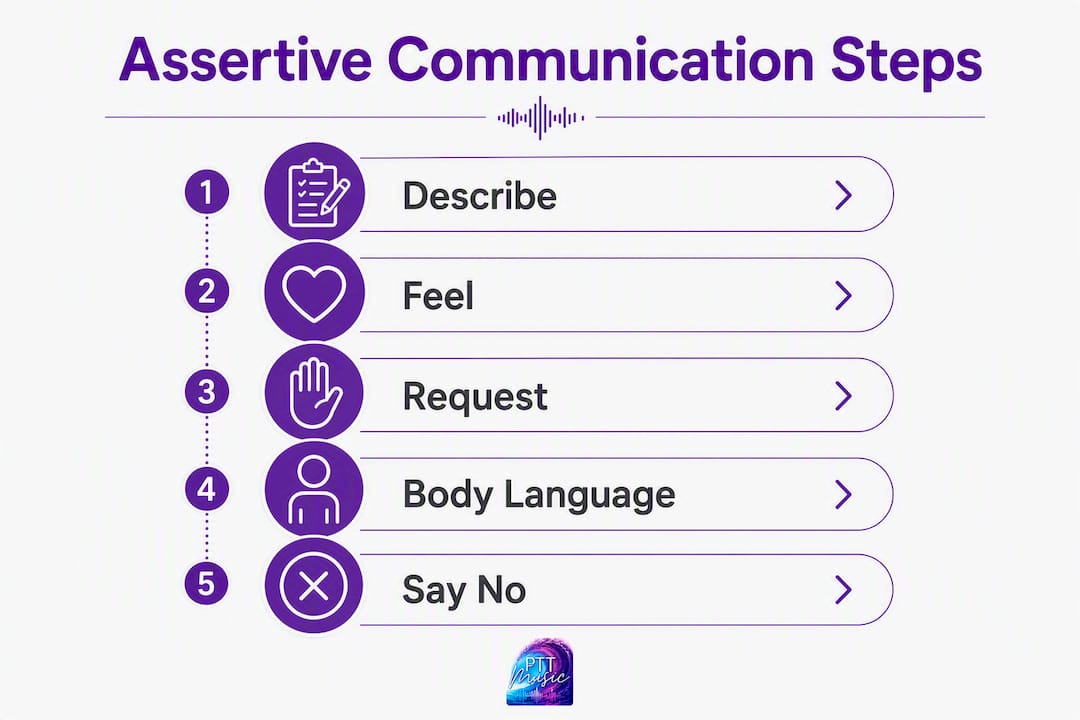
The “I” Statement Formula
The “I”-statement structure follows three simple steps: describe the situation, name your feeling, and make a specific request.
This approach works because it reduces blame and makes the conversation feel less confrontational. For example, saying, “You always interrupt me,” may trigger defensiveness. A more assertive response would be:
“When I’m interrupted in the middle of a sentence, I feel dismissed. I’d like to finish my thought before you respond.”
Using “I” statements can help you express your feelings clearly, communicate your needs respectfully, and encourage a more productive conversation.
A quick memory aid based on Cleveland Clinic guidance is: problem → feeling → request. It follows the same structure but is easier to remember in the moment.
Body Language That Supports Assertive Communication
Stand or sit upright without appearing rigid. Maintain steady but natural eye contact during the conversation. Keep your hands visible and relaxed.
Avoid crossing your arms, looking at the floor, or allowing your voice to rise at the end of statements as though you are asking for permission. Speaking at a calm, even pace can reinforce your words and communicate confidence.

Practicing in front of a mirror before a high-stakes conversation is not awkward; it is preparation. Rehearsing your nonverbal signals beforehand can increase the likelihood that your message is received as intended.
How to Say No Without Over-Explaining
In many situations, “no” is a complete sentence. Over-explaining or adding lengthy justifications after declining a request can weaken the boundary you have just set.
A brief and honest reason is appropriate when needed, but a long apology may make your response sound uncertain. For example:
“I can’t take that on right now.”
This is clear, respectful, and enough on its own. By contrast, saying, “I can’t take that on right now, and I’m so sorry. I know this puts you in a difficult position, and I feel terrible, but…” can weaken your message before it is fully understood.
Practice saying no aloud before you need to say it to someone. You can also record yourself and listen to your tone. The goal is to become comfortable saying no calmly, clearly, and without hesitation.
Pro Tip: Role-playing with a trusted friend can be especially helpful. Ask the person to push back after you say no, then practice repeating or clarifying your boundary. Practicing with real-time resistance can prepare you more effectively for difficult conversations than silent rehearsal alone.
Ready-to-Use Assertive Communication Scripts for Real Situations
These assertive communication scripts follow the “I” statement structure. Adapt the wording to fit your natural voice, but keep the same three-part pattern: describe the situation, explain how it affects you, and make a clear request.
Workplace Scripts
-
Declining extra work — gentle: “I want to do this well, but my current projects are already at full capacity. I can take this on after [date], or we can discuss reprioritizing my workload.”
Firm version:
“I’m not able to take on additional work right now. Let’s discuss what can be removed from my workload if this becomes a priority.” -
Asking for clarification: “When I receive feedback without specific examples, I find it difficult to know what to improve. Could you walk me through one or two concrete examples?”
Follow-up if you meet resistance:
“I understand. I’m asking because I genuinely want to get this right.” -
Requesting feedback: “I’d like to understand how you view my work. Would you be open to a 15-minute check-in this week?”
Personal Scripts
-
Making a request with a partner or friend:“When plans change at the last minute, I feel anxious and unprepared. I’d really appreciate a heads-up by noon if anything changes.”
If they push back:
“I’m not asking you to be perfect. A quick message would make a real difference to me.” -
Declining a favor: “I care about you, but I can’t help with this one. I hope you find the support you need.”
If they continue to press:
“My answer is still no. I’m happy to talk about something else.” -
Setting a boundary with a family member:
“When the conversation turns to [topic], I feel stressed and tend to shut down. I’d like us to agree not to discuss that topic for now.”
Assertive Communication Worksheet and Practice Exercises
The Mini Assertiveness Worksheet
Copy or print this worksheet and complete it after any attempt at assertive communication, whether it went well or not.
| Field | Your Notes |
|---|---|
| Situation | What happened, and who was involved? |
| “I” Statement Draft | Write the complete three-part statement you used or wish you had used. |
| Body Language Goal | What nonverbal signals did you aim to use, such as steady eye contact, relaxed hands, or an even tone of voice? |
| Outcome | How did the other person respond? What changed as a result? |
| Reflection | What worked well? What would you adjust next time? |
Assertive Communication Role-Play Exercises
Choose one of these scenarios and practice it with a trusted friend or in front of a mirror:
-
Addressing interruptions at work:
A coworker repeatedly interrupts you during meetings. Use an “I” statement to explain how it affects you and ask for a specific change. -
Saying no to a friend:
A friend asks you to help them move on a weekend when you need to rest. Decline respectfully and maintain your boundary if they push back. -
Asking your manager for clearer feedback:
Your manager gives you vague feedback. Ask for specific examples using the problem-feeling-request formula.
Journaling Prompts for Assertive Communication
Before practicing assertive communication, spend five minutes reflecting on one of these journaling prompts:
-
“I avoid asserting myself when…” (finish the sentence honestly)
-
“The story I tell myself about what might happen if I speak up is…”
-
“One small moment this week when I could have communicated more directly was…”
Assertiveness Progress-Tracking Checklist
Aim for two small moments of assertive communication each day. At the end of every week, review your worksheet entries and ask yourself:
-
Did I use the “I” statement structure?
-
Did my body language match my words?
-
Did I maintain my boundary when someone pushed back?
Structured assertiveness exercises such as role-playing, journaling, and practicing specific phrases are commonly used because repetition can make these communication skills feel more familiar and natural over time.
How to Respond When Your Assertiveness Meets Resistance
Pushback is normal, and it does not necessarily mean that you did something wrong. The other person may simply be adjusting to a version of you that communicates more directly.
De-Escalation Scripts to Keep in Mind
-
“I hear you. I want to stay focused on what I asked for.”
-
“Let’s take a breath. I’m not trying to argue; I’m trying to be clear.”
-
“I understand that we see this differently. My position has not changed.”
A Simple Decision-Making Process for Heated Conversations
-
Pause. Take one slow breath before responding.
-
Repeat your original “I” statement. Use the same words if necessary.
-
Assess the conversation. Ask yourself, “Is this conversation still productive?” If it is, continue. If it is not, say:
“I think we both need a moment. Can we return to this conversation in an hour?” -
Leave if the situation becomes unsafe or disrespectful. Say:
“I’m going to step away now. We can talk when things are calmer.” -
Reflect afterward. Record the experience in your worksheet, noting what escalated the situation and what helped calm it.
Avoid turning the conversation into a contest of explanations and justifications. Calmly repeating your original statement is often more effective than introducing new arguments.
Safety Note: If asserting yourself in a relationship repeatedly leads to intimidation, threats, or emotional harm, prioritize your safety over any communication technique. Consider speaking with a qualified counselor or contacting a crisis support service in your country.In the United States and Puerto Rico, contact the Crisis Text Line by texting HOME to 741741 for free, confidential support available 24 hours a day.
Signs You Might Benefit from Professional Support
Self-guided practice can be helpful, but some situations may be easier to manage with support from a trained professional.
Consider reaching out for help if you:
-
Feel intense anxiety or panic when thinking about having a direct conversation
-
Have a history of trauma that makes conflict feel physically or emotionally unsafe
-
Experience repeated harassment at work or at home
-
Have tried assertive communication techniques several times but still feel stuck
-
Notice that your communication patterns are significantly affecting your emotional well-being or daily life
Useful U.S. Search Terms for Finding Support
-
“Assertiveness training near me”
-
“CBT for assertiveness”
-
“Communication skills coach”
-
“Therapist for social anxiety”
Cognitive behavioral therapy, often called CBT, may help address thought patterns that make assertive communication difficult. Structured assertiveness training may also help some people build confidence and improve communication skills.
A communication coach typically focuses on practical skill-building and real-world application. A licensed therapist may be a better fit when anxiety, trauma, depression, or other mental health concerns are part of the situation. Both can be valid forms of support, depending on your needs.
A Research-Informed 4-Week Assertive Communication Practice Plan
This four-week assertiveness plan builds gradually, beginning with awareness and ending with real-world application. Each week introduces a new communication skill while reinforcing what you have already practiced.
Week 1: Build Awareness and Practice Small Acts of Assertiveness
-
Each morning, identify one low-stakes situation in which you could speak up, such as expressing a preference, correcting a small error, or clearly stating what you want when ordering food.
-
Practice speaking up in that situation.
-
Notice how the experience feels.
-
Write one sentence in your journal about what happened.
Daily practice time: 5 minutes
Week 2: I-statements and body language
-
Write one “I” statement each day using the situation-feeling-request formula.
-
Practice saying it aloud in front of a mirror while paying attention to your posture, eye contact, facial expression, and tone of voice.
-
UUse at least one “I” statement in a real conversation.
Daily practice time: 5–10 minutes
Week 3: Practice Saying No and Handling Pushback
-
Look for one opportunity each day to decline something you might normally accept out of obligation.
-
Role-play a pushback scenario with a trusted friend, or record yourself responding to resistance.
-
Review your worksheet entries from Weeks 1 and 2. Identify any patterns in your thoughts, feelings, body language, or responses.
Daily practice time: 10 minutes
Week 4: Apply Assertive Communication in Real Situations
-
Choose one meaningful conversation you have been avoiding and prepare an “I” statement beforehand.
-
ave the conversation and use a de-escalation script if needed.
-
At the end of the week, review all your worksheet entries.
-
Celebrate specific improvements, such as speaking more clearly, maintaining a boundary, or staying calm, rather than judging success only by the other person’s response.
Daily practice time: 10 minutes, plus the conversation itself
A Simple Warm-Up Before Difficult Conversations
Use this brief routine before a practice session or an important conversation:
-
Take two slow, comfortable breaths.
-
Reset your posture by relaxing your shoulders, placing your feet flat on the floor, and keeping your chin level.
-
Optionally, listen to two or three minutes of music that helps you feel calm, focused, or energized.
Music may help some people adjust their mood before a difficult conversation, but choose something that supports calm focus rather than increasing tension.
Pro Tip: When your schedule is busy, reduce your daily assertiveness practice to two minutes instead of skipping it completely. Even one small act of assertiveness and a short journal entry can help you maintain the habit. Consistent practice over time is usually more useful than one long practice session.
Beginning with low-stakes interactions allows you to become more familiar with assertive communication before approaching more difficult conversations. This is not avoidance; it is a gradual and practical way to build confidence.

Key Takeaways
Assertive communication is a learnable skill. Start with one “I” statement today, practice it in low-stakes situations, and gradually build toward more difficult conversations over four weeks.
| Point | Details | |
|---|---|---|
| Core Definition | Assertiveness means expressing your needs clearly and honestly while respecting the other person. | |
| The “I” Statement Formula | Use situation → feeling → request to communicate clearly and reduce defensiveness… | |
| Body Language Matters | Upright posture, steady eye contact, relaxed gestures, and a calm tone can reinforce your message. | |
| Saying No Does Not Require a Long Explanation | Over-explaining after declining a request can weaken your boundary. A brief, respectful response is often more effective. | |
| Practice Progressively | Begin with low-stakes acts of assertiveness in Week 1 and work toward meaningful conversations by Week 4. |
Your Next Step
Use the one-line “I” statement from the beginning of this article in a real conversation within the next 24 hours. Afterward, complete the mini assertiveness worksheet in Section 7 to reflect on what happened, how the other person responded, and what you might adjust next time.
The Mindset Shift That Makes Assertive Communication Easier
Here is something worth reflecting on: many people who struggle with assertiveness are not weak or naturally afraid of conflict. Somewhere along the way, they may have learned that speaking up was unsafe, unwelcome, or not worth the consequences. That is not a character flaw; it is an adaptation. And adaptations can change.
Your voice has real value, not only in major conversations but also in the small, everyday moments when you hold back what you truly need. Each time you use an “I” statement instead of staying silent, and each time you say no without apologizing excessively, you begin to replace an old communication pattern with a healthier one.
Progress will not always be linear. Some conversations may not go as planned. That is part of learning assertive communication, not proof that you are doing it incorrectly.
If music helps you feel calm and focused before a difficult conversation, use it as part of your preparation. If you need support from a communication coach or therapist to understand what is behind your silence, seeking help is a sign of strength, not failure. You do not have to build assertiveness alone.
Useful Resources for Further Reading and Practice
These resources provide evidence-based information, practical worksheets, and structured exercises for readers who want to learn more about assertive communication.
-
Being Assertive: Reduce Stress, Communicate Better — Mayo Clinic: A clear introduction to assertive communication that covers its definition, nonverbal signals, potential benefits, and practical ways to build the skill.
-
How To Become More Assertive — Cleveland Clinic: Step-by-step guidance focused on expressing your needs clearly, setting boundaries, and using the problem-feeling-request formula.
-
Assertive Communication Skills — Cornell Health (PDF):A printable assertive communication worksheet and “I” statement guide. It is a useful reference for practicing clear and respectful communication.
-
Assertive Communication: Examples, Benefits, Techniques — Healthline: An accessible overview of assertive communication techniques, potential benefits, and examples for both personal and professional situations.
-
What Is Assertive Communication? 10 Real-Life Examples — PositivePsychology.com: Includes practical examples, role-playing scenarios, communication exercises, and worksheet-style activities.
-
Why assertiveness matters — New Scientist:A research-focused overview of assertiveness training and its possible effects on communication skills and emotional well-being.
If any of the warning signs discussed in Section 9 apply to you, return to that section and use the suggested search terms to find a qualified professional in your area.