
Confidence is often built through everyday action rather than one dramatic breakthrough. Small commitments, repeated practice, honest feedback, and gradual challenges can help you build a stronger sense of capability over time.
Instead of waiting until you feel completely confident, start by doing something manageable.
Complete one task.
Speak up once.
Practice one skill.
Keep one promise to yourself.
Then repeat.
At PTT Music, that idea fits naturally with songs centered on confidence, resilience, determination, personal growth, focus, and forward movement. Tracks such as “Believe In Me,” “Bold,” “I Got Heart,” “Built For This,” “Rise,” and “The Time Is Now” can become part of a personal routine built around preparation, action, and progress.
Explore the full PTT Music catalog and choose the tracks that fit your own confidence-building routine.
Key Takeaways
Building confidence can become more practical when you focus on small actions you can repeat instead of waiting for a sudden change in how you feel.
| Point | Practical Approach |
|---|---|
| Start small | Choose manageable commitments that you can realistically complete. |
| Practice regularly | Repetition can help unfamiliar situations become more familiar over time. |
| Use real feedback | Pay attention to what actually happened instead of relying only on what you feared might happen. |
| Learn from setbacks | Treat mistakes as information you can use to adjust your next attempt. |
| Use PTT Music intentionally | Build playlists around confidence, preparation, focus, resilience, and positive action. |
Table of Contents
-
What Helps Build Confidence Over Time?
-
Daily Habits That Support Self-Confidence
-
How to Respond to Self-Doubt More Constructively
-
A Practical 30-Day Confidence Plan
-
PTT Music Songs for Confidence and Motivation
-
How to Build a Confidence Playlist
-
Why Confidence Is More Than One Motivational Trick
-
How These PTT Music Songs Fit the Confidence Theme
-
Frequently Asked Questions
-
Build Confidence One Step at a Time With PTT Music
-
Sources
What Helps Build Confidence Over Time?
Confidence does not have to be treated as a fixed personality trait.
In many situations, it can grow as you gain experience, practice skills, complete responsibilities, and collect evidence that you can handle challenges.
One useful concept in confidence research is self-efficacy, or the belief that you can perform a particular task or handle a particular situation.
Small completed tasks can help provide real evidence of progress.
For example:
-
sending an email you have been putting off;
-
speaking once during a meeting;
-
completing a short workout;
-
finishing part of a project;
-
asking a question;
-
introducing yourself to someone;
-
practicing a skill for ten minutes.
These actions may seem small, but they create something valuable:
experience.
Instead of asking:
“Do I feel confident yet?”
try asking:
“What did I actually do today that I was unsure about before?”
That question keeps the focus on action rather than waiting for a feeling.
Research on self-efficacy and multi-component approaches has explored how combinations of practice, feedback, reflection, and related strategies may support confidence in specific contexts.
You can review one example here:
PMC article on multi-component interventions and self-efficacy
The important takeaway for everyday life is modest:
Confidence can be supported by practice, experience, feedback, and continued learning.
Daily Habits That Support Self-Confidence
You do not need to rebuild your entire personality.
Start with habits that are simple enough to repeat.
1. Keep Three Small Commitments
Each morning, choose three things you intend to complete.
Examples:
-
reply to one overdue message;
-
make your bed;
-
practice a skill for ten minutes;
-
finish one section of a project;
-
organize your workspace;
-
make one important phone call.
Keep the tasks realistic.
The purpose is not to impress yourself.
It is to practice following through.
At the end of the day, write down what you completed.
This creates a simple record of action instead of relying only on memory.
2. Practice One Skill Regularly
Confidence is often connected to competence.
Choose one area that matters to you and practice it consistently.
That might be:
-
speaking;
-
writing;
-
fitness;
-
music;
-
leadership;
-
technology;
-
communication;
-
sales;
-
design;
-
teaching.
Instead of saying:
“I need to become confident at this,”
try:
“I will practice this for ten minutes today.”
Specific actions are easier to follow than vague goals.
3. Take Small Social Steps
If you want greater confidence in social or professional settings, practice through manageable situations.
Examples:
-
greet someone first;
-
ask one question;
-
introduce yourself;
-
contribute one idea;
-
respectfully express a different opinion;
-
make one phone call you have been avoiding.
Start with situations that feel challenging but manageable.
You do not need to turn every day into a major test.
4. Record Small Wins
At the end of the day, write down three things you handled reasonably well.
They do not have to be dramatic.
For example:
“I finished the task.”
“I asked the question.”
“I stayed calm during the conversation.”
“I tried again.”
“I prepared instead of avoiding it.”
This is not about pretending everything went perfectly.
It is simply a way to notice progress that might otherwise be overlooked.
5. Ask for Useful Feedback
Confidence becomes more grounded when it is connected to reality.
Ask someone you trust:
“What did I do well?”
and:
“What is one thing I could improve?”
Good feedback can help you separate imagined weaknesses from areas that genuinely need more practice.
How to Respond to Self-Doubt More Constructively
Self-doubt does not automatically mean you should stop.
It can simply mean that a situation feels unfamiliar, important, or uncertain.
Instead of trying to eliminate every doubtful thought, you can learn to respond to it more practically.
Notice the Thought
For example:
“I’m worried I’m going to mess this up.”
You do not need to pretend the thought is not there.
Replace Extreme Predictions With Something More Realistic
Instead of:
“I’m going to fail.”
try:
“I may make mistakes, but I can prepare and respond.”
Instead of:
“Everyone will think I’m terrible.”
try:
“Some parts may go well, and some may need improvement.”
The goal is not unrealistic positivity.
It is a more balanced interpretation.
Prepare for the Moment
Before a presentation, interview, difficult conversation, or important task, rehearse the basics.
Think through:
-
how you will begin;
-
the main point you want to communicate;
-
one likely challenge;
-
how you might respond;
-
what you will do afterward.
Preparation can make unfamiliar situations feel more manageable.

Compare Fear With What Actually Happened
Afterward, ask:
“What did I predict?”
and:
“What actually happened?”
Sometimes the experience goes better than expected.
Sometimes it does not.
Either way, you gain information for the next attempt.
You can also explore this perspective on the inner critic through:
The well-meaning protector: befriending the inner critic — Psychology Today
A Practical 30-Day Confidence Plan
A structured month can help you experiment with confidence-building habits without pretending that everyone should experience the same results on the same schedule.
Use this as a flexible framework rather than a guarantee.
Week 1: Notice and Complete
Focus on following through.
Each day:
-
choose three small commitments;
-
complete what you reasonably can;
-
record one thing you handled well.
The goal is simply to begin collecting evidence of action.
Week 2: Practice and Participate
Continue your daily commitments.
Add one manageable social or professional action.
Examples:
-
speak first;
-
ask a question;
-
introduce yourself;
-
contribute an idea;
-
make a call.
Notice what becomes easier through repetition.
Week 3: Stretch Slightly
Choose one situation that is somewhat more challenging.
For example:
-
lead a small task;
-
give a short presentation;
-
pitch an idea;
-
volunteer for responsibility;
-
have an important conversation.
Prepare before the event and ask for feedback afterward.
Week 4: Review and Adjust
Look back through your notes.
Ask:
What became easier?
What still needs practice?
Which situations brought out my strengths?
What should I practice next month?
| Week | Focus | Simple Check-In |
| 1 | Small commitments | What did I complete? |
| 2 | Social practice | What did I try? |
| 3 | Stretch challenge | What did I learn? |
| 4 | Review | What should I continue? |
The goal is not to create perfect scores.
The goal is to notice patterns.
PTT Music Songs for Confidence and Motivation
Music can be part of the environment you create before, during, or after a challenge.
It does not need to “cause” confidence.
Instead, choose tracks whose themes fit the mindset you want to bring into the moment.
Here are several PTT Music songs that naturally fit a confidence-building playlist.
“Believe In Me” — PTT Music
Best for: Self-belief
A natural starting point for a confidence playlist centered on recognizing your own potential.
“Bold” — PTT Music
Best for: Speaking up and taking action
A fitting track before a presentation, conversation, meeting, creative challenge, or another moment that asks you to step forward.
“I Got Heart” — PTT Music
Best for: Inner determination
Confidence is not only about appearing fearless.
Sometimes it is simply recognizing that you have enough determination to continue.
“Built For This” — PTT Music
Best for: Preparing for a challenge
A strong addition to a pre-event playlist when you are getting ready for something demanding.
“No Limit” — PTT Music
Best for: Thinking bigger
This title naturally fits moments when you want to challenge assumptions about what you can attempt.
“Rise” — PTT Music
Best for: Starting again
Confidence can take a hit after a setback.
“Rise” works naturally in a playlist about rebuilding momentum.
“Stronger Than Before” — PTT Music
Best for: Comeback confidence
A fitting title for recognizing growth after difficulty.
“No Distractions” — PTT Music
Best for: Focus
Confidence also comes from preparation.
This track fits work sessions, study, practice, or preparation before an important task.
“Get Set” — PTT Music
Best for: Preparation
A natural opening track before moving into higher-energy songs.
“The Time Is Now” — PTT Music
Best for: Taking action
At some point, preparation needs to become action.
This makes “The Time Is Now” a fitting closing track for a confidence playlist.
Explore these songs and more through the PTT Music music page.
How to Build a Confidence Playlist
Instead of filling your playlist with random motivational tracks, give each song a purpose.
Preparation
Try:
-
“Get Set”
-
“No Distractions”
-
“This Is It”
These tracks can fit the preparation stage.
Self-Belief
Try:
-
“Believe In Me”
-
“I Got Heart”
-
“Bold”
These songs naturally connect with confidence and personal strength.
Challenge
Try:
-
“Built For This”
-
“No Limit”
-
“All In”
Use these when you are ready to approach something demanding.
Comeback
Try:
-
“Rise”
-
“Snap Back”
-
“Stronger Than Before”
-
“Gotta Get Through”
These tracks fit moments when confidence needs rebuilding.
Forward Action
Try:
-
“Steps”
-
“On My Way”
-
“Keep It Movin’”
-
“The Time Is Now”
These songs fit the transition from preparation to progress.
Sample PTT Music Confidence Playlist
-
“Get Set”
-
“Believe In Me”
-
“I Got Heart”
-
“Bold”
-
“Built For This”
-
“No Limit”
-
“Rise”
-
“Stronger Than Before”
-
“On My Way”
-
“The Time Is Now”
The playlist creates a simple progression:
Prepare → Believe → Step Forward → Face the Challenge → Recover → Keep Moving → Act
Using Music as Part of the Routine
Music can become part of a repeatable preparation ritual.
For example:
Before a Presentation
Try:
“Get Set” → “Bold” → “Built For This”
Then review your opening line and main points.
Before Focused Work
Try:
“No Distractions” → “All In” → “Steps”
Then begin the task.
After a Setback
Try:
“Snap Back” → “Rise” → “Stronger Than Before” → “Keep It Movin’”
Then write down one lesson and one next step.
Before Taking Action
Try:
“Believe In Me” → “I Got Heart” → “The Time Is Now”
The music becomes part of your preparation rather than a promise that it will automatically change your confidence level.
For additional conversations around personal growth, resilience, relationships, and motivation, explore the PTT Music Podcast.
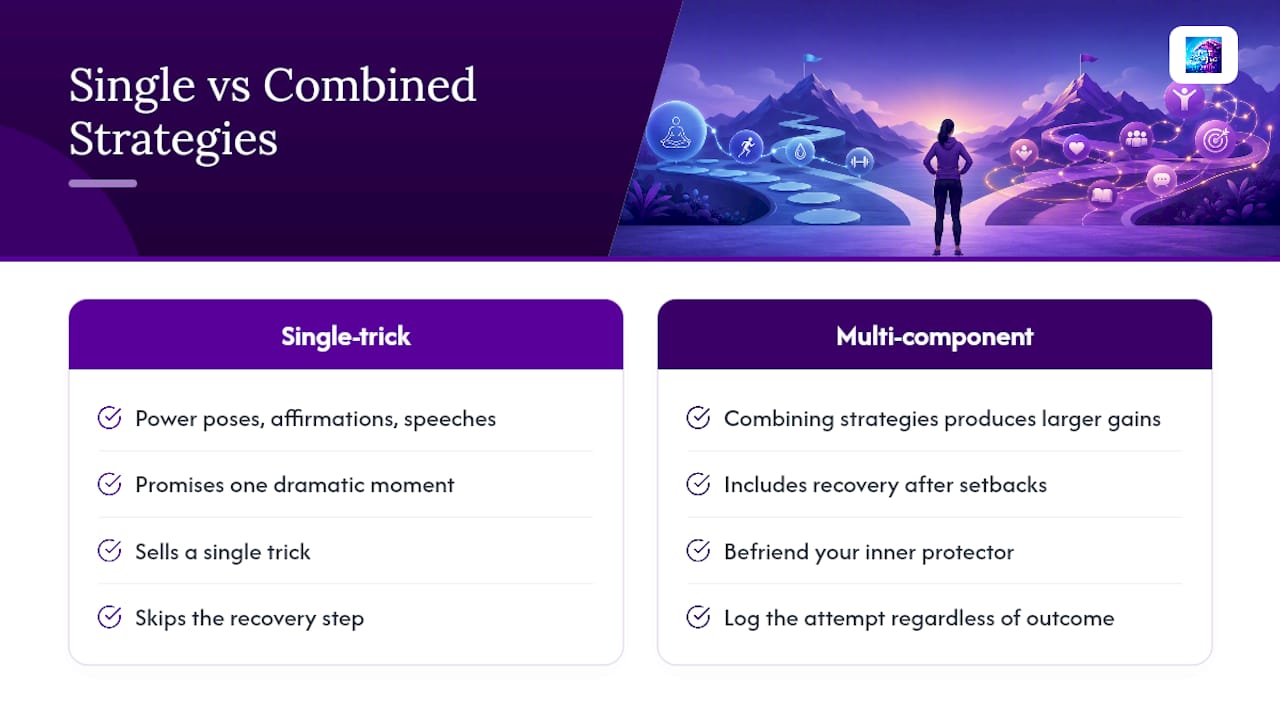
Why Confidence Is More Than One Motivational Trick
Confidence advice often focuses on one dramatic technique.
But real confidence usually involves several things working together:
-
preparation;
-
practice;
-
experience;
-
feedback;
-
reflection;
-
patience;
-
trying again.
A motivational song can help set the tone.
An affirmation may help some people organize their thoughts.
Preparation can reduce uncertainty.
Practice can improve ability.
Feedback can identify what actually needs improvement.
None of these needs to be presented as a magic solution.
What matters is creating a system that helps you prepare, act, learn, and continue.
Research on multi-component interventions has explored similar combinations of strategies in specific settings.
You can read more here:
PMC article on multi-component interventions and self-efficacy
How These PTT Music Songs Fit the Confidence Theme
The PTT Music tracks included in this article were selected because their titles naturally connect with different stages of building confidence.
“Believe In Me” represents self-belief.
“Get Set” represents preparation.
“No Distractions” represents focus.
“Bold” represents stepping forward.
“I Got Heart” represents determination.
“Built For This” represents facing challenges.
“Rise” represents starting again.
“Stronger Than Before” represents rebuilding.
“Steps” represents gradual progress.
“On My Way” represents movement.
And “The Time Is Now” represents action.
Together, these tracks form a practical confidence journey:
Prepare → Believe → Practice → Act → Learn → Rebuild → Keep Moving
That is why confidence is such a natural fit for the broader PTT Music focus on motivation, personal growth, resilience, purpose, and positive action.
Explore More PTT Music for Personal Growth
Confidence is only one part of personal growth.
The wider PTT Music catalog includes tracks that can naturally fit themes such as:
-
confidence;
-
resilience;
-
motivation;
-
focus;
-
determination;
-
personal growth;
-
purpose;
-
relationships;
-
discipline;
-
forward movement.
Explore the full PTT Music catalog.
Visit the PTT Music home page for more original music and content.
For conversations about motivation, relationships, resilience, personal growth, and purposeful living, explore the PTT Music Podcast.
Read more lifestyle, motivation, and personal-growth articles through the PTT Music Blog.
You can also browse current products through the PTT Music Store and PTT Music Song & Merchandise Collections.
Frequently Asked Questions
How can I build confidence every day?
Start with small actions you can realistically complete.
Practice one skill, follow through on a few commitments, take manageable challenges, and review what you learned.
How long does it take to become more confident?
There is no universal timeline.
Confidence can develop at different rates depending on the person, skill, situation, and amount of practice.
It is better to focus on consistent action than on expecting a specific result within a fixed number of days.
Does confidence come from positive thinking?
Positive thinking alone is usually not enough.
Confidence can also involve preparation, practice, experience, feedback, and learning from setbacks.
Can music increase confidence?
It is better to say that music can be used as part of a confidence-building routine if you find it motivating or helpful.
Music does not automatically create confidence, but a familiar playlist can become part of how you prepare for an important moment.
What are good PTT Music songs for confidence?
Consider:
“Believe In Me,” “Bold,” “I Got Heart,” “Built For This,” “No Limit,” “Rise,” “Stronger Than Before,” “No Distractions,” “Get Set,” and “The Time Is Now.”
What PTT Music songs fit a comeback playlist?
Try:
“Snap Back,” “Rise,” “Gotta Get Through,” “Stronger Than Before,” “Relentless,” and “Keep It Movin’.”
What PTT Music songs fit focus and productivity?
Consider:
“No Distractions,” “All In,” “Steps,” “Get Set,” and “On My Way.”
Build Confidence One Step at a Time With PTT Music
Confidence does not always begin with feeling fearless.
Sometimes it begins when you decide to “Believe In Me.”
You “Get Set.”
You remove “No Distractions.”
You become “Bold.”
You remember:
“I Got Heart.”
You approach the challenge thinking:
“Built For This.”
If something goes wrong, you “Rise.”
You become “Stronger Than Before.”
You keep taking “Steps.”
Soon you realize you are “On My Way.”
And eventually:
“The Time Is Now.”
Confidence can be built through the actions you take, the skills you practice, the feedback you accept, and the willingness to keep moving.
Explore the PTT Music catalog, choose songs that fit your own confidence routine, and use them as part of your preparation for the next meaningful step.