
If you suspect you have burnout, the single most important thing you can do right now is stop pushing harder and start protecting your biology. Pause nonessential work where you can, guard your sleep above everything else, and tell at least one trusted person what you are experiencing.
Two things you can do today:
-
Protect tonight’s sleep. Set a firm lights-out time, put your phone in another room, and treat those hours as non-negotiable recovery time. Chronic occupational stress produces measurable changes in cortisol and immune function, and sleep is the most direct way to begin reversing that damage.
-
Set one boundary at work. Decline or postpone one nonessential commitment today. You do not need to explain yourself at length. “I need to protect my capacity this week” is enough.
Table of Contents
-
What is burnout, and why do its three dimensions matter for recovery?
-
What causes burnout, and which workplace factors put you most at risk?
-
How does burnout differ from ordinary stress and clinical depression?
-
How to handle burnout at work: manager conversations, accommodations, and realistic changes
-
What does a realistic burnout recovery plan look like over three months?
-
Micro-practices you can use during a workday to ease symptoms
What is burnout, and why do its three dimensions matter for recovery?
Burnout is defined by three core dimensions: emotional and physical exhaustion, cynicism or alienation toward your work, and a reduced sense of professional efficacy. These are not three separate problems. They form a cycle. Exhaustion fuels cynicism, cynicism erodes your sense of competence, and that eroded competence feeds more exhaustion.
The World Health Organization’s ICD-11 classifies burnout as an occupational phenomenon, not a medical disorder. That distinction matters practically: it means the primary drivers are in your work environment, not inside you as a person, and that addressing those environmental conditions is a core part of recovery, not optional.
Understanding all three dimensions also shapes what kind of help actually works. If your dominant experience is exhaustion, biological restoration (sleep, rest, exercise) is the urgent priority. If cynicism is most prominent, reconnecting with meaning and community matters most. If reduced efficacy is the loudest signal, cognitive work around perfectionism and self-worth tends to be the lever. Treating burnout as a single, undifferentiated problem is why so many people rest for a week and return to work feeling exactly the same.
In daily life, exhaustion looks like dragging yourself through tasks that once felt easy. Cynicism shows up as a creeping sense that your work is pointless or that your organization does not care. Reduced efficacy feels like staring at a task you know how to do and feeling genuinely incapable of starting it.
What are the signs of burnout you should watch for?
Burnout rarely announces itself cleanly. It tends to accumulate quietly until the weight becomes impossible to ignore. Recognizing the pattern across physical, emotional, and behavioral domains is the first step toward doing something about it.
Physical symptoms
-
Persistent fatigue that sleep does not fully relieve
-
Frequent headaches or muscle tension, especially in the neck and shoulders
-
Gastrointestinal problems (nausea, stomach upset, changes in appetite)
-
Disrupted sleep: difficulty falling asleep, waking at 3 AM with racing thoughts, or sleeping far more than usual
-
Getting sick more often than you used to
Emotional symptoms
-
Cynicism or detachment toward your job, colleagues, or clients
-
A pervasive sense of helplessness or feeling trapped
-
Emotional numbness: not feeling much of anything, even about things that used to matter
-
Irritability that feels disproportionate to the situation
-
Loss of satisfaction from work you once found meaningful
Behavioral symptoms
-
Withdrawing from coworkers, friends, or family
-
Procrastinating on tasks you are fully capable of completing
-
Decreased performance despite working longer hours
-
Increased reliance on food, alcohol, or screens to decompress
-
Skipping self-care routines you previously maintained
Quick self-assessment questions: Have these symptoms been present for more than two weeks? Are they getting worse rather than better? Are they affecting your ability to do your job or maintain your relationships? If you answered yes to all three, what you are experiencing is likely beyond ordinary stress and warrants a deliberate recovery plan or professional evaluation.
What causes burnout, and which workplace factors put you most at risk?
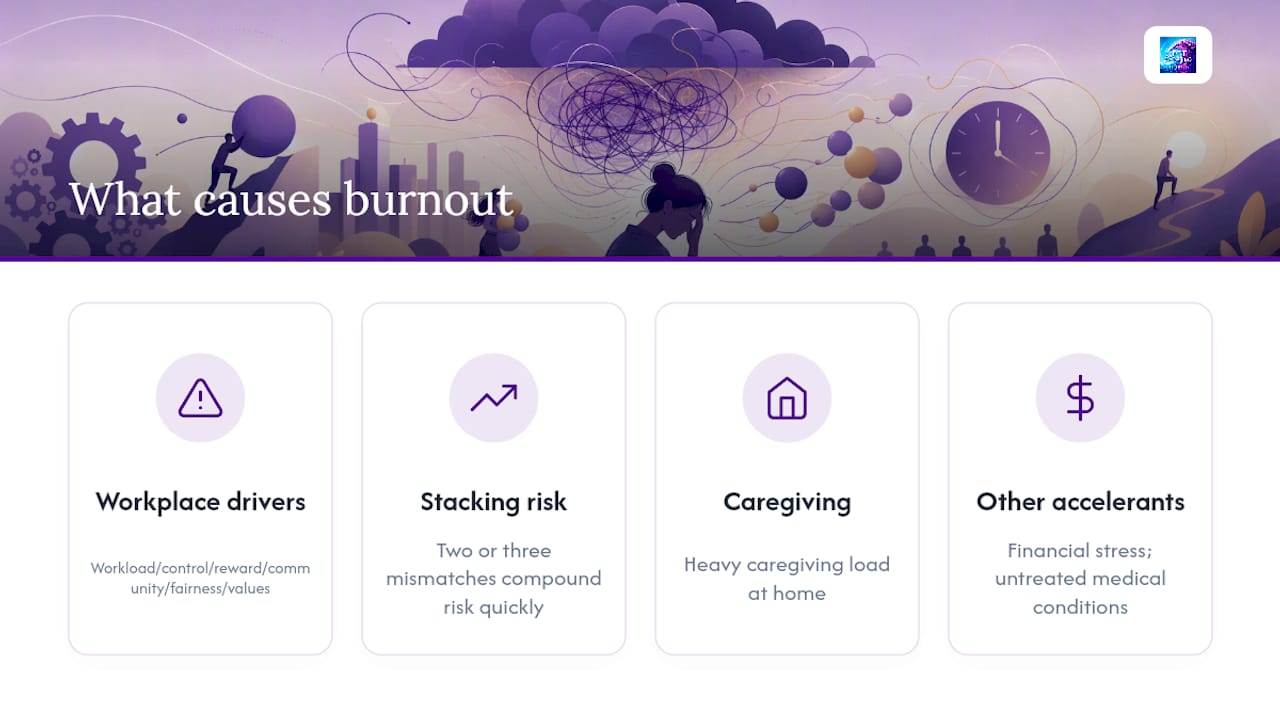
Research consistently identifies six workplace mismatches as the primary structural drivers of burnout: excessive workload, lack of control over how you do your work, insufficient reward or recognition, weak or fractured community at work, perceived unfairness, and a mismatch between your personal values and what the organization actually rewards.
Any one of these can wear you down over time. When two or three stack together, the risk compounds quickly.
Outside of work, several factors accelerate the process. Carrying a heavy caregiving load at home (for children, aging parents, or a sick partner) while also managing a demanding job leaves almost no recovery window. Financial stress keeps the nervous system in a low-grade threat state, which makes it harder to disengage mentally even during off-hours. Untreated medical conditions, particularly thyroid disorders, anemia, or sleep apnea, can mimic or worsen burnout symptoms significantly.
Consider a concrete pattern that appears often: a high-performing professional with perfectionist tendencies takes on more than their capacity allows because saying no feels like failure. Over months, the workload grows, the quality of their output drops slightly, and they respond by working longer hours to compensate. Sleep shrinks. Social connection disappears. The very identity that made them effective (being the reliable, capable one) becomes the mechanism of their depletion. By the time they recognize what is happening, they are running on cortisol and habit, not genuine energy.
That pattern is not a character flaw. It is a predictable outcome of specific conditions meeting a specific cognitive style, and both sides of that equation are addressable.
How does burnout differ from ordinary stress and clinical depression?
This distinction matters more than most people realize, because the right response to each condition is different. Treating burnout like depression (with medication alone) or treating depression like burnout (with a vacation and better boundaries) can delay real recovery by months.
How to handle burnout at work: manager conversations, accommodations, and realistic changes
Most people wait far too long to have this conversation, partly out of fear and partly out of the belief that they should be able to handle it alone. The reality is that addressing workplace mismatches directly is one of the most evidence-supported paths to sustainable recovery. A conversation with your manager is not optional; it is part of the treatment.
Starting the conversation
You do not need to use the word “burnout” if that feels risky. A version that works in most workplace cultures: “I want to flag that I’ve been running at a high level for a long time and I’m noticing it’s starting to affect my performance. I’d like to talk about what adjustments might be possible in the short term.” Keep it factual, keep it brief, and come with one or two specific requests rather than a general complaint.
If your manager is part of the problem, go to HR or your Employee Assistance Program (EAP) first. Most US employers with more than a few dozen employees offer EAP services, which typically include free, confidential short-term counseling and referrals. You do not need manager approval to access your EAP.
Accommodations worth requesting
-
Temporarily reduced hours or a compressed schedule
-
Reassignment of one or two high-drain tasks to a colleague
-
Protected no-meeting blocks of two to three hours per day
-
A brief leave of absence (FMLA may apply if a clinician documents a qualifying condition)
-
A formal EAP referral and time to attend appointments
How long to try workplace fixes
Give structured workplace changes about a month before concluding they are not working. If your symptoms are not stabilizing after that window, or if your manager is unresponsive or retaliatory, escalate to HR, consult your EAP, or speak with a clinician about medical leave. A job change is a legitimate option, but it works best as a deliberate choice made from a stable state rather than an escape made from a depleted one.
What does a realistic burnout recovery plan look like over three months?
Recovery from burnout is not just rest. It requires rebuilding depleted resources across physical, emotional, social, and identity domains, and it typically takes several months for significant, lasting improvement. Expecting to feel normal after a two-week vacation is one of the most common recovery mistakes.
The three stages
Stabilization (weeks 1–4): The goal here is to stop the depletion, not to rebuild. Protect sleep, reduce workload where possible, establish one or two micro-habits, and begin professional support if symptoms are moderate to severe. You will likely not feel better yet. That is expected.
Rebuilding (months 1–3): Energy begins to return in patches. This is when you start reintroducing meaningful activities outside work, reconnect with social support, and begin addressing the structural conditions (workload, boundaries, values alignment) that drove burnout in the first place. Therapy tends to be most productive in this phase.
Consolidation (months 3–12): You are functioning more consistently, but the risk of relapse is real if the structural conditions have not changed. This phase is about building identity and routines that are not entirely work-dependent, and developing the self-awareness to catch early warning signs before they escalate again.
Sample 3-month plan
| Week/Month | Focus | Weekly actions | Checkpoint |
|---|---|---|---|
| Weeks 1–2 | Stabilize biology | Set sleep schedule; add one micro-rest per day; decline one nonessential commitment | Are you sleeping 7+ hours? |
| Weeks 3–4 | Reduce work drain | Have manager conversation; request one accommodation; start EAP or therapy intake | Is workload slightly reduced? |
| Month 2 | Rebuild outside work | Add one nonwork activity per week; reconnect with one friend or family member; begin regular exercise | Are you doing something you enjoy outside work? |
| Month 3 | Address root causes | Identify the primary workplace mismatch; make one structural change; review values alignment | Does work feel slightly more sustainable? |
Track progress weekly using four simple metrics: average sleep hours, energy level on a 1–10 scale at midday, ability to complete daily tasks without significant struggle, and mood at end of workday. You are not looking for dramatic improvement week to week. You are looking for a slow, steady upward trend over months.
When should you seek professional help for burnout?
Multimodal treatment, combining psychological and physiological approaches, produces better outcomes than either alone. If your symptoms have been present for more than two weeks, are worsening, or are significantly impairing your ability to work or maintain relationships, professional support is not a last resort. It is the appropriate next step.
Micro-practices you can use during a workday to ease symptoms
These are not cures. They are circuit breakers: small interventions that interrupt the stress spiral long enough for your nervous system to reset. Use them consistently, and they compound.
-
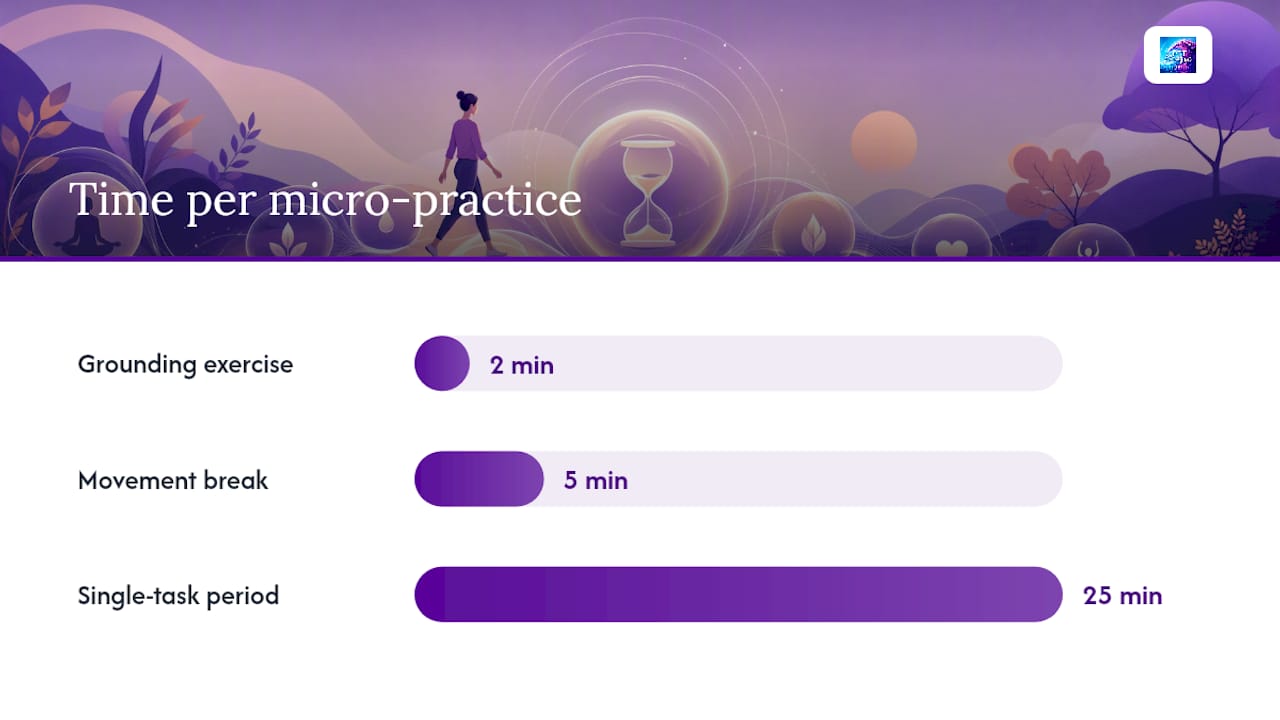
2-minute grounding exercise. Name five things you can see, four you can touch, three you can hear, two you can smell, and one you can taste. This pulls attention out of anxious future-thinking and into the present moment. Do it before a high-stakes meeting or when you feel overwhelmed.
-
5-minute movement break. Stand up, walk to a different room or outside, and move your body without a screen. Do not check your phone. The goal is a genuine sensory break, not a change of location while still scrolling.
-
Focused breathing (box method). Inhale for four counts, hold for four, exhale for four, hold for four. Repeat four times. This activates the parasympathetic nervous system and reduces the physiological stress response within minutes.
-
Single-task for 25 minutes. Close every tab except the one you need. Set a timer. Work on one thing only. When the timer ends, take a five-minute break before starting again.
-
End-of-day transition ritual. Write down three things you completed today (not everything left undone). Close your laptop. Say out loud or in writing: “Work is done for today.” This sounds simple, but it creates a psychological boundary that many people with burnout have lost entirely.
High-stress day checklist:
-
Completed one grounding or breathing exercise
-
Took at least one screen-free break
-
Ate something and drank water
-
Sent one message to someone I trust
-
Closed work at a set time
If you find yourself needing these micro-practices every single day just to get through, that is a signal that the underlying conditions have not changed enough. Micro-practices manage symptoms; they do not fix structural problems. Use them as a bridge while you work on the larger changes.
How to use music intentionally to support your recovery
Music is not a passive backdrop. Research on how music affects mood shows it can actively shift physiological arousal, reduce perceived stress, and support emotional regulation when used with intention. The key word is intention. Music that plays while you work through a stressful task is not the same as music used deliberately for restoration.
- For mood regulation during low-energy afternoons: Uplifting, moderate-tempo music can provide a gentle energy lift without the cortisol spike of caffeine. Pairing music with mindfulness practices deepens the restorative effect.
Pro Tip: Avoid the “productivity music” trap. Music marketed as focus or productivity enhancement often increases arousal rather than restoring it. During burnout recovery, your nervous system needs restoration, not optimization. Choose music that feels genuinely good to you, not music that promises to make you more efficient.
Listening duration matters too. Short, intentional sessions of 10–20 minutes tend to be more restorative than hours of ambient background music, which can become another form of sensory noise your depleted system has to process.
Key Takeaways
Dealing with burnout requires protecting your biology first, then addressing the structural conditions that caused it, then rebuilding the identity and habits that make you resilient long-term.
| Point | Details |
|---|---|
| Protect sleep immediately | Sleep is the highest-leverage biological intervention; treat your sleep schedule as non-negotiable from day one. |
| Address workplace conditions | Burnout is driven by structural mismatches; a manager conversation or accommodation request is part of recovery, not optional. |
| Recovery takes months, not days | Significant improvement typically requires 3–12 months of deliberate rebuilding across physical, emotional, and social domains. |
| Seek professional help early | If symptoms persist beyond two weeks or impair daily function, EAP, therapy, or primary care is the appropriate next step, not a last resort. |
| PTT Music supports daily regulation | Intentional music listening and motivational podcasts from PTT Music can support mood regulation and micro-recovery throughout the day. |
Burnout does not mean you failed
We want to say something directly: burnout is not a sign that you are weak, ungrateful, or not cut out for your work. It is a predictable physiological and psychological response to conditions that exceeded your capacity for too long. The fact that you are reading this, looking for answers, is already a form of courage.
At PTT Music, we believe that resilience is not about pushing through pain. It is about knowing when to pause, when to ask for help, and how to rebuild with intention. Music has been a part of human healing for as long as humans have needed healing, and we have seen firsthand how a song, a podcast episode, or a moment of genuine connection can shift something in a person who felt completely stuck.
You do not have to figure this out alone. Recovery is not a solo performance. It is a process, and every step forward, no matter how small, is worth honoring. We are here for that process with you, through every piece of music, every conversation, and every word we put into the world.
PTT Music is here for the hard days too
When you are working through burnout, you need tools that meet you where you are, not where you wish you were. PTT Music’s original music and motivational podcast episodes are built for exactly that: the moments between therapy sessions, the commute when your mind will not quiet down, the Sunday evening when the weight of the week ahead feels heavy.

Our music catalog on PTT Music includes tracks designed to restore, uplift, and ground you, available on Spotify, Apple Music, and over 150 streaming platforms. Our motivational podcast offers practical conversations about resilience, mindset, and moving forward with purpose. These are not replacements for therapy or clinical care. They are the daily soundtrack to a recovery that is already in motion.
Sample a track or an episode today and let music do what it does best: remind you that you are not alone, and that forward is still possible.
Authoritative sources and emergency resources
The following sources informed this guide and are worth bookmarking for further reading or to share with a clinician.
-
https://www.simplypsychology.com/articles/burnout-recovery-guide
-
https://mhanational.org/resources/burnout-signs-causes-recover/
US emergency and crisis resources:
Use these sources as a starting point for deeper reading or as a reference when speaking with a clinician. They are not a substitute for professional evaluation, and the right next step for your specific situation is best determined with a qualified healthcare provider.