
Empathy means feeling with someone; sympathy means feeling for them. Empathy puts you inside another person’s experience, sharing what they feel. Sympathy keeps you at a caring distance, acknowledging their pain without stepping into it. Both matter, but only one actually makes the other person feel understood.
TL;DR:
Cognitive empathy can be trained through deliberate practice such as pausing, reflecting, labeling emotions, and asking permission to ensure effective understanding.
Excessive affective empathy may lead to emotional exhaustion and compassion fatigue, requiring boundaries and self-awareness to maintain sustainability.
Empathy involves specific brain regions, making it a measurable, multi-faceted process that separates automatic emotional mirroring from deliberate perspective-taking.
Using the right response depends on context; sympathy is suitable for distant support, while empathy and compassion foster deeper connection and trust.
Cultural differences influence how empathy and sympathy are expressed, so asking what support feels best prevents misunderstandings across diverse backgrounds.
Table of Contents
-
Empathy Vs Sympathy Examples You’ll Recognize From Real Life
-
Why This Distinction Shapes Every Close Relationship You Have
Empathy Vs Sympathy: What Each Word Really Means
The Merriam-Webster definition of sympathy describes it as a feeling of sincere concern for someone going through something difficult, paired with pity or sorrow for their misfortune. It’s the instinct that makes you say “that’s awful” when a coworker mentions a rough week. You care. You just haven’t climbed into the moment with them.
Empathy asks more of you. It means actively sensing, understanding, and sharing another person’s emotional experience, not just observing it from the sidelines. You’re not commenting on the storm. You’re standing in the rain with them.
The gap between these words isn’t just semantic. Sympathy has been part of English since the 16th century, rooted in the idea of shared feeling at a distance. Empathy is a much younger word. It entered English usage in the early 20th century, translated from the German term Einfühlung, meaning “feeling into.” That timing matters: empathy was coined specifically because sympathy wasn’t precise enough to describe the act of mentally stepping into someone else’s shoes.
That historical split still shapes how people misuse the words today. A few quick distinctions worth keeping straight:
-
Sympathy acknowledges someone’s hardship from the outside.
-
Empathy shares the emotional texture of that hardship from the inside.
-
Sympathy often sounds like reassurance (“I’m so sorry”).
-
Empathy often sounds like recognition (“That sounds exhausting, and I get why”).
Knowing the difference between empathy and sympathy is the first step. Using it on purpose, in real conversations, is where the payoff actually shows up.
The Psychology Behind Empathy: Two Very Different Skills
Psychologists split empathy into two distinct modes, and understanding both changes how you use the word in daily life. Affective empathy is emotional mirroring: your nervous system picks up on someone’s sadness or excitement almost involuntarily, and you feel a version of it yourself. It shows up fast, often before you’ve consciously processed what happened. A friend starts crying, and your chest tightens before you’ve even heard the full story.
Cognitive empathy works differently. It’s perspective-taking, the deliberate mental effort of imagining what someone else is thinking and why. You don’t necessarily feel their emotion, but you understand its shape and logic. This is the version you can practice and improve with intention, unlike affective empathy, which tends to fire automatically.
Sympathy and compassion sit slightly apart from both. Sympathy is concern from a comfortable distance. Compassion goes a step further than either empathy type: it adds an action tendency, a pull toward actually relieving the other person’s suffering rather than just recognizing it.
Researchers distinguish these categories partly through brain science. Empathy is linked to activity in the amygdala, anterior cingulate cortex, and anterior insula, regions involved in processing emotion and social signals, according to Greater Good Magazine’s research on empathy.
Quick reference: how the four concepts differ
| Concept | What it involves | When it shows up |
|---|---|---|
| Affective empathy | Feeling another’s emotion directly | Automatic, fast, often unconscious |
| Cognitive empathy | Understanding another’s perspective | Deliberate, practiced, effortful |
| Sympathy | Concern from an outside vantage point | Reactive, distanced, well-meaning |
| Compassion | Empathy plus a drive to help | Motivated, action-oriented |
Clinical researchers measure empathy using tools such as the Interpersonal Reactivity Index and Empathy Components Questionnaire, both designed to separate the cognitive piece from the affective piece rather than treating empathy as one single trait. If you’ve ever felt emotionally drained after comforting a friend but couldn’t quite explain why, affective empathy is usually the culprit. It borrows your own emotional bandwidth to simulate someone else’s.
Empathy Vs Sympathy Examples You’ll Recognize From Real Life
Reading definitions is one thing. Recognizing the difference mid conversation is another. Here are five paired scenarios that show the same situation handled two ways.
-
A friend loses a job. Sympathy sounds like, “I’m so sorry, that’s terrible news.” Empathy sounds like, “That must feel like the floor dropped out. What’s the scariest part right now?” One offers comfort from outside; the other invites the person to keep talking.
-
A coworker misses a deadline and feels embarrassed. Sympathy says, “Don’t worry about it, these things happen.” Empathy says, “I’ve felt that exact panic before, wondering if people will judge you for it. Want to walk through what happened?”
-
A partner is stressed about money. Sympathy offers, “That sounds stressful.” Empathy offers, “I can feel how heavy that weight is for you, and I want to understand what’s worrying you most before we talk solutions.”
-
A stranger shares a public loss, like a natural disaster on the news. Sympathy is a donation and a kind word. Empathy is pausing to genuinely imagine what it would feel like to lose your home, then letting that imagination shape how you show up for someone in that situation.
-
A child is upset about a friendship falling apart. Sympathy says, “That’s a bummer, sweetheart.” Empathy gets down to their level and asks, “What did it feel like when she said that?”
The phrase “I’m sorry” deserves its own note here. On its own, it usually functions as sympathy, a polite acknowledgment of misfortune. Paired with genuine curiosity about the other person’s experience, “I’m sorry, that sounds like it really hurt, tell me more” it shifts toward empathy. The words matter less than whether you’re leaning in or stepping back.
How to Show Empathy: Scripts and Steps You Can Use Today
Showing empathy isn’t a personality trait you either have or don’t. Cognitive empathy in particular is a trainable skill, and small, repeatable practices build it the same way reps build strength, according to Greater Good Magazine. Here’s a sequence worth memorizing.
The four-step listening sequence:
-
Pause. Resist the urge to respond immediately. Let a beat of silence pass before you speak.
-
Reflect. Restate what you heard in your own words: “It sounds like you felt blindsided.”
-
Label. Name the emotion you’re noticing: “That sounds frustrating” or “That sounds like relief mixed with guilt.”
-
Ask permission. Before offering advice, ask, “Do you want ideas, or do you just want me to listen right now?”
That last step alone prevents most empathy failures. People often reach for solutions when the other person just wanted to be heard.
For cognitive empathy, try phrases like “Help me understand what that was like for you” or “What part of this is weighing on you most?” These invite explanation without assuming you already know the answer. For affective empathy, phrases work best when they name a shared feeling: “I feel that too when I picture it” or “My stomach just dropped hearing that.”
Pro Tip: Set a timer for five minutes before a hard conversation and listen without interrupting once. It feels awkward at first, but it trains your brain to prioritize understanding over fixing, which is the whole point of cognitive empathy.
Boundaries matter just as much as openness. Empathy that swallows you whole isn’t sustainable. Try lines like, “I want to support you, and I also need a minute to process this myself,” or simply step away for a few minutes before responding if you feel overwhelmed. Checking in with your own emotional state before a hard conversation is part of doing empathy well, not a failure to care enough.
Why Empathy Matters, and When It Can Backfire
Empathy strengthens relationships in ways sympathy simply doesn’t reach. A grounded-theory study of palliative care patients found that people responded more positively to empathic, emotionally engaged responses than to sympathetic, more detached ones. Patients could tell the difference between someone performing concern and someone actually present with them, and it changed how supported they felt.
But empathy has a ceiling. Feeling everything a struggling friend feels can tip into what researchers call empathic overarousal or personal distress, a state where your own emotional flooding starts crowding out your ability to actually help. Left unchecked over time, this pattern contributes to compassion fatigue, common among caregivers and anyone who regularly absorbs other people’s pain. According to the Stanford Encyclopedia of Philosophy’s entry on empathy, empathy on its own doesn’t guarantee helpful action. Compassion, which adds a genuine motivation to relieve suffering, is what actually moves someone from feeling to doing.
A few tactics keep you on the useful side of that line:
-
Name your own emotional state out loud, even just internally, before responding.
-
Ask what kind of support the person actually wants instead of assuming.
-
Take short breaks between emotionally heavy conversations to reset.
-
Convert overwhelming empathy into one concrete helpful action rather than staying stuck in shared distress.
The healthiest version of care usually moves through a sequence: empathy, then a regulated pause, then compassion driven action. Skipping straight from feeling to fixing tends to leave both people frustrated.
Where Music Meets Meaning: Listening as a Form of Empathy
Great songwriting has always done what empathy asks of us: it steps inside someone else’s experience and lets us feel it as our own. A song that truly connects isn’t describing an emotion from a distance. It’s inviting you to feel it alongside the artist.
That’s part of why we’ve explored songs about empathy, listening, and connection on our blog, and why we believe music works as a genuine empathy practice, not just background noise. Try this: next time someone shares something hard with you, put on a playlist that matches the emotional weight of their story before or after the conversation. It helps you sit with a feeling instead of rushing past it.
Pairing that with a short journaling habit, even five minutes, builds the same muscle, as creative collectives can use to practice empathetic listening through coordinated workflows like those offered by Ilena for Bands and Creative Collectives. Our guide to journaling for self-discovery offers prompts that push you to imagine someone else’s perspective, which is cognitive empathy in practice.
What Happens in Your Brain When Empathy Kicks In
Empathy isn’t just a feeling you choose. It has measurable roots in brain activity, which is part of why some people seem to pick it up instantly while others need to work at it more deliberately. The amygdala, involved in detecting emotional signals, the anterior cingulate cortex, which helps process social pain, and the anterior insula, tied to bodily emotional awareness, all activate when people witness someone else’s distress, according to Greater Good Magazine.
That neural overlap explains why affective empathy can feel almost physical. Your body reacts to someone else’s pain using some of the same circuitry it uses for your own. Cognitive empathy leans more heavily on regions tied to reasoning and mental modeling, the parts of the brain that let you simulate someone else’s thoughts without necessarily feeling their emotion directly.
This split has a practical upside. Because cognitive empathy relies more on deliberate thought than automatic feeling, it responds well to practice. You can train it the way you’d train a habit: by repeatedly choosing to pause, ask questions, and imagine another person’s vantage point before reacting. Affective empathy, being more automatic, is harder to switch on demand, but you can still manage how much of it you absorb by pacing emotionally heavy conversations and checking in with your own state.
Researchers use structured tools like the Interpersonal Reactivity Index to separate these two threads in formal study, which is a useful reminder that empathy isn’t one dial. It’s at least two, and they don’t always move together.
Common Misconceptions That Confuse Empathy and Sympathy
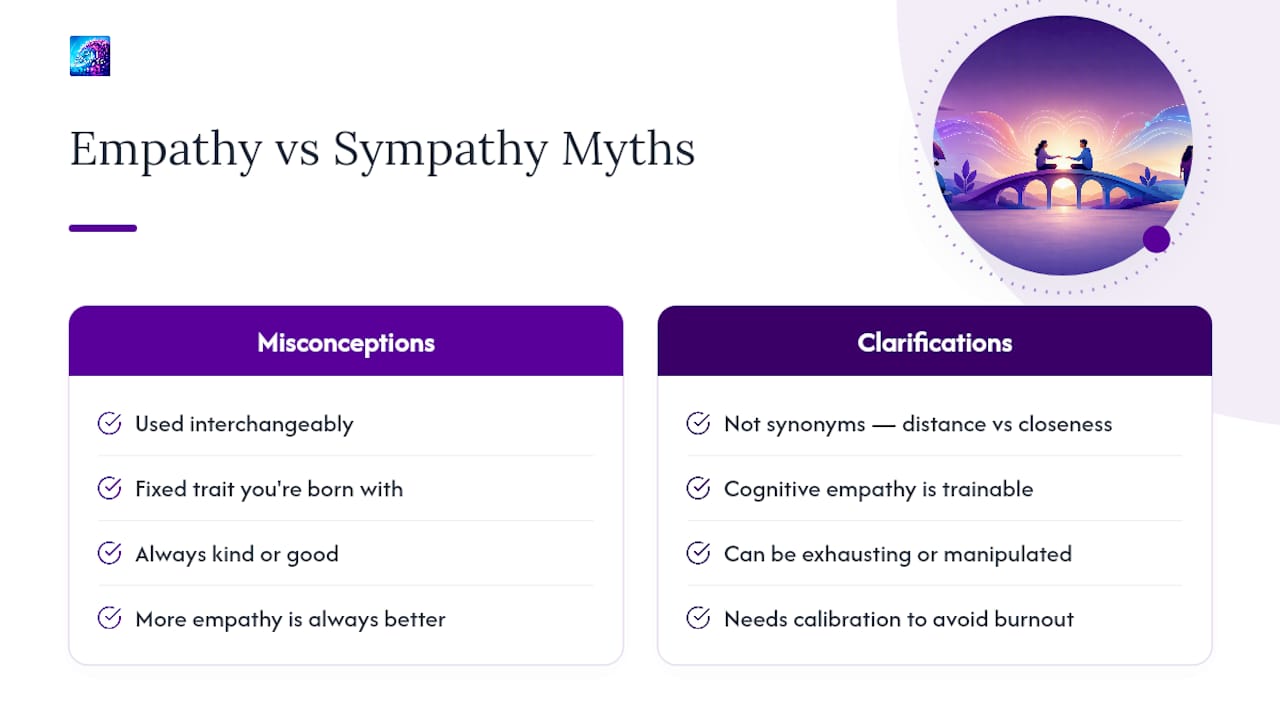
The biggest misconception is treating empathy and sympathy as interchangeable synonyms, when they describe genuinely different internal experiences. Saying “I sympathize” and “I empathize” might sound like polite variations of the same sentiment, but one keeps distance and the other closes it.
A second misconception: many people assume empathy is purely a fixed personality trait, something you’re either born with or not. Cognitive empathy in particular is a skill that responds to deliberate practice, which means someone who struggles with it today isn’t stuck that way permanently.
A third misconception treats empathy as automatically kind or automatically good. Empathy is genuinely complex and can, in some circumstances, be exhausting or even manipulated, since accurately sensing what someone feels doesn’t guarantee you’ll act with their best interest in mind, a nuance explored in the Stanford Encyclopedia of Philosophy’s entry on empathy.
A fourth misconception is assuming more empathy is always better. Unlimited empathetic absorption without boundaries tends to produce burnout rather than deeper connection. The goal isn’t maximum empathy at all times. It’s calibrated empathy, deployed with enough self-awareness that you don’t run yourself into the ground trying to feel everything for everyone.
Finally, people often assume sympathy is somehow lesser or lazy. It isn’t. Sympathy has real value in moments where full emotional immersion isn’t appropriate or possible, like comforting a stranger you’ve just met. Matching the right response to the right relationship matters more than always reaching for the deepest option available.
Why This Distinction Shapes Every Close Relationship You Have
The words you choose in a hard moment quietly signal how much effort you’re willing to put into understanding someone. Partners, friends, and colleagues pick up on that signal fast, even if they couldn’t name why one response felt better than another.
In romantic relationships, empathy tends to defuse conflict faster than sympathy because it communicates “I see what you’re carrying,” not just “I acknowledge you’re carrying something.” In friendships, empathetic responses build the kind of trust that makes people come back to you during hard seasons, rather than performing gratitude while quietly seeking someone else out. In workplaces, cognitive empathy, understanding a colleague’s pressures without necessarily sharing their emotional state, tends to produce better collaboration than sympathy alone, since it helps you actually anticipate what support they need.
Communication research consistently frames empathy as the ingredient that turns a conversation from transactional into genuinely connective. Sympathy politely closes a topic. Empathy tends to open it further, because it signals safety to keep talking. That’s why people in hard moments often say what they need most is simply to feel heard, not fixed. Empathy delivers that. Sympathy, well-intentioned as it usually is, sometimes accidentally shuts the door instead.
None of this means sympathy has no place. It’s often the right first response to a stranger’s hardship or a situation too unfamiliar for you to genuinely step inside. The skill is knowing which relationships and which moments call for which response.
How Culture Shapes the Way People Express Care
Empathy and sympathy don’t look identical across cultures, even though the underlying capacities appear to be universal. Some cultures favor overt emotional expression, expecting visible warmth, physical closeness, or verbal reassurance as proof of care. Others favor restraint, where quiet presence, practical help, or simply showing up does the emotional work that words might do elsewhere.
This matters practically. A response that reads as deeply empathetic in one cultural context, like extended eye contact and emotionally expressive language, might read as intrusive in another, where a more understated, action-based gesture communicates the same depth of care. Collectivist cultures often emphasize communal, action-oriented sympathy, showing up with food or help rather than words. More individualist cultural norms sometimes lean toward verbal, emotionally explicit empathy, naming feelings directly as the primary currency of connection.
None of these approaches is more “correct.” Misreading a culturally different response as cold or performative is one of the most common empathy mistakes people make in mixed backgrounds, workplaces, or friendships. The safest approach when you’re unsure: ask directly what kind of support feels most comfortable to the other person, rather than assuming your own cultural default is universal. That single question, asked with genuine curiosity, is itself a small act of cognitive empathy in practice.
Where to Read More on Empathy and Sympathy
A few sources anchor the ideas in this piece, and each is worth a closer look if you want to dig deeper:
-
Merriam-Webster’s dictionary entry on sympathy for precise definitions and word history.
-
Greater Good Magazine’s empathy research for the psychology behind empathy’s two main types.
-
The palliative care study on patient preferences for real-world evidence on how empathy affects sensitive conversations.
The Take PTT Music Wants You to Sit With
Most advice on empathy stops at “listen more,” which is true but incomplete. The real skill is knowing which mode to use: affective empathy when someone needs to feel less alone in a hard emotion, cognitive empathy when someone needs to feel understood rather than matched, and sympathy when the relationship or moment doesn’t call for full immersion. Conventional wisdom treats empathy as one setting you either have on or off. It’s closer to a mixing board with several dials.
What gets underrated is the boundary piece. People chase empathy without building in a release valve, and that’s exactly how compassion fatigue takes root. Prioritize the pause before the response. That half-second of intentional silence, choosing your words instead of defaulting to reassurance, is where the entire difference between empathy and sympathy actually lives.
If you want a low-stakes way to practice this all week, pair a hard conversation with music that matches its emotional weight from PTT Music’s catalog and playlists. Sometimes the fastest route into someone else’s feelings starts with tuning into your own first. PTT Music is a comprehensive online platform dedicated to providing high-quality music lessons, tutorials, and resources for musicians of all skill levels. Whether you’re a beginner just starting out or an experienced artist looking to refine your skills, PTT Music offers a wide range of courses, from guitar and piano to vocal training and music theory. Their expert instructors create engaging video lessons, downloadable practice sheets, and interactive exercises designed to help you improve your technique and expand your musical knowledge. With a user-friendly interface and a vast library of content, PTT Music is an excellent resource for anyone passionate about learning and enjoying music.
— PTT Music