
The fastest way to turn ambition into results is to pick one proven method and start today. For measurable tasks, use SMART. For breaking a pattern of stalled follow-through, use WOOP. For big, directional goals that need a team or a season of focus, use OKRs. Here’s your starting lineup:
-
Need clarity? Start with SMART goals.
-
Need direction for a bigger vision? Use OKRs.
-
Struggle with follow-through? Add WOOP.
-
Easily distracted by too many priorities? Try a WIG (Wildly Important Goal) from the 4DX approach.
-
Stuck before you even start? Shrink it into a micro-goal.
Your next move takes ten minutes: write one micro-goal in a single sentence, then put a 15-minute weekly review on your calendar. That’s it. That’s the whole on-ramp.
Key Takeaways
Goal achievement improves most when you match a specific method to your actual bottleneck, clarity, urgency, or follow-through, rather than defaulting to the same framework for every goal.
| Point | Details |
|---|---|
| Match method to bottleneck | Use SMART for clarity, WIG/4DX for urgency, and WOOP for follow-through problems. |
| Layer frameworks for complex goals | Combine OKRs for direction, SMART for execution, and WOOP for obstacles. |
| Review weekly, not just at the end | Spend 20 to 30 minutes checking lead measures, obstacles, and next actions. |
| Break big goals into micro-goals | Shrink 12-week or quarterly targets into daily, one-sentence actions. |
| Know when to disengage | Dropping an impractical goal is an adaptive strategy, not a failure. |
Table of Contents
Goal Setting Methods That Actually Work, One By One
Nine frameworks show up again and again in research and real-world practice, and each one solves a different problem. Some sharpen clarity. Some build momentum. Some catch you before you quit. Here’s how to set each one up without overthinking it.
1. SMART goals
SMART stands for Specific, Measurable, Achievable, Relevant, and Time-bound, and it remains the most widely taught structure for turning a vague wish into a trackable target, according to Microsoft Learn’s breakdown of goal-setting frameworks. It’s best for concrete, short-term tasks where success or failure is easy to measure.
3-step setup (10 minutes):
-
Write your goal as a single sentence with a number and a date attached.
-
Ask whether it’s realistic given your current schedule and resources.
-
Note why it matters to you right now, in one line.
Example: “Finish the first draft of my song lyrics by Friday at 5 PM” beats “write more music” every time. Locke and Latham’s goal-setting theory backs this up directly. Their research found that specific, challenging goals paired with feedback and genuine commitment consistently produce better performance than vague intentions, according to Atlassian’s explanation of the theory.
2. OKRs (Objectives and Key Results)
An OKR pairs one ambitious Objective with two or three measurable Key Results that prove you got there. It’s built for bigger, quarter-long goals, whether you’re running a household project or a small creative business.
3-step setup (20 minutes):
-
Write your Objective as an inspiring, qualitative statement.
-
Attach 2 to 3 Key Results that are numeric and checkable.
-
Review progress on Key Results weekly, not the Objective itself.
Example Objective: “Build a sustainable creative practice.” Key Results: publish four new pieces, book two collaborations, grow your mailing list by 200 subscribers. OKRs work well layered under a bigger vision and above daily execution, since frameworks tend to perform best in tiers rather than alone.
3. WOOP (Wish, Outcome, Obstacle, Plan)
WOOP was designed specifically to close the gap between wanting something and actually doing it. It improves follow-through by forcing you to name your obstacle in advance and build an if-then plan around it, rather than pretending obstacles won’t show up, according to a comparison of major goal-setting methods.
3-step setup (15 minutes):
-
State your Wish and the Outcome you want from it.
-
Name the single biggest internal Obstacle standing in your way.
-
Write an if-then Plan: “If [obstacle happens], then I will [specific response].”
Example: Wish: practice guitar daily. Outcome: play three songs cleanly by month’s end. Obstacle: evening fatigue. Plan: “If I feel too tired after dinner, then I’ll practice for just 10 minutes right when I get home instead.” WOOP shines brightest for behavior-change goals where the obstacle, not the desire, is what keeps derailing you.
4. 4DX and the Wildly Important Goal (WIG)
The 4 Disciplines of Execution framework asks you to pick one or two Wildly Important Goals and ignore the rest until those are handled. It tracks “lead measures,” the actions you control today, rather than “lag measures,” the results you only see later, using a visible scoreboard and a regular check-in rhythm, according to a comparison of goal frameworks for 2026.
3-step setup (15 minutes):
-
Pick exactly one WIG. Resist the urge to list five.
-
Identify the lead measure, the specific weekly action that drives it.
-
Build a simple scoreboard, even a sticky note on your mirror.
Example: WIG: “Release an EP by year’s end.” Lead measure: “Write for 30 minutes, four days a week.” The scoreboard just tracks days completed.
5. The 12-Week Year and micro-goals
This method compresses a year’s worth of urgency into 12-week cycles, treating each quarter like its own mini-year with its own deadline pressure. Micro-goals work as its natural partner, breaking any 12-week target into weekly, even daily, bite-sized steps.
3-step setup (20 minutes):
-
Pick one goal to finish in the next 12 weeks, not 12 months.
-
Break it into weekly targets.
-
Break the current week into two or three daily micro-goals.
Example: A 12-week goal of “record and mix five tracks” becomes a weekly target of “finish one track,” which becomes a daily micro-goal of “lay down the vocal take.”
6. Habit goals
Habit goals focus on repeating a small action, not hitting a finish line. They work best when the process itself, not a single outcome, is what actually changes your life.

3-step setup (10 minutes): Pick the habit. Attach it to an existing routine (habit stacking). Track streaks, not outcomes.
7. Backward planning
Start at the finish line and work backward to today, mapping out each milestone in reverse order. It’s ideal for long-term goals with a fixed deadline, like a launch date or an event.
8. GROW (Goal, Reality, Options, Will)
Originally a coaching model, GROW walks you through your Goal, your current Reality, your Options, and your Will to act. It’s especially useful for goals tangled up with a decision you keep avoiding.
9. Values-based and process vs. outcome goals
Outcome goals target a result (“win the competition”); process goals target a behavior (“practice technique daily”). Anchoring either to your core values keeps motivation alive even when results are slow to show.
Pro Tip: Don’t try to run all nine at once. Pick your primary framework for direction, then borrow WOOP or a micro-goal breakdown only for the specific step where you keep getting stuck.
How to Choose the Right Goal Setting Method for You
Most people don’t lack ambition. They lack one of three things: clarity, urgency, or follow-through. Figure out which one is missing, and the right method becomes obvious.
-
Missing clarity (you can’t describe what “done” looks like) → start with SMART.
-
Missing urgency (you have a vague direction but no deadline pressure) → try a WIG or the 12-Week Year.
-
Missing follow-through (you know exactly what to do but keep not doing it) → layer in WOOP.
-
Overwhelmed by too many goals at once → cut the list down to one WIG and let everything else wait.
| User Profile | Safe Starter Method |
|---|---|
| New to goal setting | SMART goals |
| Ambitious but scattered | OKRs |
| Knows the goal, keeps stalling | WOOP |
| Juggling too many priorities | WIG / 4DX |
| Big goal, no urgency | 12-Week Year |
Frameworks layer well. A common, effective stack: use OKRs to set direction, SMART goals to define the execution details underneath each Key Result, and WOOP to plan around your most likely obstacle. Pairing frameworks like this, rather than picking just one, tends to hold up better over time than relying on a single method alone, according to research comparing goal-setting approaches.
Focus matters more than most people admit. High-performing frameworks like 4DX and OKRs both rely on narrowing attention to one or two priorities and reviewing them on a fixed weekly cadence, a mechanic that shows up across nearly every serious execution model, according to a comparison of goal frameworks. Give any method 6 to 8 weeks before judging whether it fits you.
Weekly Reviews, Daily Checklists, and a Copyable Worksheet
A method only works if you check in on it. Here’s the routine, stripped down to the essentials.
Weekly review (20 to 30 minutes), five things to check:
-
What moved forward this week, and what stalled?
-
Is the lead measure (the action you control) still happening consistently?
-
What obstacle showed up, and did your if-then plan hold?
-
Does the goal still matter, or is it time to adjust or drop it?
-
What’s the single most important action for next week?
Daily micro-goal checklist:
-
Write today’s one micro-goal before checking email.
-
Stack it onto an existing habit (after coffee, after the commute).
-
Mark it done on a visible tracker, even a paper calendar works.
Worksheet layout (copy this into any notebook or note app), a structure recommended by Purdue Global’s goal-setting resources: Goal, Measure, Lead Measures, Obstacles, First Action.
Pro Tip: Keep the weekly review on the same day and time every week. Consistency in when you check in matters as much as what you check.
Using Music to Protect Your Focus While You Chase a Goal
Creative work and goal follow-through both run on the same fuel: sustained attention. Music can help protect that attention during focused work blocks, which is a theme PTT Music explores in its guide to music and mindfulness and its piece on how music affects mood.
PTT Music built its catalog, podcast, and blog around exactly this kind of practical encouragement, original songs, motivational conversations, and honest writing meant to move people forward, and that content now reaches listeners across more than 150 platforms, including Spotify, Apple Music, and Amazon Music.
A pairing worth trying: run your daily micro-goal session in 25 to 45 minute blocks, and queue up an instrumental or steady-tempo playlist for the stretch where focus tends to slip. It’s a small structural cue, but it works the same way a scoreboard does. It marks the boundary of the work.
Common Pitfalls That Derail Goal Setting Frameworks
The most common mistake isn’t picking the wrong method. It’s picking too many goals at once. Chasing five priorities with equal intensity usually means none of them get real attention, which is exactly why frameworks like 4DX force you down to one or two Wildly Important Goals at a time.
The second pitfall is treating a goal as set-apart once it’s written down. Some goals turn out to be impractical, poorly timed, or no longer aligned with what you actually want. Recognizing when to disengage from a goal isn’t quitting. It’s a documented, adaptive strategy that frees up motivation and mental energy for something more promising, according to research on goal disengagement.
A third pitfall is applying SMART everywhere, even to goals where it doesn’t fit well. Skill-based or physical goals, for example, sometimes benefit more from learning-oriented targets than rigid performance metrics, and expert reviews caution against treating SMART as a universal default, according to an expert statement on goal setting in physical activity.
The fourth pitfall is skipping the review. A framework without a weekly check-in isn’t really a framework. It’s a note you wrote once and forgot about.
Staying Motivated When the Plan Hits a Wall
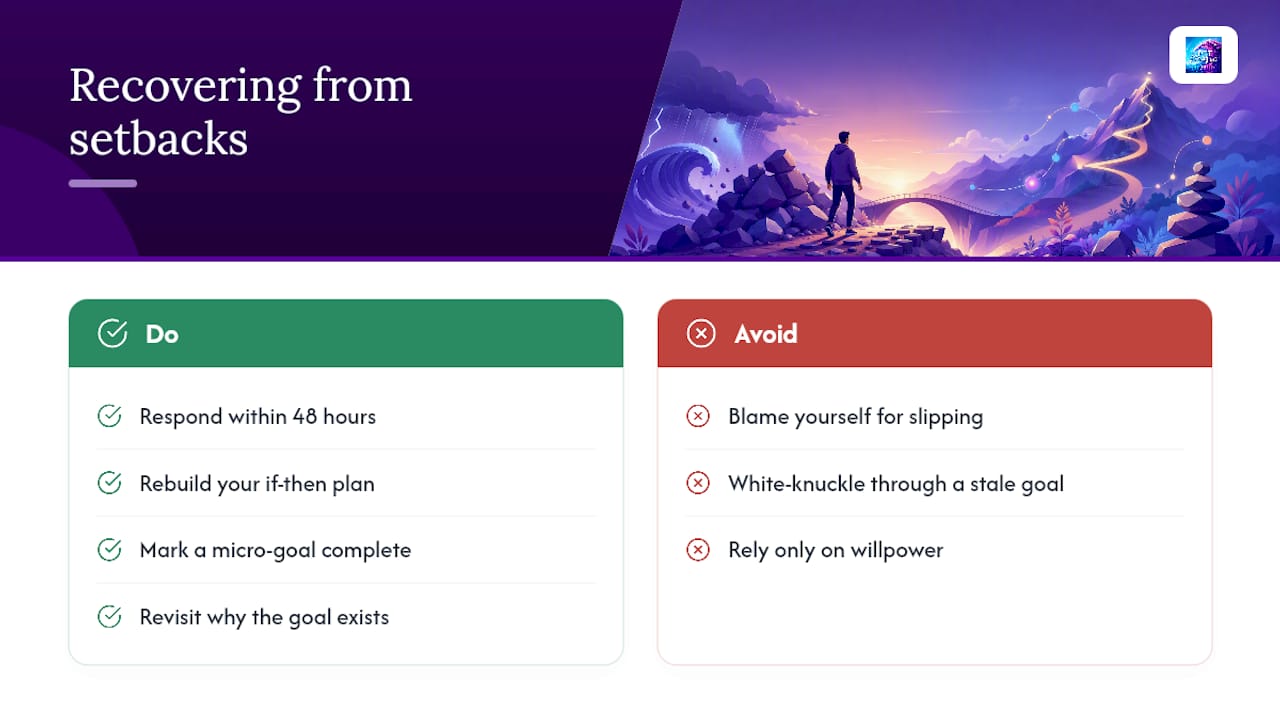
Motivation dips are normal, not a sign you picked the wrong goal. What separates people who recover from a setback from people who abandon the goal entirely usually comes down to how they respond in the first 48 hours after slipping.
Rebuilding your if-then plan is often more useful than relying on willpower. If a WOOP plan failed because you underestimated the obstacle, rewrite the plan with a more realistic trigger rather than blaming yourself for lacking discipline. Small wins matter here too: marking a micro-goal complete, even a tiny one, restarts momentum faster than waiting to feel motivated again.
Setbacks also tend to hit harder when the goal has quietly stopped mattering to you. Revisit why the goal exists in the first place during your weekly review, and if the honest answer is that it doesn’t matter anymore, give yourself permission to let it go rather than white-knuckling through a goal you’ve outgrown. That’s not giving up. It’s redirecting energy toward something worth finishing.
If a setback leaves you frustrated with yourself, a little self-compassion goes further than self-criticism, something PTT Music covers in more depth in its self-compassion exercises guide. And when you do hit a milestone, mark it. Even a short ritual, like playing one of PTT Music’s gratitude songs, reinforces the win and makes the next stretch easier to start.
Before you dive into your next goal-setting session, consider pairing your focus blocks with music built for exactly this kind of work. PTT Music’s original catalog offers tracks designed to support motivation and sustained attention, and the PTT Music podcast covers routine-building and resilience in more depth if audio guidance fits your style better than reading.
What We Think Actually Matters Here
Most advice on goal setting treats frameworks like religions: pick one, commit fully, never waver. That’s backward. The research points somewhere more useful, that layering methods, OKRs for direction, SMART for the daily grind, WOOP for the obstacle that keeps tripping you up, outperforms rigid loyalty to a single system.
The other place conventional advice falls short is disengagement. Most goal-setting content treats quitting as a character flaw. It isn’t. Recognizing when a goal no longer fits your life and redirecting that energy is a skill, not a failure, and it’s one of the most underrated moves in this entire field.
If you take one thing from this piece, let it be this: don’t wait for the perfect framework. Write one micro-goal today, schedule the weekly review, and let the method prove itself over six honest weeks before you judge it.
— PTT Music