
Emotional intelligence is not about controlling every emotion or always responding perfectly. It is about becoming more aware of what you are feeling, understanding how emotions influence your choices, listening carefully to other people, and responding with greater intention.
You can practice these skills through small everyday habits.
Start simply:
Pause. Name what you are feeling. Listen before responding. Reflect on what happened. Then decide what you want to do next.
Music can become part of that routine without being treated as a psychological treatment. A familiar song can give you a moment to reflect, prepare for a conversation, journal, or simply slow down before reacting.
PTT Music tracks such as “Now I Know,” “Talk To Me,” “Face To Face,” “Reach Out,” “Walk With You,” “Shift,” “Steps,” and “Thank You” naturally fit themes of self-awareness, communication, connection, reflection, and personal growth.
Explore more original music through the PTT Music catalog.
Key Takeaways
Emotional intelligence becomes more practical when it is connected with everyday behaviors rather than treated as one fixed score.
| Skill | Daily Practice |
|---|---|
| Self-awareness | Pause and name what you are feeling as clearly as you can. |
| Reflection | Notice what happened before your reaction and what you did next. |
| Response choice | Give yourself a short pause before replying in emotionally charged situations. |
| Listening | Focus on understanding before preparing your own response. |
| Perspective | Consider another possible explanation before assuming intent. |
| Communication | Ask questions and clarify rather than relying only on assumptions. |
| Repair | When a conversation goes poorly, acknowledge your part and reconnect. |
| Growth | Review patterns and choose one small behavior to practice next. |
Table of Contents
-
What Emotional Intelligence Means in Everyday Life
-
The Four Practical Areas of Emotional Intelligence
-
8 Daily Micro-Habits for Emotional Intelligence
-
A Simple 4-Week Practice Plan
-
How to Build a More Precise Emotional Vocabulary
-
How to Pause Before Reacting
-
Why Active Listening Matters
-
How to Review Your Progress Without Overcomplicating It
-
Common Barriers to Emotional Intelligence
-
A PTT Music Playlist for Emotional Intelligence and Connection
-
How PTT Music Can Support Reflection and Communication
-
Frequently Asked Questions
-
Keep Growing With PTT Music
-
Sources
What Emotional Intelligence Means in Everyday Life
Emotional intelligence, often shortened to EQ, generally refers to skills related to recognizing emotions, understanding them, responding to them thoughtfully, and navigating relationships.
Different frameworks describe emotional intelligence differently.
The Six Seconds emotional intelligence model uses three broad ideas:
Know Yourself → Choose Yourself → Give Yourself
Other models emphasize abilities such as recognizing emotions, understanding emotional information, regulating responses, and navigating social situations.
Rather than arguing that one model is the only correct one, this article focuses on practical behaviors that can be useful in everyday life:
notice → pause → understand → communicate → choose
It is better not to claim that a few exercises will automatically increase a person’s EQ score or permanently “rewire” emotional habits.
A more realistic goal is:
Practice becoming more aware and intentional in situations where emotions matter.
The Four Practical Areas of Emotional Intelligence
For everyday use, emotional intelligence can be organized into four broad areas.
1. Self-Awareness
Self-awareness means noticing your own reactions.
Ask:
“What am I feeling right now?”
and:
“What happened just before I started feeling this way?”
You may not always have the perfect word.
That is fine.
The point is to notice.
2. Response Management
Once you notice what you are feeling, the next question is:
“What do I want to do with this?”
A feeling does not automatically have to become an immediate action.
Sometimes a short pause gives you time to choose a more useful response.
3. Social Awareness
Social awareness involves paying attention to other people.
That might include:
-
what they say;
-
what they do not say;
-
tone;
-
context;
-
timing;
-
asking questions.
Avoid assuming you can accurately “read” someone’s emotions from posture or facial expressions alone.
The safer approach is:
Notice, then clarify.
4. Relationship Skills
Relationship skills include:
-
listening;
-
communicating clearly;
-
giving feedback;
-
receiving feedback;
-
repairing misunderstandings;
-
showing appreciation;
-
setting appropriate boundaries.
These are practical behaviors that can be practiced repeatedly.
8 Daily Micro-Habits for Emotional Intelligence
You do not need a complicated program.
Try these eight small practices.
1. Take an Emotional Pulse Check
Once or twice during the day, pause and ask:
“What am I feeling right now?”
Try to use a specific word.
Instead of:
“Bad.”
you might say:
“Frustrated.”
Instead of:
“Fine.”
you might notice:
“Calm,” “uncertain,” “interested,” or “tired.”
You can explore additional emotional-awareness exercises through:
Psychology Today — 10 Ways to Increase Your Emotional Awareness
The exact number of daily check-ins is less important than making the practice manageable.
2. Ask What Triggered the Reaction
Once you name the feeling, ask:
“What happened before this?”
For example:
Feeling: irritated
Possible trigger: someone interrupted me repeatedly.
Or:
Feeling: encouraged
Possible trigger: someone recognized my work.
You are looking for patterns, not diagnosing yourself.
3. Pause Before Responding
Before replying to a difficult message or conversation, give yourself a moment.
You might:
-
take one comfortable breath;
-
count slowly;
-
read the message again;
-
ask for clarification;
-
decide to reply later.
There is no need to claim that one particular breathing pattern automatically regulates your nervous system.
The practical purpose is simpler:
Create a little space between reaction and response.
4. Consider Another Explanation
When something bothers you, ask:
“Is there another reasonable explanation?”
For example:
Instead of:
“They ignored me because they do not respect me.”
consider:
“Maybe they were distracted, busy, or did not see the message.”
This does not mean excusing poor behavior.
It means checking whether your first interpretation is the only possible one.
5. Listen Before Preparing Your Answer
During one conversation each day, focus deliberately on the other person.
Ask yourself:
“What are they actually trying to tell me?”
Do not spend the entire time preparing your response.
6. Ask One Clarifying Question
Try:
“What do you mean by that?”
“Can you tell me more?”
“What part was most difficult?”
“What would be helpful right now?”
Questions can reduce assumptions.
7. Review One Interaction
At the end of the day, choose one conversation and ask:
What happened?
How did I respond?
What worked?
What might I do differently next time?
Keep the review short.
8. Express Appreciation
Emotional intelligence is not only about difficult emotions.
It also includes noticing what people contribute.
Try saying:
“Thank you for explaining that.”
“I appreciated your help today.”
“I noticed the effort you put into that.”
PTT Music’s “Thank You” naturally fits this part of the practice.
A Simple 4-Week Practice Plan
This plan should be treated as a structure for practice, not as a promise that your emotional intelligence will measurably improve within exactly four weeks.
Week 1 — Notice
Practice:
-
one emotional pulse check;
-
naming what you feel;
-
identifying one possible trigger.
PTT Music pairing:
“Now I Know”
The title naturally fits increased awareness.
Week 2 — Pause and Choose
Practice:
-
pausing before one emotionally charged response;
-
considering another interpretation;
-
choosing how you want to respond.
PTT Music pairing:
“Shift”
A fitting reminder that perspective can change.
Week 3 — Listen
Practice:
-
listening without interrupting;
-
asking one clarifying question;
-
summarizing what you heard.
PTT Music pairing:
“Talk To Me”
Week 4 — Connect and Repair
Practice:
-
following up on an important conversation;
-
acknowledging misunderstandings;
-
expressing appreciation;
-
reaching out when communication has become distant.
PTT Music pairings:
“Reach Out”
“Face To Face”
“Thank You”
The overall progression becomes:
Notice → Pause → Listen → Communicate → Connect
How to Build a More Precise Emotional Vocabulary
A larger vocabulary can make it easier to describe experiences accurately.
Instead of relying only on:
happy, sad, angry, stressed, fine
try more specific language.
For example:
Instead of angry, ask whether you mean:
-
annoyed;
-
frustrated;
-
resentful;
-
disappointed.
Instead of happy, you might mean:
-
relieved;
-
excited;
-
grateful;
-
content;
-
proud.
Resources based on emotion frameworks, including Plutchik’s model, can provide additional vocabulary:
Building Emotional Intelligence Guide
Try the Two-Word Challenge
When you catch yourself saying:
“I’m stressed.”
try adding two more specific words.
For example:
“I’m overwhelmed and impatient.”
This is not about finding a scientifically perfect label.
It is about describing your experience more clearly.
Research also explores how putting feelings into words may relate to emotional processing.
You can review one research source here:
PMC article on emotion labeling and regulation
However, it is better not to turn this into a simple claim that naming an emotion automatically “calms the limbic system.”
Human emotional responses are more complex than that.

How to Pause Before Reacting
The original version made several strong claims about body awareness and emotional regulation.
Statements such as:
“Your body registers emotion before your conscious mind does.”
or:
“A 60-second breath interrupts escalation.”
are too universal.
People experience emotional reactions differently.
A safer practice is simply to notice possible signs that you are becoming tense or reactive.
You might notice:
-
jaw tension;
-
faster speech;
-
restlessness;
-
clenched hands;
-
difficulty concentrating;
-
an urge to respond immediately.
When you notice one of those signs, consider pausing.
You could:
take a comfortable breath;
take a short walk;
get a glass of water;
wait before sending the message;
or:
say, “I want to think about this before I answer.”
The goal is not to force a particular physiological response.
It is to give yourself more choice.
Why Active Listening Matters
Emotional intelligence is not only about understanding yourself.
Relationships also require understanding other people’s perspectives.
A useful overview of emotional intelligence and communication can be found through:
HelpGuide — Improving Emotional Intelligence (EQ)
Try four simple listening practices.
Pause
Give the other person time to finish.
Reflect
Say:
“It sounds like you’re saying…”
Clarify
Ask:
“Did I understand that correctly?”
Respond
Only after you understand the main point should you decide what you want to say.
Validation also does not require agreement.
You can say:
“I understand why that situation frustrated you.”
without saying:
“I agree with everything you did.”
That distinction is useful in families, friendships, workplaces, and leadership situations.
How to Review Your Progress Without Overcomplicating It
There is no need to promise that you will notice improvement after one month, three months, or six months.
People develop skills differently.
Instead, track behaviors you can actually observe.
Once a week, ask:
Did I pause before reacting at least once?
Did I ask a clarifying question?
Did I listen without interrupting?
Did I repair a misunderstanding?
Did I express appreciation?
What situation still feels difficult?
This gives you concrete information without pretending you can reduce emotional intelligence to a perfect timeline.
If you want to explore structured EQ frameworks, the Six Seconds model is one resource.
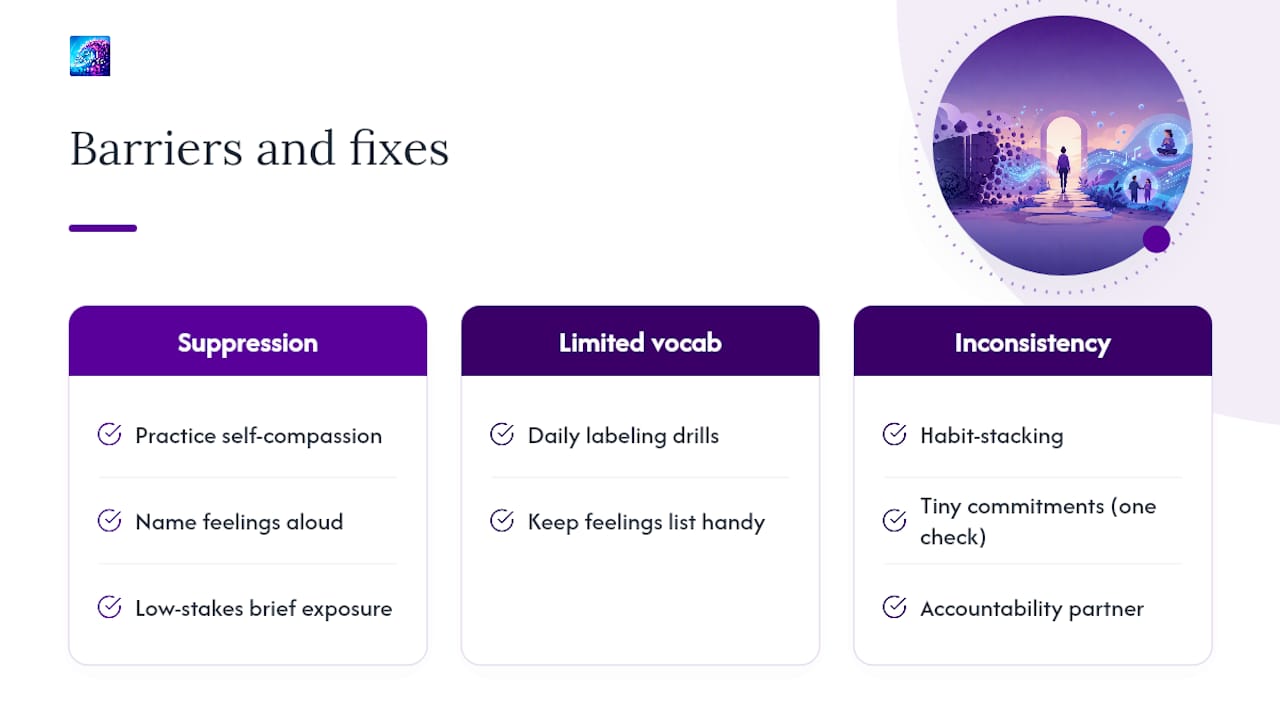
Common Barriers to Emotional Intelligence
Rather than labeling people as having “low emotional intelligence,” it can be more useful to look at specific habits.
Reacting Too Quickly
Try:
pause first.
Assuming Intent
Try:
ask before concluding.
Using Very General Emotional Language
Try:
choose a more specific word.
Avoiding Feedback
Try asking:
“How did that come across?”
Interrupting
Try:
let the other person finish.
Avoiding Repair
Try:
acknowledge what happened and reopen communication.
Trying to Change Everything at Once
Choose one behavior.
Practice it.
Then add another.
A PTT Music Playlist for Emotional Intelligence and Connection
PTT Music has several tracks whose titles naturally fit different stages of emotional awareness and communication.
“Now I Know”
Best for: Self-awareness
A natural starting point when reflection helps you recognize something more clearly.
“Shift”
Best for: Perspective
Useful as a theme when you are reconsidering an interpretation or approach.
“Talk To Me”
Best for: Communication
A natural reminder to create room for conversation.
“Face To Face”
Best for: Direct communication
Some misunderstandings are easier to address through respectful conversation rather than assumptions.
“Reach Out”
Best for: Reconnection
A fitting track when emotional intelligence needs to move beyond reflection into action.
“Walk With You”
Best for: Empathy and support
Sometimes support means accompanying another person rather than solving their problem.
“You Can Count On It”
Best for: Reliability
Healthy relationships depend on dependable behavior as well as good intentions.
“Friends”
Best for: Connection
Friendship gives us everyday opportunities to listen, communicate, forgive, and appreciate.
“Thank You”
Best for: Gratitude
Recognition and appreciation are also part of strong relationships.
“Steps”
Best for: Continued growth
Emotional intelligence does not have to improve all at once.
Small changes count.
Explore these tracks through the PTT Music music page.
How PTT Music Can Support Reflection and Communication
Music should not be presented as something that develops emotional intelligence by itself.
Instead, use it as a prompt or companion.
For Self-Reflection
Play:
“Now I Know”
Then ask:
“What did I learn about myself today?”
For Perspective
Play:
“Shift”
Then ask:
“Is there another way to interpret what happened?”
Before an Important Conversation
Consider:
“Talk To Me” → “Face To Face”
Then decide:
What do I actually need to communicate?
When Reconnecting
Try:
“Reach Out” → “Walk With You”
Then take the practical step:
send the message, make the call, or begin the conversation.
For Gratitude
Play:
“Thank You”
Then identify one person whose contribution you want to acknowledge.
This creates a simple PTT Music emotional-intelligence framework:
Notice → Shift → Talk → Listen → Reach Out → Connect → Appreciate
Why Small Practices Matter
The original article said that “short, consistent sessions beat sporadic heroic efforts every time.”
That is too absolute.
A safer principle is:
Small practices are often easier to repeat.
You do not need an ambitious emotional-intelligence program.
One thoughtful conversation can be useful.
One pause before responding can be useful.
One apology can be useful.
One moment of listening can be useful.
One expression of appreciation can be useful.
Growth can happen through repeated opportunities to practice these behaviors without demanding perfection.
Frequently Asked Questions
What is emotional intelligence?
Emotional intelligence generally refers to skills related to recognizing emotions, understanding emotional information, managing responses, and navigating relationships.
Different models define the concept somewhat differently.
Can emotional intelligence be developed?
Some emotional and interpersonal skills can be practiced and developed.
However, it is better not to promise that everyone will experience the same amount of change or improvement within a specific period.
What are some simple emotional-intelligence habits?
Try:
-
naming what you feel;
-
pausing before reacting;
-
considering another interpretation;
-
listening carefully;
-
asking clarifying questions;
-
reviewing conversations;
-
repairing misunderstandings;
-
expressing appreciation.
How long does it take to improve emotional intelligence?
There is no universal timeline.
Instead of expecting measurable change after a fixed number of weeks or months, focus on specific behaviors and notice how they develop through experience and practice.
Does deep breathing increase emotional intelligence?
No single breathing exercise should be presented as a way to increase emotional intelligence.
A brief pause or comfortable breath may simply give you time before responding.
Does labeling emotions regulate the brain?
Research examines relationships between emotion labeling and emotional processing, but it is better not to reduce that research to a guarantee that naming an emotion will automatically regulate the brain.
Use labeling primarily as a tool for clearer self-awareness.
What PTT Music songs fit emotional intelligence?
Consider:
“Now I Know,” “Shift,” “Talk To Me,” “Face To Face,” “Reach Out,” “Walk With You,” “You Can Count On It,” “Friends,” “Thank You,” and “Steps.”
Can music improve emotional intelligence?
It is better not to make that claim.
Music can provide themes for reflection, communication, empathy, and personal growth, while emotional intelligence develops through actual behaviors such as listening, communication, reflection, feedback, and relationship experience.
Keep Growing With PTT Music
Emotional intelligence does not require having the perfect response every time.
Sometimes it begins with:
“Now I Know.”
Then you:
“Shift.”
You invite:
“Talk To Me.”
You communicate:
“Face To Face.”
When distance develops:
“Reach Out.”
Instead of trying to solve everything, sometimes you simply:
“Walk With You.”
You become someone others know:
“You Can Count On It.”
You value:
“Friends.”
You remember to say:
“Thank You.”
And you continue taking:
“Steps.”
Emotional intelligence becomes practical when awareness turns into listening, communication, better choices, and stronger relationships.
Explore the PTT Music catalog, choose tracks that fit your own reflection and communication routine, and let PTT Music accompany the everyday work of listening, connecting, and growing.
Visit the PTT Music home page for more original music and PTT Music content.
For conversations around communication, relationships, confidence, resilience, purpose, and personal growth, explore the PTT Music Podcast.
Read more lifestyle, relationship, motivation, and personal-growth articles through the PTT Music Blog.
You can also browse current products through the PTT Music Store and PTT Music Song & Merchandise Collections.