
A growth mindset is the belief that abilities can develop through learning, practice, strategy, feedback, and support rather than being permanently fixed.
The idea is closely associated with the work of Stanford psychologist Carol Dweck. But growth mindset is more useful when it moves beyond motivational language and becomes part of what you actually do.
For creatives, that can mean:
-
revising instead of abandoning;
-
asking for useful feedback;
-
trying another approach when the first one fails;
-
practicing specific skills;
-
treating mistakes as information;
-
focusing on progress rather than praise.
Whether you write, design, make music, create content, paint, build products, or develop new ideas, creative growth usually involves iteration.
At PTT Music, that naturally connects with tracks such as “Create,” “Shift,” “Different,” “No Distractions,” “Steps,” and “The Time Is Now.” Their titles fit different parts of the creative process: beginning, changing perspective, developing your own direction, focusing, making progress, and taking action.
This guide gives you a practical one-week growth mindset plan for creatives built around one central principle:
Process over praise.
Explore more original music through the PTT Music catalog.
Key Takeaways
A growth mindset is more useful when belief is paired with practical behavior.
| Principle | Creative Practice |
|---|---|
| Focus on process | Pay attention to strategy, practice, revision, and progress rather than only praise or final results. |
| Use feedback | Ask for specific information you can apply to your next attempt. |
| Learn from mistakes | Treat errors as information rather than permanent judgments about your ability. |
| Change the strategy | Persistence does not mean repeating an ineffective approach forever. |
| Keep creating | Small, repeated opportunities to practice can give you more experience to learn from. |
| Use PTT Music intentionally | Choose tracks that fit focus, creativity, adjustment, perseverance, and forward movement. |
Table of Contents
-
What Is a Growth Mindset for Creatives?
-
Growth Mindset vs. Fixed Mindset
-
What the Research Actually Supports
-
Process Over Praise: What It Means for Creative Work
-
Practical Growth Mindset Habits for Creatives
-
The False Growth Mindset Trap
-
A One-Week Growth Mindset Plan for Creatives
-
A Short PTT Music Playlist for Creative Growth
-
Growth Mindset in Creative Work, School, and Career
-
How to Recognize Your Current Mindset
-
How Environment and Feedback Shape Creative Growth
-
What Actually Works Beyond Motivational Slogans
-
Frequently Asked Questions
-
Keep Creating With PTT Music
-
Sources
What Is a Growth Mindset for Creatives?
A growth mindset is not a permanent personality upgrade.
It is a way of thinking about ability and development.
Instead of assuming:
“I either have creative talent or I don’t,”
a growth-oriented approach asks:
“What can I practice, change, learn, or try next?”
That distinction matters for creative work because creativity almost always involves unfinished attempts.
A first draft may need rewriting.
A design may need revision.
A song may need another arrangement.
A campaign idea may need testing.
A presentation may need another rehearsal.
The first version does not have to become a final verdict on your ability.
For creatives, a growth mindset can look like:
Create → Review → Learn → Adjust → Create Again
That process is often more useful than waiting to feel naturally talented.
Growth Mindset vs. Fixed Mindset
The difference often becomes visible through the language you use after something does not go according to plan.
Fixed-Mindset Language
“I’m not creative.”
“I’m bad at writing.”
“I can’t design.”
“Nobody liked it, so the idea must be terrible.”
“They are naturally talented, and I’m not.”
These statements treat the current situation as permanent.
Growth-Oriented Language
Try:
“I’m still learning how to do this.”
“This version did not work. What should I change?”
“Which part needs more practice?”
“What feedback would make the next version stronger?”
“What is that person doing that I could learn from?”
The goal is not to force unrealistic positivity.
You do not need to tell yourself that every idea is excellent.
A more useful mindset is:
“This can improve.”
Almost everyone has a mixture of fixed and growth-oriented thinking.
You might be flexible about your career but very fixed about drawing.
You might confidently learn new technology but assume you could never perform publicly.
That makes growth mindset more useful when applied to specific areas instead of treated as one permanent label.
What the Research Actually Supports
Growth mindset research is real, but it should not be presented as proof that simply believing you can improve automatically produces better grades, greater creativity, faster learning, or professional success.
Research has found that growth-mindset interventions may produce benefits in some contexts, while outcomes can vary depending on the population, environment, implementation, and support available.
For background, see:
Growth Mindset — Stanford Center for Teaching and Learning
and:
You can also explore this overview:
Growth Mindset — Psychology Today
The practical lesson is more modest:
Believing that improvement is possible can be useful when it is paired with learning, strategy, practice, feedback, and opportunities to improve.
Belief alone does not guarantee results.
Process Over Praise: What It Means for Creative Work
Creative people often receive feedback that sounds like:
“You’re talented.”
“You’re naturally creative.”
“You’re gifted.”
Positive feedback can feel encouraging.
But if all your confidence depends on being called talented, criticism can begin to feel like proof that you have lost that identity.
Process-focused feedback asks different questions.
Instead of:
“Am I talented?”
ask:
“What worked?”
“What needs revision?”
“What did I learn?”
“What should I try differently?”
“What skill needs more practice?”
This shifts attention from identity to development.
Research and discussion around growth mindset have explored differences between praise focused on fixed traits and feedback centered on process, strategy, and learning.
You can explore one discussion here:
Scientific American — The Remarkable Reach of Growth Mind-Sets
For a creative person, process over praise can mean valuing:
-
revision over perfection;
-
learning over looking talented;
-
feedback over applause;
-
experimentation over certainty;
-
improvement over comparison.
Practical Growth Mindset Habits for Creatives
You do not need a complicated mindset program.
Begin with a few repeatable practices.
1. Set a Learning Goal
Instead of only setting an outcome goal:
“Finish an amazing song.”
try:
“Improve the structure of the chorus.”
Instead of:
“Become a great writer.”
try:
“Practice stronger openings this week.”
Instead of:
“Get more engagement.”
try:
“Test three different approaches and compare what I learn.”
Learning goals give you something specific to work on.
2. Break Skills Into Smaller Parts
Creative work contains many separate skills.
Writing might include:
-
research;
-
openings;
-
structure;
-
clarity;
-
storytelling;
-
editing.
Music might include:
-
songwriting;
-
arrangement;
-
performance;
-
timing;
-
production;
-
mixing.
Choose one component and work on it deliberately.
3. Keep a Creative Mistake Log
After a project or practice session, write down:
What did not work?
Why might it have happened?
What will I try next?
For example:
Problem: The article opening felt weak.
Observation: It took too long to reach the main point.
Next attempt: Put the reader’s problem in the first paragraph.
The mistake becomes information.
4. Ask for Specific Feedback
Instead of:
“Do you like it?”
try:
“Where did you lose interest?”
or:
“What is the one section you would improve?”
or:
“Which part felt strongest?”
Specific questions tend to produce more useful responses.
5. Revise Before You Judge
Build revision into the creative process.
Instead of deciding whether you are “good” or “bad” after the first attempt, create another version.
Version two gives you something version one cannot:
comparison.
6. Try Another Strategy
Persistence does not mean repeating the same method forever.
If something does not work, change something.
Try:
-
another format;
-
another tool;
-
another audience;
-
another structure;
-
another time of day;
-
another feedback source;
-
another creative constraint.
Growth includes adaptation.
A One-Week Growth Mindset Plan for Creatives
Seven days will not permanently transform your mindset.
Instead, think of this as a one-week experiment that introduces several practices you can continue if they prove useful.
Day 1 — Notice Your Language
Write down one creative limitation you regularly tell yourself.
Examples:
“I’m not good at design.”
“I can’t write headlines.”
“I’m terrible at public speaking.”
Rewrite it:
“I’m still developing this skill.”
Then identify one part you can practice.
PTT Music Pairing:
“Now I Know”
Use the title as a prompt:
What do I know about the skill I need to develop?
Day 2 — Create Something Imperfect
Make one small piece without demanding perfection.
Write a paragraph.
Sketch an idea.
Record a rough demo.
Create a draft.
The goal is simply to produce something you can review.
PTT Music Pairing:
“Create”
A natural soundtrack for moving from thinking into making.
Day 3 — Ask for One Piece of Feedback
Choose someone whose opinion is useful.
Ask:
“What is one specific thing I could improve?”
Do not ask whether the entire project is good or bad.
Ask for information you can use.
PTT Music Pairing:
“Talk To Me”
A fitting title for inviting useful communication.
Day 4 — Change One Strategy
Look at something that has not been working.
Ask:
“What could I do differently?”
Change one variable.
PTT Music Pairing:
“Shift”
The title fits the move from repeating toward adjusting.
Day 5 — Practice One Skill
Choose one small skill and work on it deliberately.
Examples:
-
stronger headlines;
-
cleaner transitions;
-
chord changes;
-
vocal timing;
-
visual composition;
-
presentation openings.
PTT Music Pairing:
“No Distractions”
A natural fit for focused practice.
Day 6 — Review a Mistake
Choose one mistake from the week.
Write:
What happened?
What did I learn?
What will I try next?
PTT Music Pairing:
“Steps”
Growth rarely requires solving everything at once.
Sometimes the next step is enough.
Day 7 — Make the Next Version
Return to something you worked on earlier in the week.
Create version two.
Compare it with version one.
Ask:
What changed?
What improved?
What still needs work?
PTT Music Pairing:
“The Time Is Now”
Reflection eventually needs to become action.
One-Week Overview
| Day | Growth Practice | PTT Music Track |
|---|---|---|
| 1 | Notice limiting language | “Now I Know” |
| 2 | Create an imperfect first version | “Create” |
| 3 | Ask for feedback | “Talk To Me” |
| 4 | Change one strategy | “Shift” |
| 5 | Practice one skill | “No Distractions” |
| 6 | Learn from one mistake | “Steps” |
| 7 | Create the next version | “The Time Is Now” |
The sequence becomes:
Notice → Create → Ask → Shift → Practice → Learn → Act
A Short PTT Music Playlist for Creative Growth
If you want a simple soundtrack for creative practice, consider:
“Create”
Best for: Beginning
Useful when the hardest part is simply starting.
“Different”
Best for: Original thinking
A fitting title when you want to explore an approach that is less predictable.
“Shift”
Best for: Changing strategy
Use it when the current method is not producing what you want.
“No Distractions”
Best for: Focus
A natural choice during editing, practice, writing, planning, or production.
“Steps”
Best for: Progress
A reminder that improvement can happen incrementally.
“Gotta Get Through”
Best for: Persistence
A fitting addition when a project becomes demanding.
“Stronger Than Before”
Best for: Recognizing development
Useful after revisiting a skill or project and noticing improvement.
“On My Way”
Best for: Recognizing progress
You do not need to be finished to recognize that you are moving.
“The Time Is Now”
Best for: Taking action
A fitting closing track before publishing, presenting, performing, submitting, or launching.
Explore more original tracks through the PTT Music catalog.
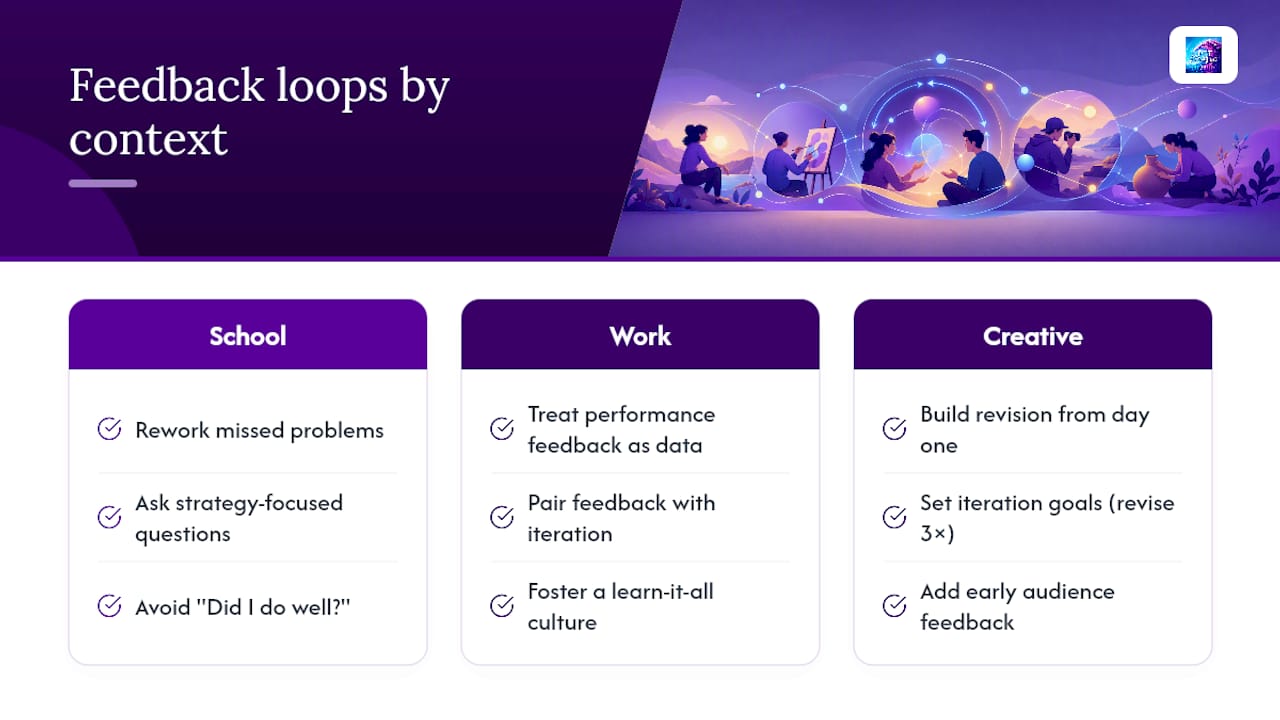
Growth Mindset in Creative Work, School, and Career
The underlying principle can apply across different settings.
In School
Instead of asking only:
“What grade did I get?”
also ask:
“Which concept do I still need to understand?”
A mistake on a test can point toward what needs more practice.
At Work
Feedback does not automatically define your professional worth.
It can also provide information about:
-
skills;
-
expectations;
-
communication;
-
priorities;
-
performance.
Harvard Business School discusses growth and fixed mindsets in professional and entrepreneurial contexts here:
Growth Mindset vs. Fixed Mindset — Harvard Business School Online
In Creative Work
A first version does not have to carry the entire weight of your ability.
Writers revise.
Musicians rerecord.
Designers iterate.
Marketers test.
Creators edit.
That makes creative work naturally compatible with growth-oriented thinking.
How to Recognize Your Current Mindset
Instead of trying to label yourself permanently as having either a growth or fixed mindset, observe your reactions.
Watch what happens when:
-
someone criticizes your work;
-
your first attempt fails;
-
another person succeeds;
-
you have to learn something unfamiliar;
-
a project requires revision.
Ask:
Do I become curious or defensive?
Do I ask what I can learn?
Do I avoid the skill entirely?
Do I automatically compare myself with someone else?
Do I try another strategy?
Your answers may vary depending on the area.
That is useful information.
You might have a growth-oriented mindset about technology while feeling very fixed about singing.
The goal is not to earn a perfect mindset score.
It is to notice where you have quietly decided:
“I cannot improve here.”
Then test that assumption through practice.
How Environment and Feedback Shape Creative Growth
Creative development does not happen in isolation.
The people and environments around you can influence whether mistakes are treated as:
embarrassments
or:
information.
A useful creative environment allows people to say:
“That version did not work.”
without automatically turning it into:
“You are not talented.”
Similarly, constructive feedback should not mean endless praise.
Useful feedback identifies:
-
what worked;
-
what did not;
-
why;
-
what might improve it.
Workplace discussions sometimes describe this as creating a “learn-it-all” rather than “know-it-all” culture.
You can explore one discussion here:
Forbes — Does Your Culture Have Know-It-Alls or Learn-It-Alls?
It is safer, however, to avoid claiming that such cultures automatically innovate faster or recover from setbacks more quickly in every organization.
The more useful takeaway is:
Environments that make constructive learning and feedback possible may make it easier for people to experiment and improve.
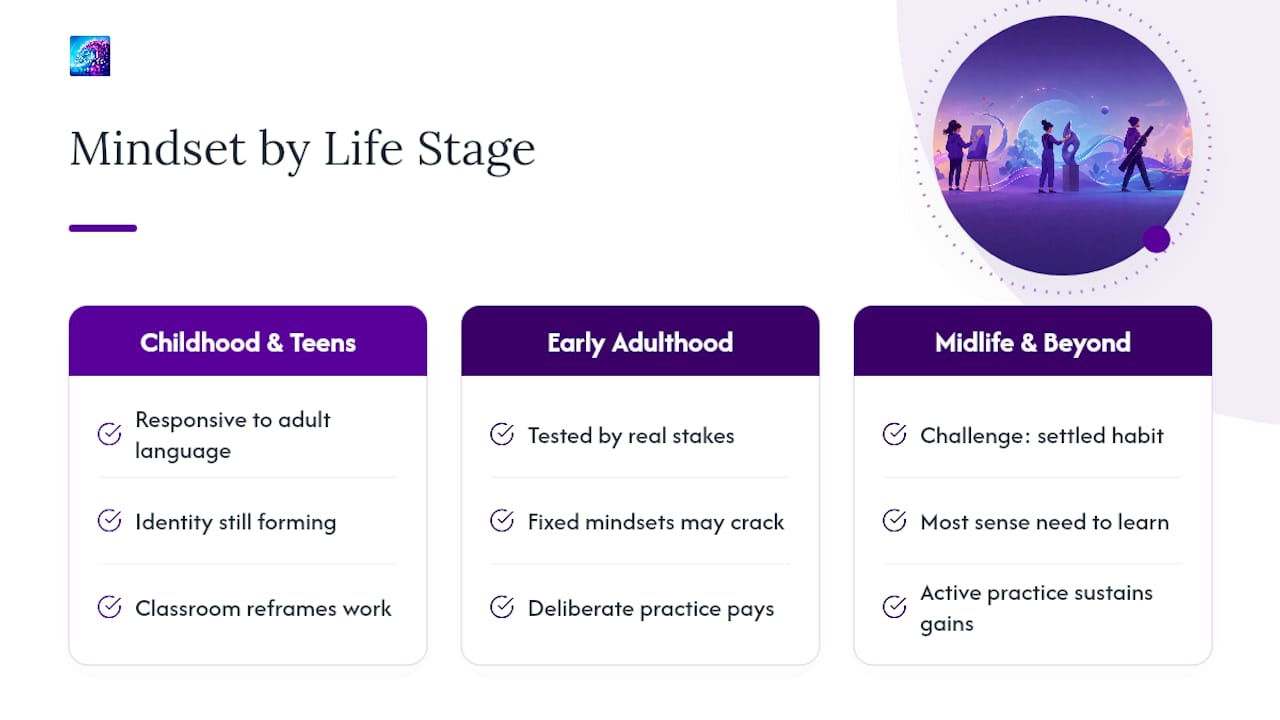
Growth Mindset Across Life Stages
People can continue learning at different stages of life.
But there is no need to claim that one growth-mindset technique works identically for children, teenagers, working adults, and older learners.
The context changes.
Children may depend heavily on teachers and parents for feedback.
Students increasingly manage their own learning strategies.
Working adults encounter professional feedback, changing technologies, and new responsibilities.
Later adulthood may bring new opportunities to learn skills, hobbies, creative practices, or technologies.
The central question remains:
“What am I still willing to learn?”
The original article included a claim connecting a Pew statistic with how mindset changes in midlife. That comparison is stronger than the statistic itself supports, so it is better to keep lifelong learning separate from claims about growth-mindset outcomes.
What Actually Works Beyond Motivational Slogans
Growth mindset can easily become a poster slogan:
Believe you can improve.
But belief is only the beginning.
For creators, the practical version looks more like:
Believe improvement is possible.
Then:
Practice.
Ask for feedback.
Revise.
Change strategy.
Try again.
The most useful question after a creative setback is often not:
“Am I talented enough?”
It is:
“What should I try next?”
That is the difference between using growth mindset as inspiration and using it as a working process.
The PTT Music Approach: Create, Learn, and Keep Moving
Growth mindset fits naturally with PTT Music because creativity itself involves iteration.
Consider the progression:
“Create” — begin.
“Different” — explore another direction.
“Talk To Me” — invite feedback.
“Shift” — change strategy.
“No Distractions” — practice with focus.
“Steps” — continue progressing.
“Stronger Than Before” — recognize development.
“On My Way” — acknowledge progress.
“The Time Is Now” — act.
Together, these titles create a practical creative-growth framework:
Create → Experiment → Listen → Adjust → Focus → Progress → Grow → Move → Act
Music does not have to create a growth mindset for you.
It can simply become part of the environment in which you practice one.
Frequently Asked Questions
What is a growth mindset?
A growth mindset is the belief that abilities can develop through learning, practice, strategies, feedback, and support rather than being completely fixed.
Can a growth mindset make you more creative?
It is better not to promise that adopting a growth mindset automatically increases creativity.
A growth-oriented approach may encourage behaviors that are useful in creative development, such as experimenting, revising, seeking feedback, and continuing to learn.
Can you develop a growth mindset in one week?
One week is better treated as a starter experiment, not a guaranteed transformation.
Seven days can give you time to try new practices and decide which ones you want to continue.
What does “process over praise” mean?
It means paying greater attention to practice, strategy, revision, learning, and progress rather than relying mainly on external approval or labels such as “talented.”
What should I do after making a creative mistake?
Ask:
What happened?
What can I learn?
What should I change next time?
Then test the new approach.
What PTT Music songs fit a growth mindset playlist?
Consider:
“Create,” “Different,” “Shift,” “No Distractions,” “Steps,” “Gotta Get Through,” “Stronger Than Before,” “On My Way,” and “The Time Is Now.”
Can music build a growth mindset?
It is better not to say that music automatically builds a growth mindset.
Music can be part of a creative routine, while the actual mindset practice comes through learning, reflection, feedback, strategy, and repeated action.
Keep Creating With PTT Music
A growth mindset does not require pretending every attempt is successful.
Sometimes the first thing you need to do is simply:
“Create.”
Then try something:
“Different.”
Listen when someone says:
“Talk To Me.”
When the approach needs adjustment:
“Shift.”
When it is time to work:
“No Distractions.”
Keep taking:
“Steps.”
You may eventually become:
“Stronger Than Before.”
You recognize:
“On My Way.”
And when preparation has gone far enough:
“The Time Is Now.”
Creative growth is rarely one perfect breakthrough.
It is often the result of making, learning, revising, experimenting, and continuing.
Explore the PTT Music catalog, choose a soundtrack for your next creative session, and focus on the process that moves your work forward.
For more original music and PTT Music content, visit the PTT Music home page.
For conversations around creativity, confidence, resilience, relationships, and personal growth, explore the PTT Music Podcast.
Read more lifestyle, creativity, motivation, and personal-growth content at the PTT Music Blog.
You can also browse current products through the PTT Music Store and PTT Music Song & Merchandise Collections.