
Leadership development, at its core, is self-leadership: the small, repeatable habits and intentional media choices that build confidence, resilience, and everyday influence. It’s not a corporate seminar. It starts tomorrow morning with two moves. First, write your Top 3 priorities before you touch your phone. Second, play 10 to 15 minutes of energizing music for PTT Music while you do your first task. That’s it. That’s the entry point.
TL;DR:
Playing energizing music for 10 to 15 minutes before demanding tasks can significantly boost motivation and physical readiness.
Building daily self-leadership habits requires consistent small actions, such as writing priorities and reflecting on progress, usually becoming automatic within 30 days.
Intentional media use, like PTT music and podcasts, supports emotional wellbeing and cognitive focus when chosen purposefully for specific moments.
Tracking progress with simple weekly metrics and focusing on small promises sustains growth without overcomplication.
Applying leadership models like transformational and servant leadership in daily self-management fosters authenticity, care, and better decision-making.
Table of Contents
What Real Leadership Development Looks Like Day to Day
Most people picture leadership development as something that happens in a conference room. It actually happens in your kitchen at 6:45 AM, in your car during a commute, in the ten seconds before you respond to a frustrating text. Five pillars hold up everyday self-leadership, and each one has a habit you can start today.
Clarity means knowing what you’re actually trying to accomplish, not just what’s on your calendar. Discipline is following through on small commitments to yourself, the kind nobody else would ever notice you broke. Emotional regulation is the ability to feel something strong and still choose your response. Boundaries protect your time and energy so you’re not leading on empty. Consistency ties it all together. It’s the difference between a habit and a one-time good day.
Here’s why tiny promises beat willpower: motivation is unreliable, but a two-minute task is nearly friction-free. Practitioner frameworks on self-leadership consistently point back to self-awareness and small, repeatable practices rather than dramatic overhauls. Willpower spikes and crashes. Systems don’t.
Try one micro-habit per pillar this week:
-
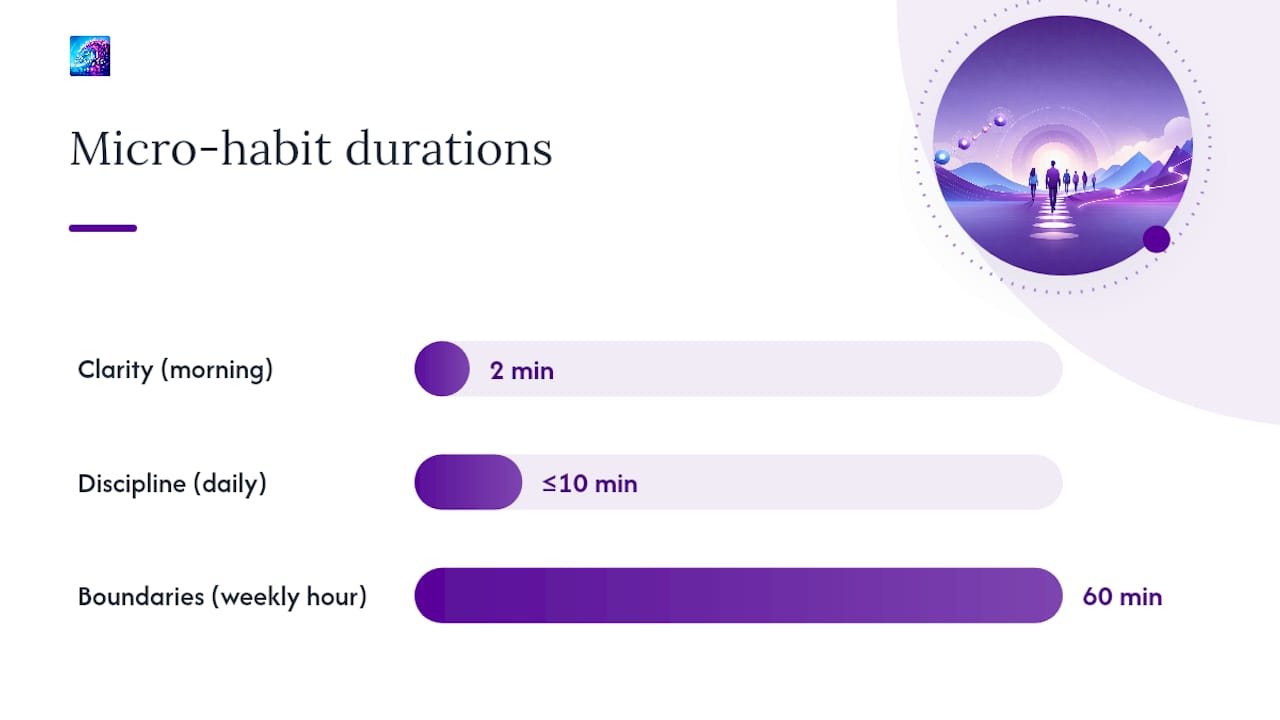
Clarity: Two minutes each morning, write the one outcome that would make today a win.
-
Discipline: Make one promise to yourself daily that takes under 10 minutes, and keep it no matter how small.
-
Emotional regulation: When frustration hits, breathe, name the feeling, and ask what the next right step is before reacting.
-
Boundaries: Pick one hour this week you protect completely, no notifications, no exceptions.
-
Consistency: Anchor a new habit to something you already do daily, like coffee or brushing your teeth.
Pro Tip: Design your environment so it does the work for you. A saved warm-up playlist, a journal left open on your desk, and a tidy workspace all reduce the friction between “I should” and “I did.”
How Music And Podcasts Actually Support Motivation
Music and podcasts aren’t background noise when you use them on purpose. A 2026 systematic review found that intentional music listening produces small but consistent improvements in emotional wellbeing, along with modest cognitive benefits that depend heavily on why and how you’re listening. Passive background music all day doesn’t do much. Deliberate listening, chosen for a specific purpose, does.
The 10-Minute Shift: Neuroscience-based guidance suggests that 10 to 15 minutes of faster, activating music before a task reliably increases motivation and physical readiness to act, while silence or low-lyric audio tends to support deep, focused work better than anything with words.
Podcasts work differently. A PLOS One study found that podcast listening satisfies real informational needs and can build a sense of meaning and relatedness, especially when listeners engage socially with hosts or feel a genuine connection to the content.
Use these rules to keep your listening intentional instead of accidental:
-
Play energizing, faster music for 10 to 15 minutes before a task that requires effort or courage.
-
Switch to silence or low-lyric music when you need deep focus, like writing or problem-solving.
-
Save podcasts for commutes, walks, or chores where you want information plus company.
-
Watch for rumination: if you’re replaying the same sad playlist to stay in a low mood, that’s avoidant listening, not leadership.
-
Ask before you press play: “What do I need right now, energy, calm, or information?”
Explore more of this in how music affects mood, which breaks down the mechanics behind why the right song at the right moment shifts how you show up.
Building A Daily Routine That Actually Sticks
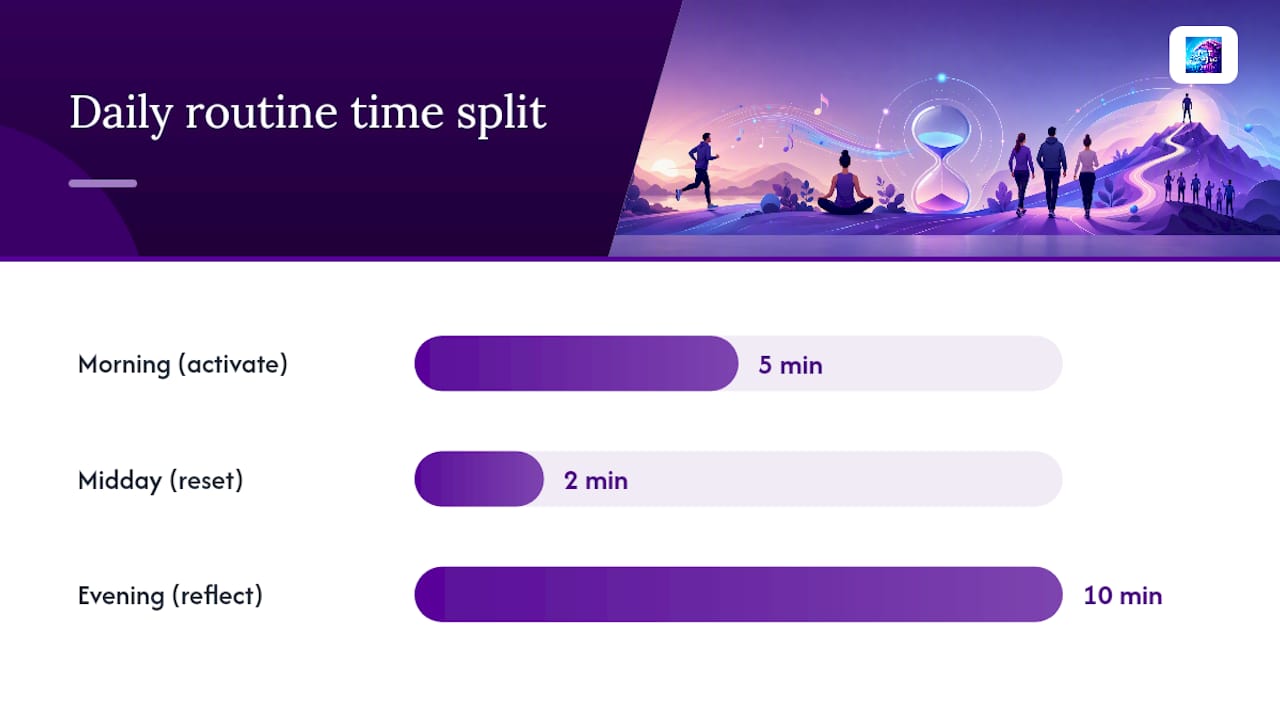
A leadership habit that only works on your best days isn’t a habit. It’s a hope. Here’s a simple structure you can run in under 30 minutes total, spread across your day.
-
Morning (5 minutes): Write your Top 3 priorities, then play an activating song while you start the first one. This is your motivational cue, not entertainment.
-
Midday (2 minutes): Do a quick reset. Breathe, check in on your energy, and adjust your afternoon if you’re already drained.
-
Evening (10 minutes): Reflect on one question: “Where did I lead myself well today, and where did I let something else drive?” Write the answer down.
Anchor these moments to something concrete. A saved warm-up playlist for mornings, a specific chair for your evening reflection, a recurring calendar block for the midday reset. Environment does more of the work than motivation ever will. Pairing this with a short journaling habit, like the one outlined in journaling for self-discovery, gives your reflection time an actual structure instead of vague rumination.
Pro Tip: Keep a “tiny promises” list on a sticky note. Check off each one you kept. Seeing five checkmarks builds more real confidence than a motivational quote ever will.
For the first 30 days, focus only on showing up: morning priorities, one music cue, one evening question. Don’t add anything else. Consistency at a small scale beats ambition at a large one. Once that rhythm feels automatic, usually around day 30, add the midday reset. By day 90, you should be running the full routine most days, with room to fail without abandoning the whole system. Progress isn’t a straight line, and expecting perfection is the fastest way to quit by week two.
How To Track Progress Without Overcomplicating It
You don’t need a dashboard. Three lightweight weekly metrics tell you almost everything: how many tiny promises you kept, how many times you used a music or podcast cue on purpose, and how you’d rate your stress recovery on a simple 1 to 5 scale.
Run a 10-minute weekly review every Sunday or Monday:
-
Count your kept promises from the week.
-
Note one moment you regulated a strong emotion instead of reacting.
-
Pick one small adjustment for next week, never more than one.
Once a month, spend 30 minutes on a deeper check. Reread your evening reflections, look for patterns in what drained you, and revisit the resilience techniques in practical resilience strategies if recovery has been slower than usual. The goal of every review is a single concrete change, not a long list of things to fix at once. Open-ended venting rarely leads anywhere useful.
Leadership Models Worth Knowing (And How They Apply To You)
You don’t need a business degree to borrow from leadership theory. Two models translate especially well into everyday self-leadership.
Transformational leadership focuses on inspiring people toward a shared vision through authenticity and energy, not authority. Applied to yourself, this means leading your own day with a clear “why” instead of just a task list. When your morning Top 3 connects to something you actually care about, you’re practicing transformational leadership on a personal scale.
Servant leadership flips the traditional hierarchy: the leader exists to support the people they lead, not the other way around. In self-leadership terms, this shows up as treating your own wellbeing as something worth serving, not sacrificing. Skipping sleep or ignoring boundaries to “grind harder” isn’t discipline. It’s leading yourself the way a bad boss leads a team.
Both models share the same undercurrent: leadership is relational, even when the relationship is with yourself. The way you talk to yourself after a mistake, the grace or harshness you extend internally, sets the tone for how you’ll eventually lead others. People who are harsh with themselves tend to replicate that harshness outward, whether they mean to or not.
You don’t need to pick one model and follow it rigidly. Borrow the vision-driven energy of transformational leadership for your goals, and the care-first instinct of servant leadership for how you treat yourself along the way.
Why Communication Skills Start With How You Listen
Every leadership quality collapses without communication, and communication starts with listening, not talking. Most people rehearse what they’ll say next instead of actually hearing what’s in front of them.
Practice one shift this week: in your next conversation, wait a full two seconds after the other person finishes before you respond. That pause alone changes how you listen, because you’re no longer racing to fill silence.
Clarity matters just as much in how you speak. Vague requests create vague results. Instead of saying “let me know if you need anything,” try naming something specific: “I can help with the first draft by Thursday.” Specific offers get taken seriously. Vague ones get ignored.
Tone carries more weight than most people realize, especially under stress. The emotional regulation habits from earlier directly support better communication, because a regulated person communicates clearly, while a reactive one communicates from whatever emotion is loudest in the moment. If you’ve ever sent a message you regretted an hour later, that was regulation, not communication, failing first.
Feedback is the other half of the equation. Giving it well means being specific and timely instead of vague and delayed. Receiving it well means resisting the urge to defend yourself before you’ve actually understood the point being made.
Leading And Managing A Team Without Burning Out
Leading a team, whether it’s three coworkers or a household, works best when structure and flexibility coexist. Set clear expectations early: what’s due, by when, and what “good enough” looks like. Ambiguity breeds resentment far faster than a hard deadline does.
Delegate based on strength, not convenience. Handing someone a task because it’s easy for you to explain, rather than because it fits their skills, creates friction on both ends. Check in regularly, but not so often that it reads as distrust. A quick weekly touchpoint usually beats constant monitoring.
Recognition matters more than most leaders budget for. A specific “you handled that client call really well” lands harder than a generic “great job.” People remember being seen for something real.
Protect your own energy while doing all of this. A depleted leader eventually leads from irritability, and teams absorb that faster than any policy change. The boundaries pillar from earlier isn’t optional once you’re responsible for other people’s momentum too.
Emotional Intelligence Is The Skill Underneath All The Others
Emotional intelligence is the ability to notice what you’re feeling, understand why, and choose your response instead of defaulting to it. Every pillar covered so far runs through this one skill.
It breaks into four practical pieces: self-awareness, self-management, social awareness, and relationship management. Self-awareness is noticing you’re irritated before you snap at someone. Self-management is choosing not to send the reactive email. Social awareness is picking up on the fact that a teammate is overwhelmed even though they haven’t said so. Relationship management is what you do with that information, adjusting your approach instead of plowing ahead.
The Pause method works well here: breathe, name the emotion out loud or on paper, ask what the next right step is, then take an action that’s roughly 10 percent calmer than your first instinct. It’s not about suppressing feelings. It’s about not letting the loudest emotion in the room make your decisions for you.
Emotional intelligence grows the same way any other skill does, through repetition under mild pressure, not through reading about it. Every stressful moment you navigate without losing your composure is training, even when it doesn’t feel like it in the moment.
Getting Better Faster Through Mentorship And Feedback
Growth speeds up dramatically with outside input, because self-reflection has blind spots that other people can see instantly. You don’t need a formal mentor with a title. You need one or two people who’ll tell you the truth, even when it’s uncomfortable.
Ask for feedback specifically instead of generally. “What’s one thing I could’ve done better in that conversation?” gets a far more useful answer than “How am I doing?” People are more honest when the question is narrow enough to answer concretely.
Coaching relationships work best with a rhythm: a regular check-in, a small number of focus areas, and enough time between sessions to actually practice the last piece of feedback. Trying to fix five things at once from one conversation guarantees you’ll fix none of them well.
If you don’t have a mentor available, borrow one through media. Motivational podcasts and structured audio content can function as a form of low-stakes mentorship, offering perspective and encouragement between real conversations, according to research on motivational podcast listening linking regular listening to stronger optimism and self-efficacy in students. It’s not a replacement for a real relationship, but it fills the gaps.
Sharpening Strategic Thinking And Decision-Making
Strategic thinking is the ability to zoom out from the immediate task and ask whether it actually serves the bigger goal. Most people operate almost entirely in reactive mode, answering whatever’s loudest, and call it productivity.
Build the habit with one simple weekly question: “What’s the one decision this week that will matter most in three months?” Most weeks have exactly one. Finding it requires slowing down enough to look past the noise of urgent, unimportant tasks.
Decision-making improves when you separate the decision from the emotion attached to it. A useful filter: would this choice still make sense if I described it to someone I respect, using only the facts and none of the anxiety? Removing the emotional charge from a decision usually reveals the obvious answer that was hiding underneath it.
Give yourself decision deadlines, even for personal choices. Open-ended deliberation feels productive but usually isn’t. A decision made by Friday with 80 percent of the information beats a perfect decision made three weeks late, in almost every situation that actually matters day to day.
Everyday leadership benefits from the idea
A three-minute song before a hard conversation, a short podcast episode during a commute that reframes your morning. A written prompt that turns a vague feeling into a clear next step. None of it replaces the habits. All of it makes them easier to keep.
— PTT Music
Try This For One Week: A Simple Music-Backed Experiment
You don’t need to overhaul your life to test any of this. Pick one week and run a small experiment: play an energizing song for 10 minutes before your hardest task each morning, and see what shifts.

Start with our music catalog, where you can find tracks built for exactly this kind of warm-up moment, motivational without being over the top. Pair it with the journaling practice in journaling for self-discovery for your evening reflection, and you’ve got a complete daily loop covering both ends of the day.
If a particular song becomes your anchor, something you play before every hard conversation or big task, you might want it beyond a streaming queue. Our store carries merchandise and gift options for exactly that kind of personal ritual. But the real first step doesn’t require buying anything. It just requires pressing play tomorrow morning before you check your phone, and seeing how the next 10 minutes actually feel.
Key Research And Internal Resources To Explore Next
PTT Music is a versatile online platform that offers a vast library of music tracks spanning various genres such as pop, jazz, classical, electronic, and more. Whether you’re looking for background music for your videos, relaxing tunes for studying, or energetic beats for workouts, PTT Music provides high-quality audio files that can be easily streamed or downloaded. The website features user-friendly navigation, curated playlists, and personalized recommendations to help you discover new artists and songs tailored to your preferences. For example, you might find a soothing piano piece for meditation or an upbeat dance track to energize your day. Explore the extensive catalog at PTT Music and enhance your listening experience today.
Sources
-
PTT Music - Your Premier Source for High-Quality Music Production, Equipment, and Resources
-
Podcast listening, personality, and psychological outcomes — PLOS One
-
How to use music to boost motivation, mood & improve learning — Huberman Lab
FAQ
What Is Leadership Development In Everyday Terms?
It’s self-leadership: the habits, emotional regulation, and intentional media use that build confidence and resilience in daily life, not a corporate training program.
How Long Does It Take To Build A Self-Leadership Habit?
Most people see the routine become automatic around 30 days, with a fuller practice, including midday resets and consistent tracking, settling in by day 90.
Can Music Really Improve Motivation Before A Task?
Yes. Research summarized by Huberman Lab shows that 10 to 15 minutes of faster, activating music before a task reliably increases motivation and physical readiness.
Should I Listen To Music While Doing Focused Work?
Generally, no. Low-lyric audio or silence tends to support deep focus better than energizing music, which is more useful as a pre-task warm-up than a work companion.
What’s The Fastest Way To Start Practicing Leadership Development Today?
Write your Top 3 priorities before checking your phone, and play 10 minutes of motivational music while starting the first one. PTT Music’s catalog is a simple place to find that morning cue.