
Here are 10 lyric writing prompts you can use right now, each paired with a one-line direction so you start writing instead of staring at a blank page. The reason these work: each one anchors you to a specific moment, object, or constraint, which is exactly what songwriting craft guides consistently recommend over broad emotional themes.
-
“The last text I never sent” — Write in first person, present tense.
-
“3 AM and the kitchen light is still on” — Set the scene in your opening line.
-
“I kept your voicemail for two years” — Start with the action, not the feeling.
-
“She drove away and I counted the seconds” — Use a number as your first word.
-
“Every Sunday feels like a question” — Write the chorus first.
-
“I am not who I was in that photograph” — Use the “I am / I am not” structure.
-
“The city taught me how to disappear” — Write from a character’s point of view.
-
“We said forever like it was easy” — Limit yourself to 8 syllables per line.
-
“There’s a song on the radio I can’t skip” — Write only in the second person (“you”).
-
“I built a life out of what was left” — Write the bridge before the verse.
Pro Tip: Pick the prompt that makes you feel something uncomfortable. That tension is where the most honest lyrics live.
Key Takeaways
The single most effective habit for any songwriter is a daily 10-minute prompt session: pick one concrete starting point, write without editing, and let the draft be imperfect.
| Point | Details |
|---|---|
| Start with a concrete moment | Choose a specific image, object, or time rather than a broad emotion to anchor your lyric. |
| Pick a starting method | Use a lyrical hook for a chorus-first approach, a melody for natural phrasing, or a groove for rhythmic momentum. |
| Use timed exercises | 10–20 minute drills like free-writes, object writing, and constraint writing build momentum and generate usable lines fast. |
| Map prompt to song structure | Seed your chorus hook, two verse scenes, and a bridge question from a single prompt before drafting. |
| PTT Music supports your practice | PTT Music’s original catalog and podcast offer focused listening and creative motivation for daily writing sessions. |
Table of Contents
-
A full categorized prompt bank to match your mood or message
-
PTT Music has the music and resources to fuel your writing sessions
A full categorized prompt bank to match your mood or message
Large, themed prompt collections are among the most effective formats for getting unstuck because they let you scan by emotional state rather than hunt for inspiration from scratch. Below is a compact bank organized by category, with a usage note for each.
| Category | Sample Prompts | How to Start |
|---|---|---|
| Love / Romance | “First time I heard your name”; “You make ordinary feel rare”; “I’d cross every time zone”; “Love that doesn’t need an audience”; “The way you laugh at your own jokes”; “Falling slow” | Open with a sensory detail (sound, smell, touch) |
| Break-Up / Heartache | “I still set two cups”; “Delete, re-type, delete”; “Loving you was a full-time job”; “The side of the bed you never used”; “I’m fine is the biggest lie”; “Goodbye in a crowded room” | Start with a physical object or habit |
| Relationship Dynamics | “We fight in whispers”; “You fix things I didn’t know were broken”; “Parallel lives, same address”; “I love you but I don’t like you right now”; “We grew up but not together”; “The silence between us has a sound” | Write the tension before the resolution |
| Character / Story Songs | “A soldier writes one last letter”; “The waitress who knows everyone’s order”; “A father teaching his daughter to drive”; “The last night in a hometown”; “A stranger on a train with a secret”; “She burned the letters and felt nothing” | Name your character in line one |
| Personal / Artist Voice | “What I wish I’d said at 17”; “The version of me I left behind”; “I write songs so I don’t have to explain”; “My voice is the one thing they can’t take”; “I used to hide this part of me”; “I’m still becoming” | Write as if no one will ever hear it |
| “I Am” Identity | “I am the sum of every scar”; “I am louder than my doubts”; “I am my mother’s resilience”; “I am still here, and that’s enough”; “I am not the worst thing I’ve done”; “I am learning to stay” | Use “I am” as the first two words of every line |
| Message / PSA | “Nobody talks about the quiet ones”; “We were taught to be small”; “This one’s for the ones who almost quit”; “Say it out loud”; “The world needs your voice”; “We rise when we lift each other” | Write the chorus as a direct address to the listener |
| Genre-Adaptable | “Dust on the dashboard” (country); “Neon and rain” (R&B/pop); “Burning bridges, building wings” (rock); “Slow dance in an empty room” (soul); “Midnight frequency” (electronic/indie); “Roots that run deep” (folk/Americana) | Match your syllable count to the genre’s natural rhythm |
| Misc / Unexpected | “A song about a song”; “Write from the perspective of a city”; “The last day of summer, every year”; “What the ocean would say if it could talk”; “A letter to a younger version of a stranger”; “The feeling right before something changes” | Use an unusual point of view to force fresh language |
Three fast ways to turn a prompt into musical momentum
The single best first move depends on what you want to produce. Start with a lyrical hook if you need a singable chorus quickly. Start with a melody if you want the phrasing to feel natural and unforced. Start with a groove if you need rhythmic momentum before the words arrive.
| Starting Method | What You Do | What It Produces Fastest | Best For |
|---|---|---|---|
| Lyrical Hook / Title | Write a short title or chorus line from the prompt | A singable chorus you can build verses around | Radio-ready pop, country, R&B |
| Melody / Vocal Hook | Hum or sing a melody over a chord progression before writing words | Natural phrasing and syllable placement | Intimate storytelling, folk, singer-songwriter |
| Groove / Beat | Lock in a rhythmic pattern or drum loop, then speak the prompt rhythmically | Lyric rhythm and cadence that fits the track | Hip-hop, electronic, uptempo pop |
Writing the chorus first gives the song a clear emotional destination and makes every verse feel purposeful rather than exploratory. When you start with a groove, you’re not writing words yet — you’re finding the rhythm your words will live in, which is a completely different creative muscle.
Pro Tip: For a demo, start with the lyrical hook. For a live storytelling set, start with the melody. For a track you’re building in a DAW, start with the groove and let the beat tell you where the syllables land.
Prompts organized by the lyric skill you want to build
Different writing goals call for different kinds of prompts. Here are five technique-focused categories, each with example prompts and a micro-challenge to apply them immediately.
Imagery-driven prompts
Imagery builds sensory anchors that make a lyric feel lived-in rather than abstract. The goal is to replace an emotion with the object or scene that causes that emotion.
-
“The smell of rain on hot pavement after a long drought”
-
“A photograph face-down in a drawer”
-
“Streetlights blurring through a rain-covered window”
-
“The weight of a phone that won’t ring”
-
“Coffee going cold on the counter”
Micro-challenge: Write four lines using only physical sensations. No emotion words allowed.
POV-shift prompts
Switching perspective creates surprise and forces empathy. Constraints like POV shifts reliably increase creative novelty because they limit familiar options and push you toward unexpected combinations.
-
“Write the break-up from the city’s point of view”
-
“Tell the love story from the perspective of the song playing in the background”
-
“Write ‘I miss you’ from the other person’s side”
-
“Narrate a reunion as if you’re a stranger watching from across the room”
Micro-challenge: Take a lyric you’ve already written and rewrite one verse from a completely different perspective.
Rhyme-constraint prompts
Forcing a specific rhyme scheme before you write the content produces unexpected word choices and lines you’d never find otherwise.
-
“Write a chorus where every end word rhymes with ‘stay’”
-
“Write a verse using only slant rhymes — no perfect rhymes allowed”
-
“Write four lines where only lines 2 and 4 rhyme”
-
“Use the word ‘light’ in three different ways in one verse”
Micro-challenge: Write a four-line verse in ABAB rhyme scheme about something you saw today.
Character-driven prompts
A character gives you distance from your own story, which often makes the writing more honest, not less.
-
“A woman packing up her mother’s house”
-
“A man who taught himself to be numb”
-
“A teenager who sings only when no one is home”
-
“Someone who stayed when everyone else left”
-
“A person who keeps apologizing for things that aren’t their fault”
Micro-challenge: Write a verse where your character never says how they feel — only what they do.
Dialogue prompts
Real conversation in lyrics creates immediacy and specificity. Most writers avoid it because it feels risky. That’s exactly why it works.
-
“Write a chorus that’s entirely one person speaking to another”
-
“Start a verse with ‘You said’ and end it with what you wish you’d said back”
-
“Write a bridge that’s an argument in two voices”
-
“Use a single line of overheard conversation as your opening hook”
Micro-challenge: Write a four-line exchange between two people who love each other but can’t say it directly.
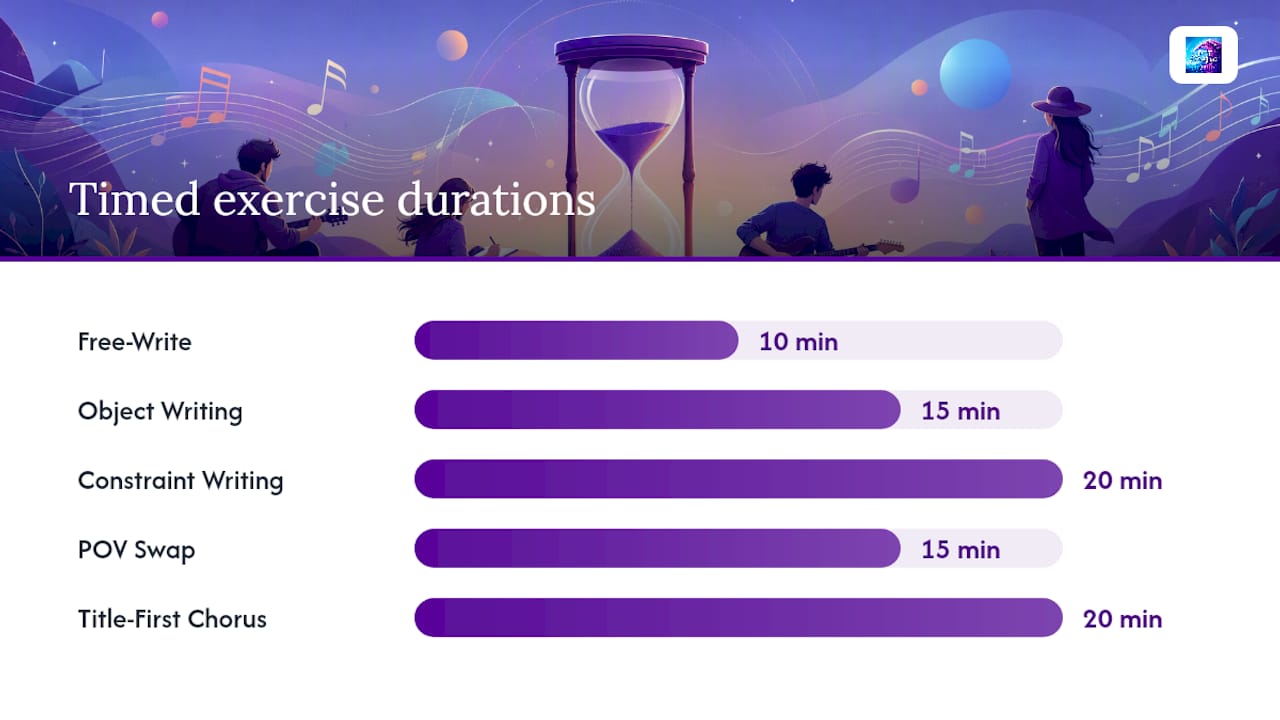
Five timed exercises that turn a prompt into a real lyric
Timed free-writes and constraint-based drills are among the most consistent ways to generate usable song material without overthinking. Each exercise below has a time, a sequence, and a clear output.
-
10-Minute Free-Write (10 minutes): Pick any prompt from this article. Set a timer. Write without stopping, without editing, without lifting your pen or pausing to reread. At the end, circle the three most specific or surprising lines. Those are your raw material.
-
Object Writing (15 minutes): Choose one object from a prompt (a voicemail, a photograph, a cup of coffee). Write about it using all five senses plus time and movement. The goal is not a lyric yet — it’s a bank of images you can pull from. Journaling and object writing are recommended sources of raw lyric material that can be adapted directly into song lines or hooks.
-
Constraint Writing (20 minutes): Take a prompt and add a rule: eight syllables per line, no adjectives, or only questions. Write a full verse under that constraint. The restriction forces your brain off autopilot and into territory it wouldn’t find on its own.
-
POV Swap (15 minutes): Write a verse from the prompt’s obvious perspective. Then rewrite it from the opposite point of view. Compare the two. The second version almost always has at least one line that’s stronger than anything in the first.
-
Title-First Chorus Drill (20 minutes): Take a prompt title (“I kept your voicemail for two years”) and write it as the last line of a chorus. Now write the three lines that lead up to it. Read it aloud. Sing it over a four-bar loop. Mark every line that feels singable and every word that feels forced.
Pro Tip: After any timed exercise, mark lines to keep with a star and lines to cut with a slash. Don’t rewrite yet. Let the draft rest for 20 minutes, then return with fresh ears.
How to move from a prompt to a finished song structure
A complete demo needs four things: a chorus hook under 10 words, at least one verse scene, one strong image, and breathing points for the singer. Practical lyric craft starts with a concrete moment, uses sensory imagery, and follows common song structures like verse, chorus, and bridge.
Here is how a single prompt seeds each song part:
Prompt: “I kept your voicemail for two years”
-
Chorus hook: “I kept your voicemail for two years / played it every time the silence got too loud”
-
Verse 1 scene: The moment of almost deleting it — the thumb hovering, the decision not to.
-
Verse 2 scene: A specific day when they played it — a hard morning, a quiet Sunday.
-
Bridge question: “What does it mean to hold on / when holding on is all you have left?”
Once you have that map, the revision checklist keeps you honest:
-
Prosody: Do stressed syllables land on the beat? Say the line aloud over the melody.
-
Show vs. tell: Replace “I was sad” with the action or object that caused the sadness.
-
Rhyme naturalness: If a rhyme forced a word you’d never say in conversation, cut it.
-
Melodic peaks: Your highest note should land on your most important word.
-
Breath points: Every four to six syllables, give the singer a natural place to breathe.
Short, practical instructions for using prompts right now
The fastest way to use any prompt is to treat it as a constraint, not a topic. A topic gives you too much room. A constraint gives you a direction.
Freewriting: Don’t edit while you write. The goal of a freewriting is volume, not quality. Write every line that comes, even the bad ones. The good lines hide inside the bad ones.
Constraints: Add a rule to any prompt. “Write only in questions.” “Use no rhymes.” “Every line must start with a verb.” Constraints narrow the field and produce lines you’d never find with an open brief.
POV shifts: If a prompt feels flat, change who’s speaking. Write it from a stranger’s view, from the future, or from the perspective of an object in the scene. The shift alone can unlock a chorus.
Quick exercises: Timed writing sprints build momentum precisely because they remove the option to overthink. Set 10 minutes. Write. Stop. That’s the whole exercise.
What a completed lyric from a prompt actually looks like
The prompt: “3 AM and the kitchen light is still on.”
Here is a short verse and chorus sketch built from that prompt using the title-first chorus drill and a POV anchored in the second person:
**Verse:**The dishes from dinner are still in the sink You’ve been standing there longer than you want to think The clock on the microwave blinks 3:04 You’re not sure what you’re waiting for
**Chorus:**3 AM and the kitchen light is still on You’re not lost, you’re just figuring out where you belong The night gets quiet when the noise finally clears And you find yourself right here
Notice what the prompt did: it gave a specific time, a specific room, and a specific image. The emotion (uncertainty, quiet resilience) arrived on its own once the scene was set. That is the whole argument for starting with a concrete moment rather than a feeling. The Poetry Foundation and Poets both offer deep resources on imagery and figurative language that lyricists can adapt directly from poetry craft into song lines.
How to beat writer’s block when prompts alone aren’t enough
Writer’s block is rarely about a lack of ideas. It’s usually about pressure, environment, or a habit of waiting for the “right” inspiration before starting.
Mindset shifts that actually work:
-
Lower the stakes. Tell yourself this draft is practice, not a finished song. Permission to write badly is the fastest way to write something real.
-
Maintain a running idea file — a song diary of hooks, titles, and short images. Professional writers don’t wait for inspiration; they mine their notes.
-
Separate the generating session from the editing session. Never edit while you’re generating. They use different parts of your brain.
Environment changes that shift your creative state:
-
Change rooms. A different physical space breaks the mental association with “stuck.”
-
Put on music that matches the emotional tone of the song you want to write. Music directly affects attention and emotional state, which means the right playlist is a genuine creative tool, not just background noise.
-
Write at a different time of day. Night writers sometimes unlock new material in the morning, and vice versa. For late-night sessions specifically, a curated playlist like the one at DRVVYN Sound’s late-night journaling collection can set exactly the right atmosphere for reflective writing.
How co-writing with prompts multiplies your output
Co-writing with prompts is one of the most underused tools in a songwriter’s practice. When two writers respond to the same prompt independently, you get two completely different emotional angles on the same idea — and the best lines from each version often combine into something neither writer would have found alone.
A simple co-write structure using prompts:
-
Both writers take the same prompt and free-write for 10 minutes separately.
-
Each reads their strongest three lines aloud.
-
Together, you pick the best chorus concept and the best verse image, regardless of who wrote them.
-
One writer drafts the verse, the other drafts the chorus. Swap and revise.
The prompt acts as a shared creative brief. It removes the awkward “what should we write about?” conversation and puts both writers in the same emotional territory immediately. For writers planning to release what they create, understanding how lyrical choices affect sync and licensing suitability is worth knowing early in the process.
How to bring your own life into any prompt
The most powerful lyric writing prompts are the ones you answer with something true. A prompt is a door. Your personal experience is what’s on the other side.
The technique is simple: take any prompt and ask, “When did I feel this?” or “Who do I know who lived this?” Then write that story, not the generic version of the prompt.
“I kept your voicemail for two years” becomes more powerful when it’s actually about the voicemail you kept. “3 AM and the kitchen light is still on” lands harder when it’s the specific kitchen you grew up in. Specificity is not self-indulgence. It’s the mechanism that makes a listener feel seen, because the more specific your truth, the more universal it becomes.
A useful practice: keep a mindfulness-informed listening journal where you note emotional responses to songs you hear. Those notes become raw material for prompts that are already personal before you even start writing.
Why prompts are really about building a creative practice
Here is the honest truth about lyric writing prompts: the prompt itself is almost never the point. What matters is the habit of showing up to write, even when the conditions aren’t perfect, even when the first draft is rough, even when you’re not sure the idea is good enough.
Every professional songwriter we admire has a version of the same story: they wrote hundreds of songs before they wrote the one that mattered. The prompts are the reps. The daily 10-minute free-write is the practice. The timed constraint drill is the training. And the imperfect draft you finish today is worth more than the perfect song you’re still planning to write someday.
At PTT Music, we believe creativity is a form of resilience. Writing through the block, shipping the imperfect draft, returning to the page the next day — these are not just songwriting habits. They are the same muscles that carry you through every hard thing in life. A prompt is just a reason to start. What you build from it is entirely yours.
Start with 10 minutes a day for 21 days. Pick one prompt from this article each morning. Write without editing. At the end of three weeks, you won’t just have new material. You’ll have a different relationship with your own creative voice.
PTT Music has the music and resources to fuel your writing sessions
Writers who pair focused prompt sessions with the right music produce more and edit less. PTT Music’s original music catalog is built to carry energy and purpose, making it a natural writing companion whether you need something uplifting for a motivational lyric session or something reflective for a late-night story song.

The PTT Music podcast covers creativity, resilience, and personal growth in a format that fits between writing sessions — practical conversations that keep your mindset sharp and your creative momentum alive. Stream PTT Music on Spotify, Apple Music, YouTube Music, and over 150 other platforms. When you’re ready to take your prompt-based songs further, Music PR for Artists: Your Practical Release Playbook offers a clear next step for releasing and promoting what you create. Visit https://pttmusic.com to explore the full catalog, podcast, and community.
Sources
- How to Write Song Lyrics: Step-by-Step for Beginners | Song Cage