
When anger spikes, the single most effective move is to physically remove yourself, take slow, deep breaths with a longer exhale than inhale, and give your nervous system time to reset before you say or do anything else. That one sequence, practiced consistently, is the foundation of every evidence-based anger management approach.
Here is what to do in the next 60–90 seconds if you feel anger rising right now:
- Step away physically. Say calmly, “I need a few minutes,” and move to a different room or step outside. No explanation needed.
- Breathe with your diaphragm. Inhale slowly, exhale for a longer duration. Repeat the cycle multiple times. The longer exhale activates your parasympathetic nervous system and slows your heart rate.
- Shift one thought. Replace “This is completely unfair” with “I’m frustrated, and I can handle this once I’m calm.”
Once your heart rate settles, you can return, communicate clearly, and work toward a real solution. The rest of this guide shows you exactly how to do each step well.
Table of Contents
- What can you do right now to manage anger in the moment?
- How do you communicate effectively once you’ve calmed down?
- How do you spot anger triggers before they escalate?
- What long-term habits actually lower your baseline anger?
- When does anger need professional help?
- Can music and podcasts actually help you regulate anger?
- Key Takeaways
- Anger is a skill, not a sentence
- PTT Music helps you build a calming daily practice
- Useful sources and further reading
What can you do right now to manage anger in the moment?
Anger is not a character flaw. It is a physiological alarm system, and according to the APA, the goal is not to eliminate it but to shift from impulsive reaction to a purposeful, regulated response. The problem is that once your heart rate climbs past a certain threshold, the prefrontal cortex, the part of your brain responsible for rational thinking, goes partly offline. Physical regulation is the only reliable way to bring it back.

The diaphragmatic breathing protocol
This method works because it directly slows your heart rate through the vagus nerve. You do not need a quiet room or a meditation cushion.
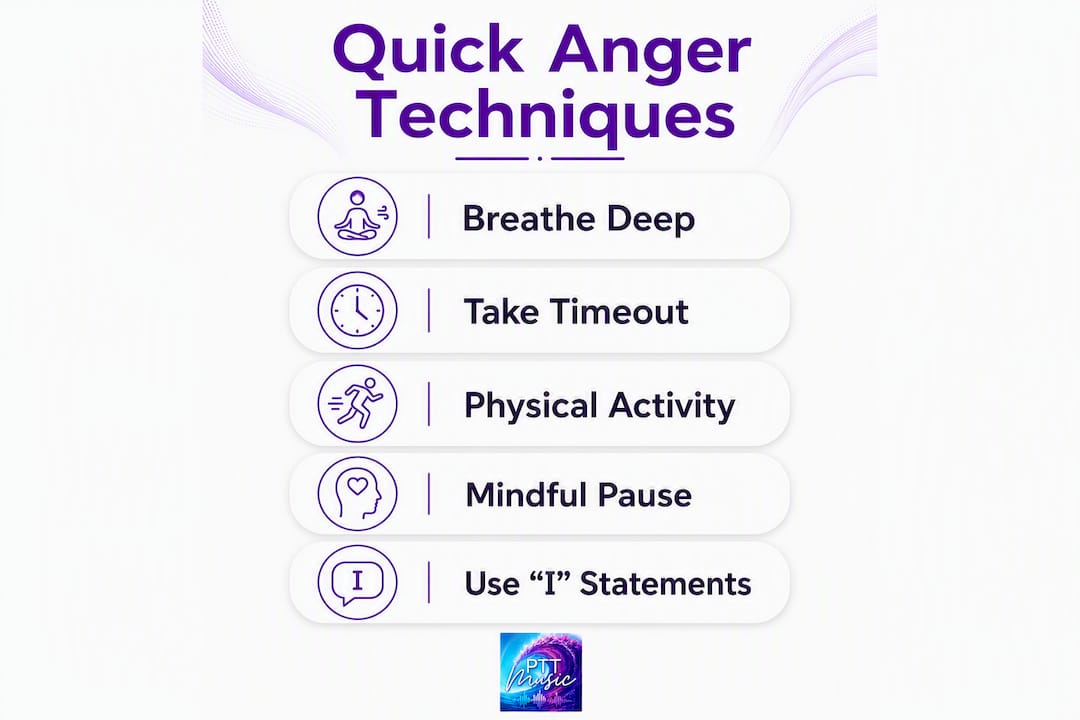
Sit or stand with your feet flat on the floor. Place one hand on your belly. Breathe in through your nose for 4 counts, feeling your belly push outward. Exhale slowly through your mouth for 6–8 counts. Repeat this six times. The exhale-longer-than-inhale ratio is the active ingredient. MedlinePlus notes that a timeout combined with diaphragmatic breathing restores physiological baseline and enables logical responding.
The timeout script and physical reset
Knowing what to say when you need space prevents the exit from feeling like abandonment or aggression. Try: “I’m getting overwhelmed. I’m going to take 20 minutes and come back to this.” Keep your voice level. Then actually leave.
During the timeout, move your body. A brisk 5-minute walk, a set of jumping jacks, or even shaking out your hands releases the physical tension that anger builds up in your muscles. These are not distractions; they are physiological tools. The Mayo Clinic recommends exercise, timeouts, and deliberate breathing as foundational anger management techniques precisely because they work at the body level before the mind can catch up.
When to remove yourself vs. regulate in place
If you are in a meeting, a car, or a public setting where leaving is not possible, use in-place regulation: slow your breathing, drop your shoulders, and focus on a neutral object for 30 seconds. Save the full timeout for situations where leaving is safe and appropriate. The rule of thumb is simple: if you feel the urge to raise your voice or say something you will regret, that is a signal to step away.
Pro Tip: Clinicians sometimes recommend a multi-sensory anchor as a rapid regulation shortcut. Press your feet firmly into the floor, name five things you can see, and take one slow breath. This grounds you in the present moment and interrupts the anger spiral before it peaks, often in under 30 seconds.
How do you communicate effectively once you’ve calmed down?
Returning to a difficult conversation too soon is one of the most common mistakes people make. The APA is clear that aggressively expressing anger tends to intensify it rather than relieve it. Assertive, respectful expression is the healthier and more effective path.
Check your baseline first
Before you re-engage, run a quick internal check. Is your heart rate back to normal? Can you think about the situation without your jaw tightening? If yes, you are ready. If not, extend the timeout.
“I” statements and repair language
“I” statements keep the focus on your experience rather than the other person’s behavior, which dramatically reduces defensiveness. Here is a short example of how a conversation can shift:
Escalation: “You never listen to me. You always do this.” Timeout: “I need 20 minutes. I’ll be back.” Calm response: “I felt dismissed when the conversation moved on before I finished. I’d like to revisit it.”
The structure is simple: “I felt [emotion] when [specific event]. I’d like [specific outcome].” Practice it regularly to build skill.
What to do and what to avoid
- Do: Use a calm, even tone. Name the specific behavior, not the person’s character. Ask questions to understand their perspective.
- Do: Propose a concrete next step, such as scheduling a follow-up conversation or agreeing on a boundary.
- Avoid: “You always” and “you never” language. These phrases trigger defensiveness and rarely reflect reality.
- Avoid: Bringing up unrelated past grievances. One issue at a time.
- Avoid: Sarcasm, eye-rolling, or dismissive body language, even when you feel justified.
Once communication is open, convert the conflict into a solvable problem. Identify the specific, concrete issue. Brainstorm two or three realistic fixes. Agree on one to try. Schedule a check-in to see if it worked. This structured approach keeps the conversation productive rather than circular.
How do you spot anger triggers before they escalate?
Intervening early is far more effective than trying to regulate at peak arousal. NHS Inform emphasizes that complex cognitive strategies rarely work once you are fully escalated, which is why catching yourself in the “yellow zone” is the skill that changes everything.
Yellow zone vs. red zone
Yellow zone (early warning): Jaw tightening, shoulders rising, faster breathing, a sense of heat in your chest, irritability, short responses, or the urge to pace. This is your window to intervene.
Red zone (peak arousal): Tunnel vision, raised voice, shaking hands, the impulse to say something destructive, or feeling out of control. At this point, physical regulation is your only option.
The 3 R’s framework, drawn from Mayo Clinic guidance, gives you a clear sequence:
- Recognize the early signs (yellow zone checklist above).
- Regulate with an immediate physical technique (breathing, timeout, movement).
- Respond assertively and clearly once calm.
Cognitive traps that fuel the fire
The APA identifies “always,” “never,” and “should” thinking as the most common cognitive patterns that amplify anger. “He always does this.” “She should know better.” These all-or-nothing thoughts feel true in the moment but are almost never accurate, and they make the emotion more intense than the situation warrants.
Anger often masks fear or a sense of perceived threat. Recognizing that the feeling is a signal, not a verdict, shifts your response from reactive to problem-solving. Ask yourself: “What am I actually afraid of losing here?” That one question can reframe an entire conflict.
To build this awareness daily, try a 2-minute evening reflection: What triggered me today? What thought was underneath it? What would a more balanced version of that thought sound like? A journal works well for this, but even a mental review before sleep builds the pattern-recognition skill over time.
What long-term habits actually lower your baseline anger?
Immediate techniques manage the moment. Sustainable habits raise your threshold so the moments happen less often. Think of your anger tolerance as a reservoir: lifestyle factors either fill it or drain it.
Mayo Clinic research is consistent on this point: regular exercise, adequate sleep, and active stress management raise the “boiling point,” making outbursts less likely. Poor sleep alone can cut your emotional resilience significantly, even after a single bad night.
Here is a practical weekly template you can build into a busy schedule:
- Daily (5–10 minutes): Diaphragmatic breathing practice, morning or evening. This trains the nervous system response so it becomes automatic under stress.
- Three times per week (20–30 minutes): Aerobic exercise, walking, running, cycling, or dancing. Physical movement metabolizes stress hormones and improves mood regulation.
- Weekly (15–20 minutes): CBT-style thought record. Write down a triggering situation, the automatic thought, the emotion and its intensity, and a more balanced alternative thought. Over 8–12 weeks, this practice measurably shifts habitual thinking patterns.
- Weekly (10–15 minutes): Assertiveness practice. Role-play a difficult conversation with a trusted person, or write out how you would handle a recurring trigger using “I” statements.
- Daily (10–15 minutes): A creative outlet, whether music, writing, drawing, or rhythmic movement. NHS Inform identifies creative outlets as effective tools for nervous system regulation and for preventing the simmering resentment that builds toward outbursts.
Context-specific prevention: In the workplace, build in a 2-minute buffer between back-to-back meetings. In parenting, agree on a family “pause signal” so everyone knows a timeout is happening, not an abandonment. In relationships, schedule a weekly 15-minute check-in to address small frustrations before they compound.
Realistic timeline: most people notice meaningful shifts in their reactivity within 4–6 weeks of consistent practice. Structured programs using CBT techniques typically show measurable change over a period of a few months.
When does anger need professional help?
Some anger patterns go beyond what self-help strategies can address alone, and recognizing that line is a strength, not a failure.
Seek professional support if you notice any of the following:
- Anger leads to physical aggression or threats, even if no one is physically harmed.
- You have experienced legal consequences related to anger (road rage incidents, workplace complaints, restraining orders).
- Relationships, employment, or your own mental health are being seriously damaged by recurring outbursts.
- You feel unable to control your anger despite genuine effort.
- Johns Hopkins Medicine is direct: if you believe you might become physically or emotionally violent, remove yourself from the situation and seek immediate professional help.
Treatment options compared
| Format | Typical Duration | What It Targets |
|---|---|---|
| Individual CBT | 8–10 sessions | Thought patterns, triggers, coping skills |
| Group anger management program | 8–12 weeks | Social skills, peer accountability, structured practice |
| Medication (when indicated) | Ongoing, psychiatrist-managed | Underlying conditions (depression, anxiety, ADHD) that amplify anger |
| Crisis services (Lifeline, local ER) | Immediate | Safety stabilization |
| Telehealth therapy | Flexible, ongoing | Access, convenience, same evidence base as in-person |
The APA notes that structured programs can move a highly reactive person toward a more regulated middle range in about 8–10 weeks using targeted CBT techniques. That is a realistic, achievable timeline for most people who engage consistently.
Cost in the U.S.: Individual therapy typically runs $100–$200 per session without insurance, though many therapists offer sliding-scale fees. Community mental health centers often provide group programs at low or no cost. Telehealth platforms have expanded access significantly, with some sessions available for under $100. Psychology Today’s therapist finder and SAMHSA’s National Helpline (1-800-662-4357) are practical starting points for finding a provider. When evaluating a therapist, look for credentials in CBT, dialectical behavior therapy (DBT), or anger management specifically.
This article provides general information, not professional medical or mental health advice. If you are experiencing severe or persistent anger issues, please consult a qualified mental health professional or contact a crisis service.
Can music and podcasts actually help you regulate anger?
The short answer is yes, and the mechanism is physiological, not just motivational. Music with a predictable rhythm and controlled tempo can entrain your breathing and heart rate, making it a practical, evidence-aligned complement to the breathing and timeout work described earlier in this guide. NHS Inform supports creative outlets, including music, as effective tools for nervous system regulation.
Here is how to use music and short podcast episodes as part of your regulation toolkit:
- During a timeout: Choose instrumental or low-tempo music (60–80 BPM) and pair it with your diaphragmatic breathing. Listen for 10–15 minutes. The rhythm gives your breath a natural anchor, which makes the breathing protocol easier to sustain.
- As a daily practice: A 3-minute motivational track in the morning sets a positive emotional baseline before the day’s stressors arrive. Think of it as a pre-emptive regulation tool.
- Short podcast episodes (3–10 minutes): A brief guided episode focused on mindset or emotional resilience works well as a mid-day reset, especially on high-stress days. The structured format keeps your attention without demanding much cognitive effort. For ideas on how short guided audio formats can be structured effectively, the Forge Fast Method’s stress management guide offers useful context on nervous-system regulation through audio-based practices.
- For daily habit-building: Pair a 10-minute podcast episode with your weekly CBT thought record or your evening reflection. The combination of guided audio and written reflection reinforces the skill faster than either alone.
PTT Music’s catalog of original music and motivational episodes is built specifically for this kind of purposeful listening. These are not background tracks; they carry energy and intention designed to move you forward. Whether you are working through a difficult moment or building a daily regulation habit, music that carries real purpose makes the practice feel less like discipline and more like something you actually want to return to.
Key Takeaways
Managing anger effectively requires immediate physical regulation first, followed by calm communication, consistent daily habits, and professional support when the pattern exceeds what self-help can address.
| Point | Details |
|---|---|
| Regulate the body first | A 15–30 minute timeout with diaphragmatic breathing restores your thinking brain before any conversation. |
| Use the 3 R’s | Recognize early warning signs, Regulate with physical techniques, then Respond assertively once calm. |
| Replace cognitive traps | Swap “always/never/should” thoughts with balanced alternatives to reduce emotional intensity. |
| Build weekly habits | Daily breathing, aerobic exercise multiple times per week, and CBT thought records produce measurable change within several weeks. |
| PTT Music as a daily tool | Purposeful music and short motivational episodes from PTT Music support nervous-system regulation as a practical adjunct to your anger coping skills. |
Anger is a skill, not a sentence
Here is something worth sitting with: most people who struggle with anger are not “angry people.” They are people who were never taught the specific skills to regulate a powerful emotion. That distinction matters because skills can be learned at any age, and the research behind this guide, from the APA, Mayo Clinic, Johns Hopkins, and NHS Inform, consistently shows that structured practice produces real, lasting change.
The conventional wisdom says to “just calm down” or “count to ten.” That advice is not wrong, but it is incomplete. What actually works is a layered approach: physical regulation first, cognitive reframing second, and consistent lifestyle habits third. The breathing protocol in this guide is not a trick; it is a physiological intervention. The “I” statements are not just polite language; they are a communication structure that prevents re-escalation. And the weekly practice template is not optional maintenance; it is how the nervous system learns a new default.
We believe at PTT Music that resilience is built one small, consistent action at a time. You do not need a perfect day to practice. You need three minutes, a breath, and the willingness to try again. Start there.
PTT Music helps you build a calming daily practice

Anger regulation is most effective when it becomes a daily habit, not just a crisis response. PTT Music offers original music and short motivational podcast episodes designed to support exactly that kind of consistent, purposeful practice. Where a therapy session addresses the deep work, a 3-minute track or a focused episode gives you something real to reach for in the ordinary moments of a hard day.
The music in PTT Music’s catalog is built to carry energy and intention, not just fill space. Pair a track with your morning breathing practice, use an episode as a mid-day reset, or let a purposeful playlist anchor your timeout. Every piece of content is created to move you forward with clarity and confidence.
Listen to the PTT Music catalog and find the track or episode that fits where you are today. Your next 3-minute practice is ready when you are.
Useful sources and further reading
The guidance in this article draws from the following authoritative sources. Each one offers practical, clinically grounded information you can return to as your practice develops.
- Anger management: 10 tips to tame your temper — Mayo Clinic: Foundational practical tips including timeouts, exercise, “I” statements, and the role of lifestyle in raising your anger threshold.
- Control anger before it controls you — APA: The APA’s clinical framework covering cognitive traps, assertive expression, and realistic timelines for structured programs.
- Learn to manage your anger — MedlinePlus: Clear, accessible guidance on timeout duration, diaphragmatic breathing, and the physiology-to-behavior rationale.
- How to control your temper — Johns Hopkins Medicine: Safety-first guidance on escalation and when to seek immediate professional help.
- Get help with anger — NHS — Accessible overview of self-help strategies and when to seek professional support.
- Anger — CDC How Right Now: A supportive, accessible resource on coping with anger, particularly during periods of heightened stress.
The most powerful thing you can do with this guide is act on one technique today. Not all of them. One. The breathing protocol takes three minutes. The evening reflection takes two. Consistent small actions, repeated over weeks, are what actually rewire a habitual anger response. That is not motivational language; it is what the clinical evidence shows.