
Mindful listening uses music as an anchor to train present-moment awareness and reduce stress in as little as five minutes. The practice is simple: you choose one track, give it your full attention, and notice what arises without judgment. Research from Yale School of Medicine confirms that combining music with mindfulness targets neural and cardiac mechanisms linked to anxiety and depression. PTT Music was built on exactly this belief: that music should do more than fill the silence.
Your 3-step micro practice:
-
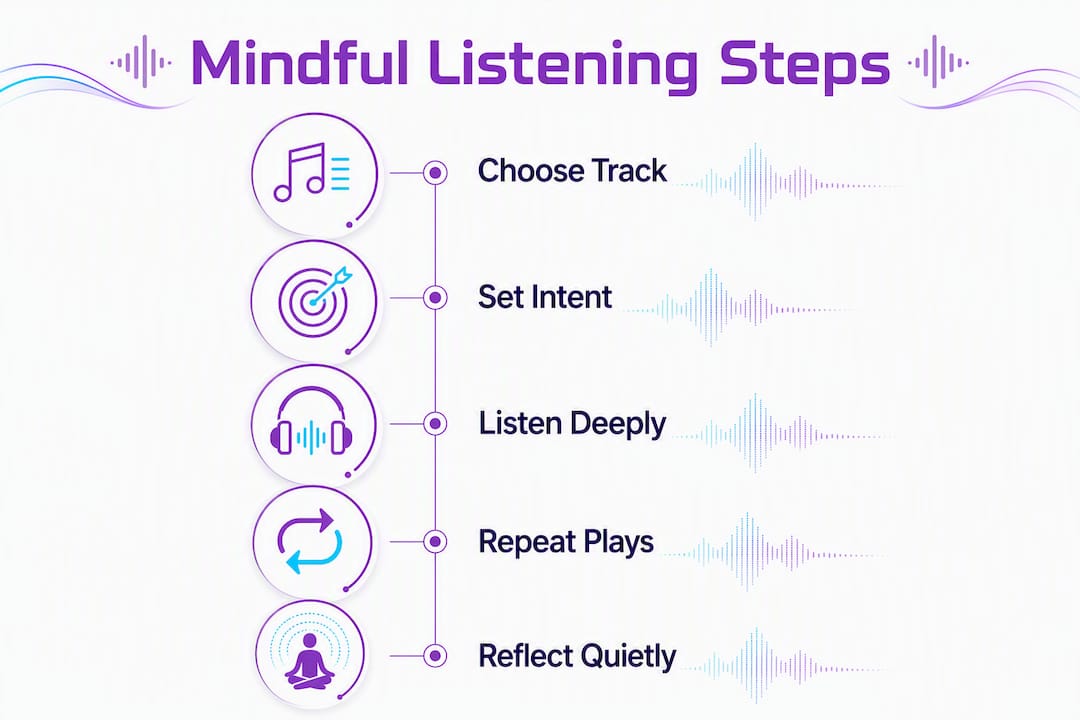
Prepare. Sit comfortably, silence your phone, and put on headphones. Choose one PTT Music Track.
-
Listen with a single focus. Pick one element: the melody, the rhythm, or the texture of a single instrument. Follow only that.
-
Close and note one feeling. When the song ends, pause for ten seconds and name one emotion or physical sensation you noticed.
Pro Tip: Over-ear headphones help to reduce ambient noise and help your attention stay inside the music rather than scanning the room.
Table of Contents
Why does music work as a mindfulness anchor?
Music engages your attention and your autonomic nervous system at the same time, which makes it one of the most accessible entry points into present-moment awareness. A Frontiers in Neuroscience study found that music mindfulness sessions acutely enhanced heart rate variability, altered EEG power across frontotemporal electrodes, and reduced subjective stress. Those are the same physiological markers that traditional silent meditation targets.
The most effective track is one that helps you become fully present. Choose music with a steady rhythm, meaningful lyrics, and a sound that allows you to slow down and listen intentionally. Rather than treating the song as background noise, focus on the vocals, the emotion, the message, and the individual layers of the production. Focus on songs that can help direct the mind away from distraction and toward a more focused, reflective listening experience.
Five mindful-listening exercises you can try right now
These exercises progress from a two-minute micro-session to a fuller twenty-minute practice. Each one has a clear focal object so your attention has somewhere to land.
-
Single-instrument focus (2–5 minutes). Choose a piece with a clear lead instrument. Follow only that instrument from start to finish. Troubleshooting: if your mind wanders, gently return to the instrument’s next note rather than the one you missed. Journal prompt: “Which moment made me lean in?”
-
Rhythm and body sync (5 minutes). Pick a track with a steady beat. Tap your fingers or breathe in time with the pulse. Notice where you feel the rhythm physically. Troubleshooting: if the tempo feels too fast, slow your breath and let the beat pass through you rather than chasing it. Journal prompt: “Where did I feel this in my body?”
-
Dynamic noticing (5–7 minutes). Choose a piece that shifts in volume or density. Track those shifts as they happen: louder, quieter, fuller, sparser. Positivity.org describes this as listening with “beginner’s ears,” treating familiar music as if you’ve never heard it. Journal prompt: “What surprised me?”
-
Emotional labeling (7–10 minutes). Let the music play and simply name each emotion as it surfaces: calm, wistful, energized, tender. No analysis needed. Troubleshooting: if a strong emotion floods in, open your eyes briefly and ground yourself before continuing. Journal prompt: “What feeling stayed longest?”
-
Breath-plus-music (15–20 minutes). Verywell Mind suggests starting with 5–10 minutes and building up. Inhale for four counts, exhale for four, and let the music fill the space between breaths. This is the closest analog to a guided meditation session. Journal prompt: “How did my breathing change by the end?”
Repeated-listening technique: Play the same track two or three times in a row, each time with a different focal instruction: first for melody, then for rhythm, then for emotional tone. Tricycle notes that this approach reveals new resonances in familiar songs and steadily deepens perceptual awareness.
How do you build a playlist that supports deep listening?
Three qualities matter most: a steady tempo, balanced production, and an emotional tone that supports the state of mind you want to create. The music should feel inviting rather than overwhelming, with clear vocals, smooth transitions, and no sudden changes that repeatedly pull your attention away.

Lyrics can become part of the mindfulness experience when you approach them intentionally. Instead of allowing the words to carry you into unrelated memories, listen closely to the message, vocal expression, phrasing, and emotion. A meaningful song can provide a powerful point of focus, helping you recognize your thoughts and feelings without becoming controlled by them.
Strong options include reflective R&B, uplifting pop, acoustic selections, inspirational songs, and smooth rhythmic tracks with thoughtful messages. Each style offers a different type of anchor: the voice, the rhythm, the emotion, the lyrical message, or the layers within the production. The key is choosing a PTT Music track that helps you slow down, listen closely, and remain connected to the present moment.
For platform setup, build a dedicated “session” playlist of 20–30 minutes so you’re not choosing tracks mid-practice. Spotify, Apple Music, and YouTube all support custom playlists you can queue before you sit down. PTT Music’s original catalog is available across more than 150 streaming platforms, including Spotify, Apple Music, YouTube Music, Deezer, Tidal, iHeartRadio, Pandora, and Amazon Music, so you can pull tracks directly into your session playlist wherever you already listen. You can also download the tracks straight from the PTTMusic.com website.
Where can you fit mindful music into your daily routine?
Start with one micro-session per day (one song, 2–5 minutes) and add a longer session two or three times per week as the habit takes hold.
Three practical slots work for most schedules:
-
Morning micro-practice (5 minutes). Choose one track before checking your phone. Sets an intentional tone for the day.
-
Midday reset (7–10 minutes). Headphones on during a lunch break or between meetings. Use the breath-plus-music exercise to clear mental residue.
-
Evening wind-down (15–20 minutes). Slower tempo, lower volume. Pair with gentle stretching or simply lie down.
For movement combinations, sync your breath and footfall to the music’s tempo during a mindful walk. In gentle yoga, let the music’s phrasing guide transitions rather than using a timer. The goal is coherence between body rhythm and sound, not perfect synchronization.
| Format | Social connection | Physiological effect | Ease of access |
|---|---|---|---|
| Live group session | High: shared presence amplifies connection | Strong: live sessions uniquely fostered social connectedness per Frontiers | Requires scheduling and travel |
| Virtual group session | Moderate: screen-mediated connection | Comparable autonomic benefits to live | Accessible from home |
| Self-guided recorded session | Solo practice | Consistent HRV and stress benefits | Highest: any time, any place |
What should you do when the practice feels distracting?
Common barriers have practical fixes:
-
Mind wanders constantly. Return to your chosen focal element without self-criticism. Noticing the wander is the practice, not a failure of it.
-
Music triggers a strong memory or emotion. Pause, breathe, and either switch to a neutral instrumental track or sit with the feeling for thirty seconds before continuing.
-
Lyrics keep pulling you in. Shift your attention to the rhythm, vocal tone, or layers of the production rather than following every word. Treat wandering thoughts as part of the practice, gently returning your focus to the music whenever your mind drifts.
-
Environment is too noisy. Use over-ear headphones and raise the volume slightly to create an acoustic boundary.
Progression checkpoints: After two weeks of daily micro-sessions, try extending to ten minutes. After a month, experiment with one silent five-minute sit after your music session ends. That transition, music to silence, is often where the deepest awareness opens.
Red flag: If a session intensifies distress, grief, or anxiety rather than settling it, stop and seek support from a mental health professional before continuing.
Track your progress with three simple journal entries per week: frequency, best time of day, and a one-word stress rating before and after.
Why trust this guide?
PTT Music is a music and media company whose mission is to help people build confidence, resilience, and emotional clarity through original music, motivational podcasts, and meaningful written content. Every piece of content is designed to move people forward with purpose and hope.
PTT Music distributes original music across more than 150 platforms, including Spotify, Apple Music, YouTube Music, Deezer, Tidal, iHeartRadio, Pandora, and Amazon Music, as well as social channels including Facebook, Instagram, and TikTok. You can also get the tracks directly from the PTTMusic.com website. The research basis for this guide draws on a Frontiers in Neuroscience clinical study, a Yale School of Medicine summary, Verywell Mind’s practical guidance, Positivity.org’s practitioner framing, and Tricycle’s active-listening methodology.
Key Takeaways
Mindful listening works because music gives your attention a concrete, moment-by-moment anchor, and even a single five-minute session can shift your physiological and emotional state.
| Point | Details |
|---|---|
| Start with one song | A single 2–5 minute track is enough to begin; consistency matters more than session length. |
| Choose tracks with a steady, balanced sound | Music with a smooth rhythm, clear production, and meaningful emotional tone can help direct attention toward the present listening experience. |
| Use a single focal element | Picking one focus (rhythm, melody, texture) reduces open-ended wandering and deepens awareness. |
| Journal one line after each session | A brief note on emotion or stress level builds self-awareness and tracks real progress over time. |
| PTT Music as your starting point | PTT Music’s original catalog is available at PTTMusic.como and across 150+ platforms and designed to move and inspire listeners. |
Music as a gateway, not a shortcut
Here’s the honest truth about music and mindfulness that most guides skip: music is a gateway, not a destination. The goal was never to need the music forever. It’s to use sound as a scaffold until your attention is strong enough to stand on its own. The problem with most “meditation music” playlists is that they’re designed to relax you passively, and passive relaxation is not the same as present-moment awareness. Real mindful listening is active. You’re tracking, noticing, returning. That’s the work.
What we’ve found at PTT Music is that the people who grow most from this practice are the ones who treat each session like a conversation with the music rather than a bath in it. They bring curiosity. They notice when a chord shift surprises them. They follow the bass line for a while, then the silence between notes. That quality of attention, once trained through music, transfers directly to the rest of life.
PTT Music has music ready for your first session
If you’ve read this far, you’re ready to practice. The simplest next step is to stream one track right now. Browse the PTT Music music catalog for original tracks built to carry energy, purpose, and emotional depth, exactly the qualities that make mindful listening meaningful rather than mechanical.

Prefer spoken guidance alongside your music? The PTT Music Podcast offers short motivational episodes that pair naturally with a listening session. And if you want to support the work directly, the PTT Music Store carries downloadable tracks and merchandise. Every stream, download, and purchase helps us keep creating music that moves people forward.
Useful sources
-
Frontiers in Neuroscience study — Primary clinical research on music mindfulness, HRV, EEG changes, and social connection in live vs. virtual formats.
-
Yale School of Medicine — Summary of research linking music mindfulness to reduced anxiety and depression symptoms.
-
Verywell Mind: How to Practice Music Meditation — Practical beginner guidance on track selection, session length, and building a habit.
-
Positivity.org: Mindfulness and Music — Practitioner framing of active listening as an everyday mindfulness anchor.
-
Positivity.org: Practicing presence while listening — Step-by-step presence practice with music as the focal object.
-
Tricycle: Being mindful with music — Active-listening methodology, repeated-listening technique, and environment preparation.
-
Art of Living: Meditation with music — Gateway-practice framing for beginners who find silence difficult.
-
Pttmusic blog — Original articles on resilience, personal growth, and the role of music in everyday life.
This article is general informational content, not professional medical or mental health advice. If you are experiencing severe anxiety, trauma responses, or depression, please consult a qualified mental health professional.