
You can overcome procrastination today by picking one tiny starter, writing a simple if-then plan, and treating your next slip with self-compassion instead of shame. That’s the whole playbook in one sentence, and every tactic below builds on those three moves. None of this requires a personality overhaul or a flood of willpower you don’t currently have.
Here’s the starter script, ready to copy right now:
- Pick a micro-starter: open the document, notebook, or app and commit to just two minutes.
- Write an if-then plan: “At [time], in [place], I will [tiny action] for [duration].”
- Prepare your recovery line: “I skipped it yesterday. That’s normal. I’m starting again now.”
Try this exact version today: “At 3:10 PM, at my desk, I will open the report and write for ten minutes.” That’s it. Ten minutes of motion beats another day of staring at the task.
Pro Tip: Set a timer for two minutes before you even read further. Open the task, do something small, and finish this article after. Momentum built now teaches your brain more than any tip you read next.
Key Takeaways
Overcoming procrastination works best when you combine a tiny physical starter, a pre-decided if-then plan, and a self-compassion response to lapses, rather than relying on motivation or willpower alone.
| Point | Details |
|---|---|
| Start smaller than feels necessary | Use the Minute Rule, 2-minute rule, or 5-4-3-2-1 to make the first move nearly effortless. |
| Pre-decide your action | Write an if-then plan so you don’t have to choose in the moment when resistance is highest. |
| Match your timing system to the task | Use Pomodoro (25/5) for dreaded work and longer blocks (90/20) for deep focus sessions. |
| Treat lapses with self-compassion | Forgive a missed session quickly to avoid the shame spiral that fuels the next round of avoidance. |
| Use music as an optional cue | A short PTT Music track or podcast clip can serve as a start signal or reward, never a requirement. |
Table of Contents
- Quick Starters That Break Through Procrastination Fast
- Which Time-Management System Fits Your Task?
- How to Break a Big Project Into a Next Step
- Small Environment Changes That Remove Friction
- Why Emotions, Not Laziness, Drive Procrastination
- Turning One Good Session Into a Lasting Habit
- What the Research Actually Shows
- Why People Procrastinate in the First Place
- Frequently Asked Questions
- Sources
Quick Starters That Break Through Procrastination Fast
When a task feels heavy, your goal isn’t to feel motivated. It’s to make starting so small that resistance has nothing to grab onto. Three tactics do this well, each suited to a different kind of stuck.
The Minute Rule, sometimes called a gateway habit, asks you to commit to just sixty seconds of a task. Cleveland Clinic’s guidance on procrastination points out that lowering the threshold to start is often more useful than trying to finish. The 2-minute rule works the same way for anything that would take under two minutes total: reply to the email, put dishes away, schedule the appointment. Do it immediately rather than adding it to a list you’ll dread later.

The 5-4-3-2-1 rule solves a different problem: overthinking before you move. Count backward from five, and on “one,” physically start, before your brain can talk you out of it.
Three scripts to copy:
- “5-4-3-2-1, open the laptop, start typing.”
- “At 9:00 AM, at my kitchen table, I will write one paragraph of the report.”
- “Two-minute rule: reply to this message now, no drafting it for later.”
A gateway habit works best paired with a reward. Open the guitar case (gateway), play for two minutes, then let yourself put on your favorite playlist as the cue that you followed through.
Which Time-Management System Fits Your Task?
Once you’re moving, the next question is how to structure the work so procrastination doesn’t creep back in mid-session. Two systems cover most situations.
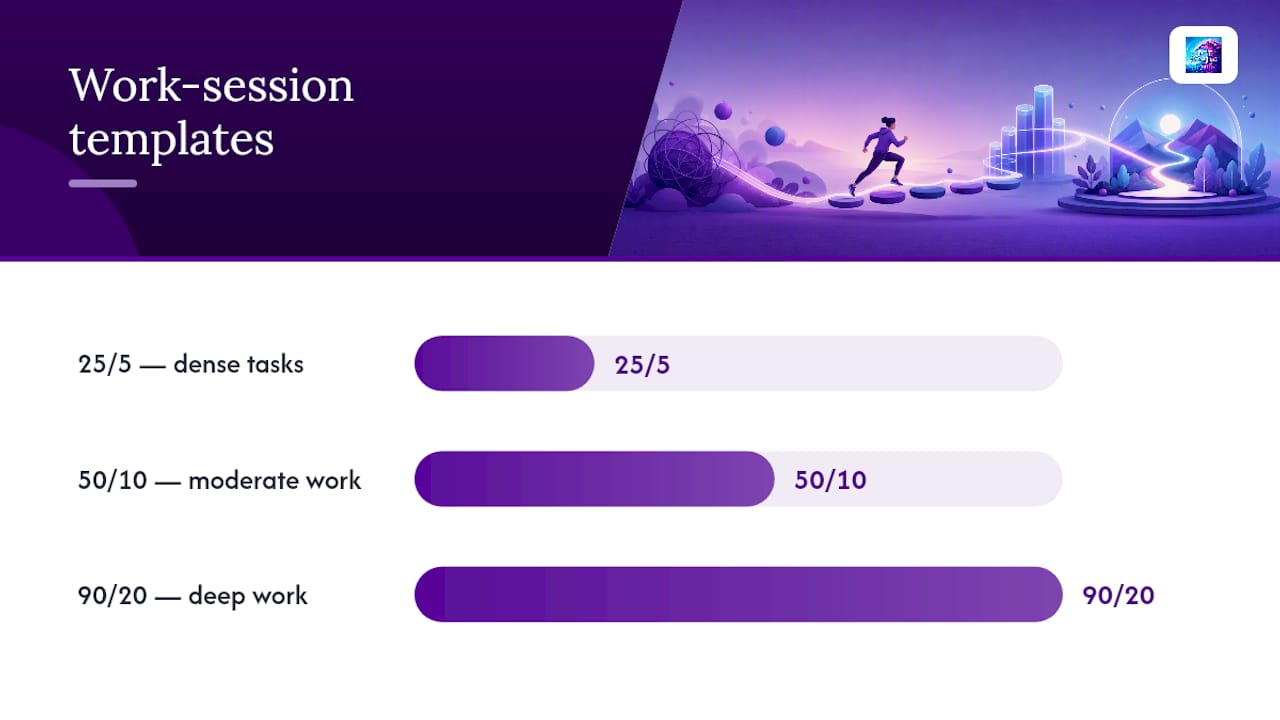
Pomodoro breaks work into short, timed sprints, typically 25 minutes on, 5 minutes off. It’s built for high-distraction tasks, tasks you dread, or days when focus feels shaky. Time-blocking reserves longer chunks of your calendar for a single project, which works better for deep, complex work that loses momentum with frequent interruptions.
Templates worth trying:
- 25/5 for dense or unpleasant tasks (emails, admin, tasks you’re avoiding)
- 50/10 for moderate focus work (writing, planning, review sessions)
- 90/20 for deep work requiring sustained concentration (creative projects, strategy, learning)
Before you close any block, define what “done” looks like in one sentence: “This block ends when the outline has five bullet points” or “This block ends when I’ve replied to ten emails.” Without that line, blocks blur into open-ended dread.
Choose based on energy, not ambition. Low energy and a hard task call for 25/5. High energy and a task you enjoy call for 90/20.
How to Break a Big Project Into a Next Step
Most procrastination isn’t laziness. It’s vagueness. “Write the paper” has no obvious entry point, so your brain avoids it entirely. The fix is turning one big blob of a task into a chain of small, specific actions.
Here’s how that looks for a 10-page paper:
- Choose a topic (15 minutes, no research yet).
- Draft a rough three-point outline (20 minutes).
- Research one section for 30 minutes, timer on.
- Write a single rough paragraph, no editing.
- Repeat for the next section.
Implementation intentions make each step automatic instead of optional. The University of Virginia’s guidance on procrastination notes that removing the moment-to-moment choice by pre-deciding when and where you’ll work reduces the openings where avoidance sneaks in. The template: “If [situation], then I will [specific action].”
Two filled examples:
- Work: “If it’s 8:30 AM and I’ve had coffee, then I will open the project file and answer one client email.”
- Study: “If I sit down at the library table, then I will read one section and write three notes.”
Keep a short checklist nearby so you’re not making decisions mid-session: task name, next physical action, and stop time.
Small Environment Changes That Remove Friction
Your surroundings either help you start or quietly talk you out of it. A cluttered desktop, a phone within reach, and fifteen open tabs all add tiny decisions your brain has to fight before the real work even begins.
Try these edits before your next session:
- Pre-open the document or file you need, the night before if possible.
- Put your phone in another room, not just face down.
- Close every browser tab unrelated to the task.
- Keep a physical checklist or sticky note with just the next step written on it.
Generic tools help too: a basic kitchen timer, a website blocker, or a simple habit-tracking app can all reduce the mental math of staying on task. Environment design that lowers friction for the task you want and raises it for distractions gives your brain fewer reasons to bail, a point backed by research on behavior change and environment.
Pro Tip: Build a two-minute “start ritual” the night before: lay out what you need, close distracting apps, and write tomorrow’s if-then plan on a sticky note where you’ll see it first thing.
Why Emotions, Not Laziness, Drive Procrastination
Procrastination usually isn’t about time management. It’s about emotional avoidance. When a task triggers anxiety, self-doubt, or the fear of doing it imperfectly, your brain’s threat response can override your intentions, favoring short-term relief over long-term progress. Researchers describe this as an emotional regulation problem more than a willpower failure, which is why pushing harder rarely works and gentler, more strategic approaches often do.

Try this three-minute mindfulness check before starting a dreaded task: sit for a moment, notice where tension sits in your body without judging it, breathe slowly for six counts, and let the sensation be present without fixing it. A brief exercise structured exactly like this measurably reduced participants’ tendency to procrastinate afterward.
When you do slip, and you will, self-compassion matters more than discipline. Try:
- “This is hard for a lot of people, not just me.”
- “I can restart right now instead of waiting for tomorrow.”
- “One missed session doesn’t erase my progress.”
Self-forgiveness after procrastinating lowers the shame and negative mood that often trigger the next avoidance cycle, which is why treating yourself kindly is a strategy, not a soft consolation prize.
If mindfulness before a session appeals to you, a short guided practice paired with calming music can make that pause easier to hold, something PTT Music’s mindfulness guide explores in more depth.
Turning One Good Session Into a Lasting Habit
A single productive afternoon feels great. The real win is making that behavior repeat without relying on motivation each time.
Habit stacking does this by attaching your micro-start to something you already do automatically: “After I pour my morning coffee, I open my project file and write for two minutes.” The existing habit becomes the trigger, so you’re not depending on remembering or feeling inspired.
Pair that with light accountability:
- A habit partner who checks in by text once a day.
- A public commitment, even a casual one posted to a friend or group.
- A simple streak calendar where you mark an X for each day you started.
Keep tracking dead simple: one checkbox per day for “did I start,” plus one weekly question, “What made starting easier or harder this week?” That single reflection often reveals your real obstacle faster than any productivity app dashboard.
What the Research Actually Shows
The tactics in this article aren’t guesses. A brief nonjudgmental mindfulness exercise reduced procrastination in a controlled study, giving you a real reason to try the three-minute practice above before your next hard task, per PsyPost’s coverage of the mindfulness research. Implementation intentions show a medium-to-large effect on goal achievement across many behaviors, according to practitioner summaries of Gollwitzer’s research on if-then planning, which is exactly why the if-then templates above carry real weight, not just tidy formatting.
- Mindfulness: lowers the emotional charge that fuels avoidance.
- Implementation intentions: removes the in-the-moment decision that gives avoidance an opening.
- Environment design: reduces the friction that makes starting feel harder than it is.
Why People Procrastinate in the First Place
Procrastination almost never comes from not caring. It comes from caring too much about the wrong thing, usually how the outcome will feel or look. Three drivers show up again and again.
Avoidance is the most common. A task feels unpleasant, boring, or emotionally loaded, so your brain trades a small immediate discomfort (starting) for a bigger long-term one (a rushed deadline). This is why procrastination spikes on tasks tied to conflict, uncertainty, or judgment, like a difficult conversation or a performance review.
Anxiety shows up when the stakes feel high. The task itself isn’t hard; the fear of doing it wrong is. Anxiety narrows focus onto worst-case outcomes, which makes starting feel riskier than waiting, even though waiting almost always makes things worse.
Perfectionism is the sneakiest driver because it disguises itself as high standards. If a project can’t be done perfectly, the perfectionist brain reasons it’s safer not to start it at all. This is often paired with an all-or-nothing mindset: work only counts as “real progress” if it’s flawless, which quietly punishes the very small starts this article recommends.
One practical shift that helps with all three: stop treating tasks as a strict binary between “working” and “procrastinating.” Judge each moment instead on whether it’s relevant and tolerable enough to take one small step, which turns an intimidating all-or-nothing task into a series of doable choices.
Why Small Starts Beat Willpower Alone
Willpower runs out. Tiny starts don’t need much of it. The habit worth building isn’t “try harder,” it’s “start smaller, then forgive yourself faster when you don’t.” Give yourself permission to fail at this today and restart tomorrow; that permission is often the difference between one bad day and one bad month. Some people play a favorite PTT Music track as a quiet cue that it’s time to begin. That’s optional, but a consistent cue helps more than people expect.
Let Music Set the Tone Before You Begin
Some readers like a small signal that tells their brain “we’re starting now.” A short motivational clip or a two-minute instrumental track can do that job without adding pressure. It’s not a requirement for any tactic in this article; every technique here works with total silence too.
If you want that option, PTT Music’s podcast offers short, encouraging episodes built for exactly this kind of pre-session boost, and the PTT Music catalog has focus-friendly tracks you can queue up as a starting ritual or a small reward once your timer goes off. Music here plays a supporting role, not the lead. The plan works with or without it, but if a familiar song or a two-minute pep talk helps you sit down faster, queue one up before your next if-then plan kicks in.
Frequently Asked Questions
What is the fastest way to overcome procrastination today? Pick a task, commit to just two minutes using the Minute Rule, and write one if-then plan naming the exact time and place you’ll start. Small, decided action beats waiting for motivation.
Why do I keep procrastinating even when I know better? Procrastination is usually driven by avoidance, anxiety, or perfectionism rather than laziness. Your brain trades short-term emotional relief for long-term cost, which is why gentler tactics like mindfulness and self-compassion often work better than pressure.
How does the 2-minute rule differ from the Minute Rule? The 2-minute rule targets tasks that genuinely take under two minutes and asks you to finish them immediately. The Minute Rule, or gateway habit, is about committing to just sixty seconds of a larger task to break the initial resistance.
Is Pomodoro better than time-blocking? Neither is universally better. Pomodoro’s short sprints suit distracting or dreaded tasks, while time-blocking’s longer chunks suit deep, complex work that needs sustained focus without interruption.
What should I do after I procrastinate on something important? Use a short self-compassion script, acknowledge the slip without harsh judgment, and restart with one tiny action rather than waiting for a “better” moment. Self-forgiveness lowers the shame that often triggers the next avoidance cycle.
Sources
A few sources back the tactics above with real evidence and practical depth: