
Purpose is not always something you suddenly “find.” For many people, it develops over time through reflection, experience, relationships, choices, and repeated action.
Instead of waiting for one dramatic moment of clarity, it can be more useful to ask smaller questions: What matters to me? What am I good at? What kind of work or activity gives me a sense of meaning? Where can I contribute? What do I want to keep building?
At PTT Music, this idea fits naturally with personal growth. A song rarely becomes meaningful because of one note. It develops through rhythm, repetition, changes, and the way each part connects. Purpose can work the same way.
This article offers practical steps for exploring your values, strengths, interests, contribution, and next direction—without assuming that everyone needs one permanent life mission.
Start With One Honest Question
You do not need an entire weekend retreat to begin.
Set aside 20 to 30 minutes this week and answer one question on paper:
“What activity makes me feel engaged, useful, or interested enough that I want to keep doing it?”
Write freely without trying to make the answer sound impressive.
Then read what you wrote and underline anything that surprises you.
You may notice a pattern connected with:
-
helping people;
-
creating something;
-
teaching;
-
organizing;
-
solving problems;
-
learning;
-
leading;
-
communicating;
-
building relationships;
-
making something better than it was before.
You are not trying to write your final purpose statement.
You are simply collecting evidence about what matters to you.
Key Takeaways
Purpose discovery is usually more practical when reflection is paired with small actions and regular review.
| Point | Practical Approach |
|---|---|
| Start with one question | Give yourself a short period of uninterrupted reflection instead of trying to solve your entire future at once. |
| Look at four areas | Explore your values, strengths, interests, and contribution. |
| Test small possibilities | Try low-risk activities before making major commitments. |
| Notice patterns | Pay attention to activities, roles, and relationships that repeatedly feel meaningful. |
| Use music intentionally | A short PTT Music playlist can create a focused atmosphere for journaling, reflection, planning, or goal setting. |
Table of Contents
-
What Actionable Steps Can Turn Reflection Into Direction?
-
Map Your Values, Strengths, Interests, and Contribution
-
Try a Purpose Timeline
-
How Small Experiments Can Help You Learn About Yourself
-
A Short PTT Music Playlist for Purpose and Reflection
-
Purpose Does Not Have to Be One Permanent Career
-
Mentors, Friends, and Community Can Help
-
Can Spiritual Practices Be Part of Purpose Discovery?
-
Avoid Turning Purpose Into Another Source of Pressure
-
How PTT Music Can Support Purposeful Living
-
Starting Small With Purpose
-
Frequently Asked Questions
-
Take the Next Step With PTT Music
What Actionable Steps Can Turn Reflection Into Direction?
Reflection becomes more useful when it leads to something you can test.
Here is a practical sequence.
1. Write Down Your Core Values
Choose five principles that matter strongly to you.
Examples might include:
family, honesty, growth, creativity, service, freedom, learning, responsibility, connection, discipline, or purposeful work.
Then rank them.
When two opportunities compete for your attention, your values can help you decide which direction fits you better.
2. Identify Moments When You Felt Useful
Think about three moments in your life when you felt:
-
engaged;
-
proud of what you contributed;
-
helpful to someone;
-
interested in continuing;
-
challenged in a positive way.
Do not focus only on jobs.
Meaningful experiences may come from family responsibilities, hobbies, volunteering, school projects, creative work, leadership, solving technical problems, helping a friend, or learning something difficult.
Look for recurring themes.
3. Ask People What They See in You
Talk with people who know you well.
Ask:
“What do you think I naturally do well?”
and
“When have you seen me at my best?”
Their answers should not define you, but they may reveal strengths you overlook because they feel ordinary to you.
4. Try Small Experiments
Instead of deciding that something is “your purpose,” test it.
Examples:
-
teach one person a skill;
-
volunteer for one activity;
-
create one small project;
-
help organize an event;
-
write one article;
-
lead one discussion;
-
spend a week learning a new skill;
-
help someone solve a problem.
Then ask yourself:
Would I want to do something like this again?
That question can be more useful than trying to predict your entire future.
Map Your Values, Strengths, Interests, and Contribution
A simple four-part framework can help organize your thoughts.
Values
Ask:
What principles matter enough that I want my decisions to reflect them?
Strengths
Ask:
What do people regularly ask me to help with?
Think beyond formal skills.
Strengths can include:
-
listening;
-
explaining;
-
organizing;
-
problem-solving;
-
creativity;
-
patience;
-
leadership;
-
technical ability;
-
communication;
-
encouraging others.
Interests and Enjoyment
Ask:
What subjects or activities do I repeatedly return to?
Interest matters because it often gives you enough curiosity to continue learning.
Contribution
Ask:
Where can what I know or do become useful to someone else?
Purpose often becomes clearer when personal strengths and interests begin creating value beyond yourself.
You can summarize the framework with four questions:
What matters to me?
What can I do well?
What keeps my interest?
Where can I contribute?
Look for areas where several answers overlap.
That overlap may suggest directions worth exploring.
Try a Purpose Timeline
Create three columns:
| Past | Present | Next |
|---|---|---|
| Meaningful experiences you’ve already had | Activities or responsibilities that matter now | One small direction you want to test |
| Skills you developed | Strengths you’re currently using | A skill you want to develop |
| People or situations you helped | Interests that keep returning | One contribution you want to make |
Do not worry about making everything connect perfectly.
The goal is to notice patterns.
You may discover that a role you assumed was temporary actually reflects something you care deeply about.
Or you may realize that a goal you once considered important no longer fits your priorities.
Both discoveries are useful.
How Small Experiments Can Help You Learn About Yourself
Large decisions can create unnecessary pressure when you do not yet have enough information.
Small experiments give you information without requiring a permanent commitment.
Use this simple format:
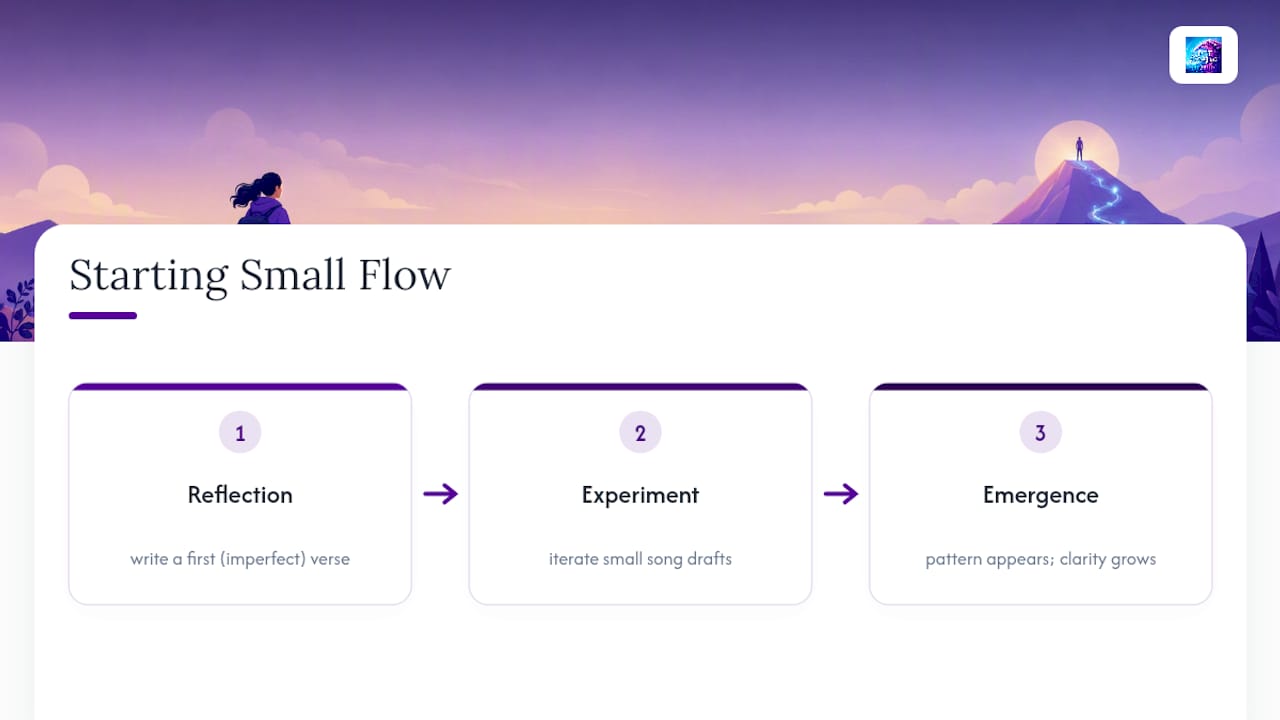
Question → Small Action → Observation → Next Step
For example:
Experiment 1: Teach Something
Question: Do I enjoy helping people learn?
Action: Teach one person something you already know.
Observation: Did you enjoy preparing, explaining, and answering questions?
Next step: If yes, look for another opportunity to teach.
Experiment 2: Create Something
Question: Does creative work feel meaningful to me?
Action: Complete one small creative project.
Observation: Did the process keep your interest?
Next step: Try a slightly larger project.
Experiment 3: Help With a Shared Goal
Question: Do I enjoy contributing to a team?
Action: Volunteer for one clear responsibility in a group project.
Observation: Which part did you enjoy most—planning, leadership, problem-solving, communication, or execution?
These observations help you understand yourself through experience rather than theory alone.
A Short PTT Music Playlist for Purpose and Reflection
Music can create a helpful environment for thinking, journaling, planning, or simply stepping away from distractions for a few minutes.
For a short PTT Music purpose and personal-growth playlist, consider:
“Thoughts & Dreams”
Best for: Reflection
A natural starting point when you are considering your goals, possibilities, and future direction.
“Choose It”
Best for: Intentional decisions
Purpose often becomes clearer when reflection turns into a choice.
“Steps”
Best for: Gradual progress
A good reminder that meaningful direction can be built through small, repeated actions.
“Destination”
Best for: Direction
Useful when you are thinking about where you want your current choices to lead.
“On My Way”
Best for: Recognizing progress
You do not need to have everything figured out to acknowledge that you are moving.
“The Time Is Now”
Best for: Taking action
A fitting closing track for moving from reflection into your next practical step.
Explore more original tracks through the PTT Music catalog.
Reflection idea: Play two or three songs, then spend five minutes writing an answer to one question:
“What is one meaningful step I can take next?”
Purpose Does Not Have to Be One Permanent Career
One common source of pressure is believing that purpose must equal one job title.
It does not have to.
Your career may be one expression of purpose, but other areas can matter too:
-
family;
-
relationships;
-
community;
-
creativity;
-
learning;
-
service;
-
leadership;
-
faith;
-
building something useful;
-
mentoring others.
Your priorities can also change over time.
A meaningful direction at age 20 may look different at 40 or 60.
That does not automatically mean the earlier direction was wrong.
It may simply mean that your responsibilities, skills, interests, and opportunities changed.
Mentors, Friends, and Community Can Help
Purpose becomes easier to examine when you have people who can challenge your assumptions and offer another perspective.
Look for people who:
-
know you reasonably well;
-
have experience you respect;
-
will tell you the truth;
-
ask good questions instead of deciding your future for you.
A useful mentoring conversation does not need to be complicated.
Ask one clear question such as:
“Based on what you know about me, where do you think I create the most value?”
or:
“What skill do you think I should develop next?”
Then compare their observations with your own.
Community can provide opportunities to test strengths through real responsibilities instead of only thinking about them.
Can Spiritual Practices Be Part of Purpose Discovery?
For readers whose lives include faith or spiritual practice, reflection can also include prayer, scripture reading, quiet time, service, or conversations within a faith community.
These practices can help people consider questions such as:
What responsibilities matter most to me?
How should I serve others?
What kind of person am I trying to become?
How should my choices reflect what I believe?
Different traditions approach these questions differently, so there is no need to force one spiritual framework onto every reader.
The broader principle remains practical:
reflect, act, observe, learn, and continue.
Avoid Turning Purpose Into Another Source of Pressure
Purpose discovery should not become another standard you use to judge yourself.
You do not need to wake up every morning feeling intensely inspired.
Some meaningful work is ordinary.
Some contribution is repetitive.
Some seasons are about responsibility rather than excitement.
It can be more realistic to ask:
“Does this direction reflect what matters to me?”
and:
“Is this something worth continuing, improving, or contributing to?”
Those questions leave room for growth without requiring constant certainty.
How PTT Music Can Support Purposeful Living
PTT Music naturally connects with themes of personal growth, motivation, confidence, resilience, relationships, purpose, and forward movement.
You can use music as part of a simple reflection routine:
-
Choose one or two PTT Music tracks.
-
Put distractions aside.
-
Listen intentionally.
-
Write for five minutes afterward.
-
Identify one action you can take.
For example:
“Thoughts & Dreams” can accompany reflection.
“Choose It” can represent decision.
“Steps” can represent progress.
“Destination” can represent direction.
“On My Way” can represent movement.
And “The Time Is Now” can represent action.
That progression creates a simple purpose framework:
Reflect → Choose → Take Steps → Find Direction → Keep Moving → Act
For more original music, visit the PTT Music music page.
You can also explore the PTT Music Podcast for conversations connected with growth, relationships, resilience, motivation, and purposeful living.
For more articles, visit the PTT Music Blog.
Starting Small With Purpose
You do not need a perfect mission statement today.
Start smaller.
Write one honest answer.
Notice one recurring strength.
Talk with one person.
Try one activity.
Take one step.
Then pay attention to what you learn.
Purpose may become clearer through the pattern created by those small decisions.
Just like music, meaning can develop one part at a time.
You do not need to hear the entire song before you begin writing the next verse.
Frequently Asked Questions
What is purpose discovery?
Purpose discovery is the process of exploring what matters to you, what you do well, what keeps your interest, and where you can contribute meaningfully.
It can develop through reflection, experience, relationships, and action.
How long does it take to understand your purpose?
There is no universal timeline.
Some people recognize meaningful directions quickly, while others develop greater clarity gradually through different experiences and seasons of life.
Rather than setting a deadline, focus on regular reflection and small experiments.
Does my career have to be my purpose?
No.
Work can be one expression of purpose, but family, relationships, creativity, community involvement, learning, mentoring, or service can also provide meaning.
What if I have several different interests?
That is normal.
Instead of forcing yourself to choose one immediately, look for themes that connect them.
For example, several different interests may all involve creativity, problem-solving, communication, teaching, or helping others.
Can music help with reflection?
Music can be used as part of a personal reflection routine if you find it helpful. Some people prefer music while journaling or planning, while others prefer silence.
The goal is to create an environment that helps you focus on the questions you want to explore.
Where can I find PTT Music for a purpose-focused playlist?
Visit the PTT Music catalog to explore original tracks.
You can also visit the PTT Music home page, explore the PTT Music Podcast, or read more personal-growth content through the PTT Music Blog.
Take the Next Step With PTT Music
Purpose does not always begin with a complete answer.
Sometimes it begins with “Thoughts & Dreams.”
Then you “Choose It.”
You take “Steps.”
You begin to see a “Destination.”
Eventually, you realize you are “On My Way.”
And when reflection has gone far enough, there comes a point when:
“The Time Is Now.”