
Strong relationships are rarely built through one grand gesture.
More often, they grow through everyday behaviors: listening, responding to small attempts at connection, making clear requests, showing appreciation, repairing misunderstandings, respecting boundaries, and continuing to learn about each other.
Relationship research offers useful frameworks for thinking about these behaviors, but no single habit, communication script, ratio, or playlist can guarantee a lasting relationship.
Music can still have a place in the routine.
A familiar song can accompany reflection, mark the beginning of a check-in, or provide a shared moment before a conversation. PTT Music tracks such as “Talk To Me,” “Face To Face,” “Reach Out,” “Walk With You,” “You Can Count On It,” “Friends,” “Thank You,” and “Now I Know” naturally fit themes of communication, connection, reliability, appreciation, and reflection.
Explore the full PTT Music catalog.
Key Takeaways
| Relationship Habit | Practical Approach |
|---|---|
| Respond to connection | Notice small attempts to talk, share, or connect. |
| Listen to influence | Take your partner’s perspective seriously without assuming agreement is always required. |
| Make clear requests | Ask for a specific behavior instead of relying only on broad complaints. |
| Stay curious | Continue learning about your partner rather than assuming you already know everything. |
| Handle conflict respectfully | Avoid insults, contempt, intimidation, and unrelated attacks. |
| Repair when needed | Acknowledge mistakes and reopen communication. |
| Set boundaries | State what you will and will not participate in clearly. |
| Show appreciation | Notice helpful, caring, and thoughtful actions. |
| Use music lightly | Let music accompany the routine rather than expecting it to fix the relationship. |
Table of Contents
-
What Makes Relationship Advice Useful?
-
12 Practical Relationship Habits
-
A 7-Day Relationship Connection Starter
-
PTT Music Songs for Communication and Connection
-
How to Pair Music With Relationship Check-Ins
-
Healthy Relationship Patterns and Warning Signs
-
What Attachment Theory Can and Cannot Tell You
-
Navigating Major Life Transitions Together
-
Handling Family, Friends, and Social Media
-
Setting Shared Goals While Keeping Individual Goals
-
When Professional Relationship Support May Help
-
Frequently Asked Questions
-
Keep Building Connection With PTT Music
-
Sources
What Makes Relationship Advice Useful?
Useful relationship advice should give you something practical to do without pretending every relationship works the same way.
The Gottman Institute has written extensively about turning toward bids for connection and accepting a partner’s influence.
One Gottman discussion cites long-term research on newlywed couples—mostly heterosexual—in which men who consistently resisted their wives’ influence showed substantially greater marital instability.
You can read the original discussion here:
Manage Conflict: Accepting Influence — The Gottman Institute
That finding should be kept in context.
It does not mean that every partner who disagrees faces an 81% chance of divorce, nor should the number be applied universally to every relationship.
The practical principle is simpler:
Healthy decision-making leaves room for both people’s perspectives.
Research has also explored interpersonal curiosity, or the desire to learn about other people.
A 2024 narrative literature review examined 23 articles and described interpersonal curiosity as potentially useful for connection while also noting that curiosity is not always prosocial and can sometimes become intrusive or disruptive.
So rather than saying:
“Curiosity guarantees more trust and satisfaction,”
a better takeaway is:
Respectful curiosity can help partners continue learning about one another.
12 Practical Relationship Habits
1. Notice Small Attempts at Connection
Connection does not only happen during date nights or major conversations.
It can happen when someone says:
“Look at this.”
“How was your day?”
“Can I tell you something?”
or simply reaches for your hand.
You do not have to respond perfectly every time.
The practical habit is noticing these moments and responding when you can.
A small response might be:
“Tell me more.”
PTT Music pairing:
“Talk To Me”
The title naturally fits an invitation to communicate.
2. Take Your Partner’s Perspective Seriously
Accepting influence does not mean giving up your opinion.
It means making room for another person’s perspective before deciding.
Instead of immediately saying:
“That won’t work.”
try:
“What matters most to you about that option?”
Then listen.
The Gottman Institute discusses this concept in more detail here:
Manage Conflict: Accepting Influence
PTT Music pairing:
“Walk With You”
The title works naturally with the idea of moving alongside another person instead of treating every disagreement as a contest.
3. Turn Broad Complaints Into Specific Requests
Statements such as:
“You never support me.”
may communicate frustration, but they do not always make the desired change clear.
Try identifying a specific request.
For example:
Instead of:
“You never help.”
try:
“Could you handle the dishes tonight while I finish this?”
Instead of:
“You don’t listen.”
try:
“Could we put our phones aside for ten minutes while we talk?”
Utah State University Extension provides a practical overview of I-messages and clear communication:
Effective Communication Skills: “I” Messages and Beyond — USU Extension
One useful structure is:
I think…
I feel…
because…
I would like…
This does not guarantee that the other person will agree.
It simply makes your own perspective clearer.
PTT Music pairing:
“Face To Face”
4. Keep Asking Real Questions
Long relationships can create familiarity.
Familiarity is valuable, but it can also tempt people to assume:
“I already know what they think.”
People continue changing.
Ask questions such as:
“What has been on your mind lately?”
“Is there something you’re looking forward to?”
“Has anything changed about what you want this year?”
“What is something I haven’t asked you about recently?”
The 2024 review of interpersonal curiosity suggests that curiosity can play a meaningful role in human connection, while also emphasizing that context and respectful boundaries matter.
Interpersonal Curiosity — PubMed
PTT Music pairing:
“I Wanna Know”
5. Agree on Basic Rules for Conflict
Conflict is not automatically evidence that a relationship is failing.
But certain ways of handling conflict can cause additional damage.
A couple might agree:
-
no insults;
-
no threats;
-
no mocking;
-
no deliberately humiliating comments;
-
one issue at a time;
-
either person may request a pause;
-
a paused conversation should have a reasonable plan for returning to it.
A simple pause might sound like:
“I want to continue this conversation, but I need some time before we do.”
That is different from disappearing or using silence as punishment.
PTT Music pairing:
“No More”
The title can represent deciding that an unhelpful communication pattern needs to change.
6. Practice Repair After a Difficult Moment
Even thoughtful people sometimes:
-
interrupt;
-
misunderstand;
-
become defensive;
-
say something poorly;
-
react too quickly.
Repair can be simple.
Try:
“That came out wrong. Let me try again.”
or:
“I understand why that bothered you.”
or:
“I was defensive. Can we restart?”
Repair does not erase serious behavior or remove accountability.
It simply gives both people an opportunity to correct the interaction.
PTT Music pairing:
“Changed Me”
The title fits reflection and learning after something has happened.
7. Build Appreciation Into Ordinary Days
Positive relationship moments do not need to follow a mathematical formula.
The often-cited 5:1 ratio associated with Gottman research should not be interpreted as a required scorecard where exactly five positive comments neutralize one negative interaction.
A more useful principle is:
Do not let appreciation disappear from everyday life.
Say:
“Thank you for doing that.”
“I noticed you handled that for us.”
“I appreciated you listening.”
“That meant a lot to me.”
PTT Music pairing:
“Thank You”
8. Set Boundaries Clearly
A boundary describes what you will do in response to a situation.
For example:
“If the conversation becomes insulting, I will pause it and come back when we can speak respectfully.”
That is different from:
“You are never allowed to disagree with me.”
Boundaries can involve:
-
privacy;
-
money;
-
personal time;
-
family involvement;
-
social media;
-
communication;
-
physical space.
A boundary should not be used as a disguised threat or means of controlling another person.
9. Keep Some Individual Interests
Being close does not require becoming identical.
Partners may still have:
-
different hobbies;
-
separate friendships;
-
different professional interests;
-
personal goals;
-
private reflection time.
At the same time, shared routines can create opportunities for connection.
Examples include:
-
a regular meal together;
-
an evening walk;
-
a weekly check-in;
-
listening to music together;
-
working toward a shared goal.
The balance will look different for every couple.
PTT Music pairing:
“Different”
The title naturally fits the idea that two people can remain different while still building something together.
10. Listen Before Trying to Fix Everything
Sometimes people want advice.
Sometimes they want understanding first.
Before solving the problem, ask:
“Would you like ideas, or would you rather I just listen?”
That simple question can clarify what the other person actually needs from the conversation.
Then listen without immediately redirecting the conversation toward your own experience.
PTT Music pairing:
“Talk To Me”
11. Rebuild Trust Through Behavior, Not One Conversation
After an important breach of trust, one apology may not be enough to restore confidence.
Depending on what happened, rebuilding may involve:
-
acknowledging the behavior;
-
answering reasonable questions;
-
changing the behavior that caused the breach;
-
following through consistently;
-
allowing the other person time to decide what they need.
There is no universal timetable for restoring trust.
And reconciliation is not always required or appropriate.
For serious betrayals, recurring conflict, or situations where both partners want structured help, professional support may be useful.
12. Begin Difficult Conversations Gently
How you introduce an issue can affect the tone of what follows, although no opening phrase guarantees a calm outcome.
Compare:
“You never listen to me.”
with:
“Can we talk about something that’s been bothering me?”
Then describe the specific issue.
For example:
“I felt overwhelmed when I handled everything alone yesterday. Could we plan how to divide it next time?”
Clear does not have to mean harsh.
PTT Music pairing:
“Reach Out”
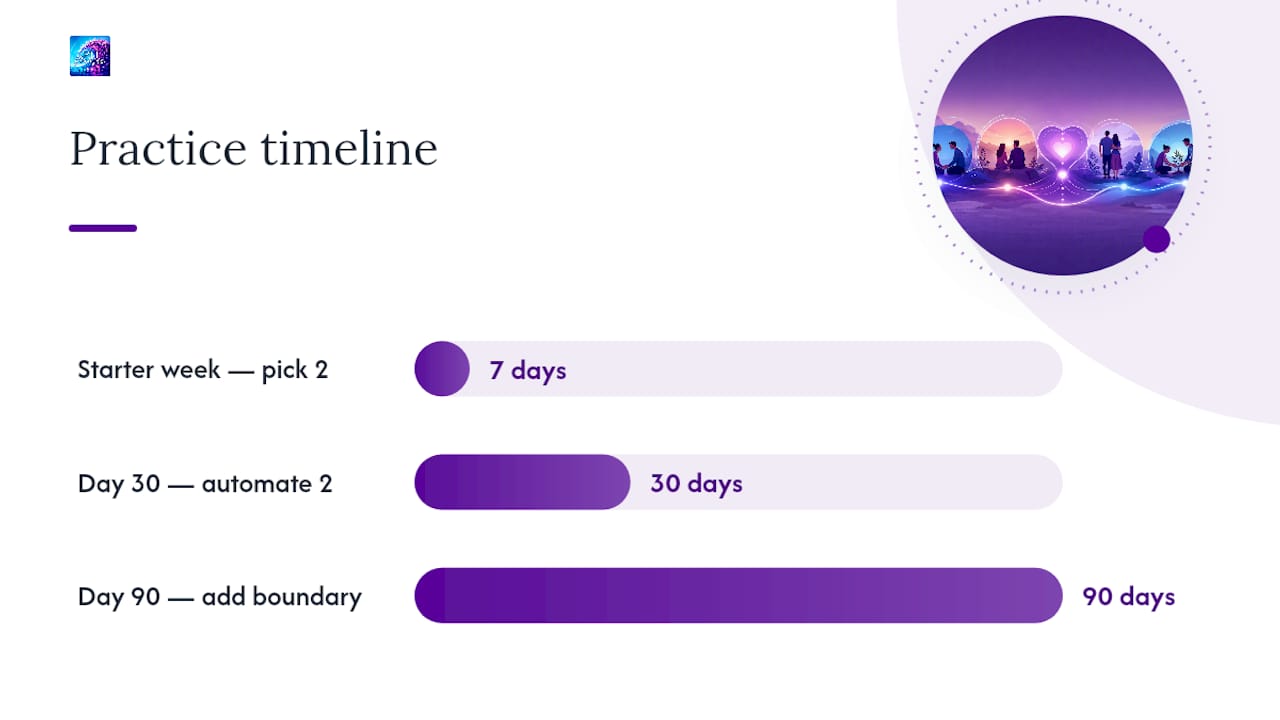
A 7-Day Relationship Connection Starter
Do not try to overhaul your entire relationship in one week.
Choose small practices.
Day 1 — Notice
Notice one attempt your partner makes to connect.
Respond if you can.
PTT Music:
“Talk To Me”
Day 2 — Ask
Ask one genuine question.
Try:
“What’s something you’ve been thinking about lately?”
PTT Music:
“I Wanna Know”
Day 3 — Make One Clear Request
Turn one broad frustration into a specific request.
PTT Music:
“Face To Face”
Day 4 — Appreciate
Say thank you for something specific.
PTT Music:
“Thank You”
Day 5 — Listen
Ask:
“Do you want advice or would you rather I listen?”
Then follow the answer.
PTT Music:
“Talk To Me”
Day 6 — Reach Out
If something small has felt distant or unresolved, begin a respectful conversation.
PTT Music:
“Reach Out”
Day 7 — Review Together
Ask:
“What felt good between us this week?”
and:
“Is there one thing we could do differently next week?”
PTT Music:
“Walk With You”
The sequence becomes:
Notice → Ask → Communicate → Appreciate → Listen → Reach Out → Review
PTT Music Songs for Communication and Connection
Here are PTT Music tracks whose titles naturally fit relationship themes.
“Talk To Me”
Best for: Communication
A natural title for opening a conversation.
“Face To Face”
Best for: Direct conversation
Useful as a theme for discussing something clearly rather than relying on assumptions.
“Reach Out”
Best for: Reconnection
A reminder that sometimes somebody has to begin.
“Walk With You”
Best for: Support
Not every difficult situation needs to be solved immediately.
Sometimes another person simply needs company.
“You Can Count On It”
Best for: Reliability
Trust is supported by consistent behavior.
“Friends”
Best for: Friendship within relationships
Long-term connection includes companionship as well as romance.
“By My Side”
Best for: Presence
A fitting title for being available during ordinary and difficult moments.
“Anytime”
Best for: Availability
Connection sometimes means making room for another person.
“Whenever”
Best for: Connection across everyday moments
A natural addition to a relationship-focused playlist.
“Now I Know”
Best for: Reflection
Useful after realizing something about yourself, your partner, or an interaction.
“Changed Me”
Best for: Learning
Relationships can reveal behaviors and perspectives worth reconsidering.
“Thank You”
Best for: Appreciation
One of the simplest relationship habits is also one of the easiest to overlook.
Explore these tracks through the PTT Music music page.
How to Pair Music With Relationship Check-Ins
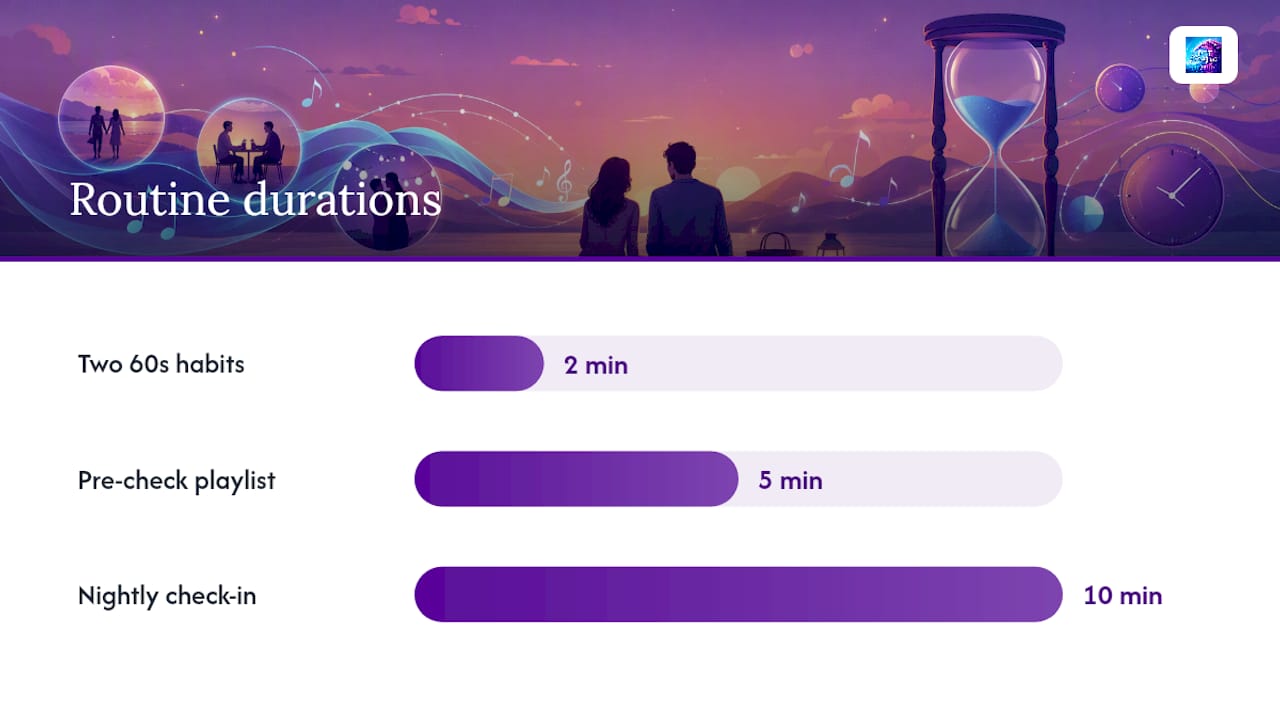
Music does not need to regulate anyone’s nervous system or change anybody’s mood to be useful.
It can simply accompany a ritual.
For example:
Before a Check-In
Play:
“Talk To Me”
Then ask:
“How are we doing?”
Before Reconnecting
Play:
“Reach Out”
Then take the actual action:
send the message or begin the conversation.
Before Discussing Something Important
Play:
“Face To Face”
Then decide:
What do I need to communicate clearly and respectfully?
When Appreciation Has Been Missing
Play:
“Thank You”
Then identify something real you appreciate.
When Supporting Your Partner
Play:
“Walk With You”
Then ask:
“What would be helpful from me right now?”
The important distinction is:
Music accompanies the conversation. It does not do the relationship work for you.
Healthy Relationship Patterns and Warning Signs
Healthy relationships can look different, but useful signs often include:
-
being able to raise concerns;
-
mutual respect;
-
room for disagreement;
-
shared decision-making;
-
personal autonomy;
-
privacy;
-
honest communication;
-
willingness to repair mistakes.
Conflict by itself does not define a relationship as unhealthy.
However, some behaviors deserve more serious attention.
These can include:
-
physical violence;
-
threats;
-
intimidation;
-
stalking;
-
coerced sexual activity;
-
controlling access to money;
-
deliberately isolating someone from family or friends;
-
monitoring or restricting communication;
-
repeated humiliation or degradation.
These are not problems that should be solved by finding a better playlist or communication script.
If you feel unsafe, prioritize safety and seek support from someone or a service equipped to help.
What Attachment Theory Can and Cannot Tell You
Attachment theory can provide one framework for thinking about patterns of closeness and relationships.
Terms such as:
secure
anxious
and:
avoidant
are widely used in popular discussions.
However, these labels should not become permanent identities or amateur diagnoses.
It is too strong to say:
“Your attachment style determines how you love.”
People’s relationship behaviors can vary by:
-
relationship;
-
circumstances;
-
experiences;
-
stress;
-
communication patterns;
-
expectations.
Instead of diagnosing yourself or your partner, focus on observable behavior.
Ask:
“What happens between us when one person wants closeness and the other wants space?”
That gives you something practical to discuss.
Navigating Major Life Transitions Together
Relationships may need adjustment during major changes such as:
-
moving in together;
-
marriage;
-
parenthood;
-
career changes;
-
relocation;
-
financial changes;
-
caring for relatives;
-
retirement.
Instead of assuming that both partners automatically know what the other expects, discuss practical questions.
For example:
How will household responsibilities be divided?
How will we make financial decisions?
How much individual time does each person need?
What has changed about our schedule?
What kind of support would be useful?
Avoid promising that couples require a specific number of months to establish a new rhythm.
Different couples and different transitions vary substantially.
The practical principle is:
When circumstances change, expectations may need to be discussed again.
Handling Family, Friends, and Social Media
Outside opinions can affect a relationship.
Family members may have expectations.
Friends may give advice.
Social media can encourage comparison.
Instead of assuming that every outside opinion is harmful, discuss which boundaries make sense.
For example:
“Which relationship topics are private?”
“How much should family be involved in this decision?”
“Is social media comparison affecting either of us?”
Friends and family can also provide valuable perspective, especially when someone feels isolated or unsafe.
So the goal should not be to create an unquestioned “united front” against everyone outside the relationship.
A healthy relationship leaves room for supportive outside connections.
Setting Shared Goals While Keeping Individual Goals
Partners do not need identical ambitions.
A useful conversation might include:
What are you working toward personally?
What are we working toward together?
Where do those goals support each other?
Where might they compete for time or resources?
Shared goals might involve:
-
saving;
-
travel;
-
family plans;
-
housing;
-
education;
-
lifestyle;
-
creative projects.
Individual goals might involve:
-
career development;
-
study;
-
hobbies;
-
friendships;
-
personal projects.
The aim is not perfect agreement.
It is making important expectations visible enough to discuss.
When Professional Relationship Support May Help
Couples sometimes seek professional support because:
-
the same conflict repeatedly returns;
-
communication has become difficult;
-
trust has been damaged;
-
a major transition is creating strain;
-
they want structured help improving communication.
Emotionally Focused Couple Therapy is one approach studied in couples research.
One recent randomized controlled study examined EFCT in relation to intimacy and shame:
Emotionally Focused Couple Therapy Study — PMC
That research should not be summarized as:
“Couples therapy works better if you start early.”
Nor does one study prove that a particular therapy is best for every couple.
Different problems, individuals, therapists, and treatment approaches can lead to different outcomes.
Professional support is an option—not evidence that a relationship has failed.
What Music Can and Cannot Do for Relationships
Avoid claims such as:
“Calming music will lower emotional tension.”
“Five minutes of music will make communication easier.”
“This playlist will prevent an argument.”
“Music can rebuild trust.”
Those promises go too far.
Music can instead:
-
accompany a shared routine;
-
provide a familiar beginning to a check-in;
-
create a shared experience;
-
inspire a discussion topic;
-
provide a theme for reflection.
Some couples may enjoy that.
Others may prefer silence.
The relationship benefits come from what the people actually do:
listen, communicate, respect boundaries, follow through, repair mistakes, and show care.
Frequently Asked Questions
What is one useful piece of relationship advice?
Pay attention to everyday opportunities for connection and take your partner’s perspective seriously.
This does not mean agreeing with everything.
It means making room for the other person in the conversation.
Does Gottman research really show an 81% divorce rate?
The statistic appears in Gottman Institute material describing a long-term study of newlywed couples, mostly heterosexual, and specifically referred to men who resisted their wives’ influence.
It should not be treated as an 81% divorce prediction for every couple or disagreement.
How can I bring up a problem without immediately blaming my partner?
Describe the situation, your own experience, and the specific change you would like to discuss.
For example:
“I felt overwhelmed handling everything yesterday. Could we divide those tasks next time?”
Is the 5:1 relationship ratio a rule?
No.
Do not treat it as a mathematical requirement.
The broader idea is that appreciation, affection, humor, support, and other positive interactions matter alongside conflict management.
Can music improve relationship communication?
It is better not to make that claim.
Music can accompany a communication routine, but better communication comes from actual behaviors such as listening, clear requests, respectful disagreement, and repair.

What PTT Music songs fit relationships and communication?
Consider:
“Talk To Me,” “Face To Face,” “Reach Out,” “Walk With You,” “You Can Count On It,” “Friends,” “By My Side,” “Anytime,” “Whenever,” “Now I Know,” “Changed Me,” and “Thank You.”
When is relationship conflict more than a communication problem?
Threats, violence, intimidation, coercion, controlling finances, isolation, stalking, or other abusive behavior should be treated as safety concerns rather than ordinary communication difficulties.
Keep Building Connection With PTT Music
Relationships are built through what happens between the big moments.
Sometimes connection begins with:
“Talk To Me.”
Then you meet:
“Face To Face.”
When distance develops:
“Reach Out.”
Instead of trying to solve everything immediately:
“Walk With You.”
Build the kind of reliability that says:
“You Can Count On It.”
Remember the value of:
“Friends.”
Stay:
“By My Side.”
Reflect until:
“Now I Know.”
Let experience show how it:
“Changed Me.”
And do not forget to say:
“Thank You.”
Music cannot communicate, apologize, listen, or rebuild trust for you.
But it can accompany the moments when you choose to do those things yourself.
Explore the PTT Music catalog, choose tracks that fit your relationship and communication routine, and let PTT Music accompany the everyday work of listening, connecting, and growing together.
Visit the PTT Music home page for more original music and PTT Music content.
For conversations around relationships, communication, resilience, confidence, and personal growth, explore the PTT Music Podcast.
Read more relationship, communication, motivation, and lifestyle content through the PTT Music Blog.
You can also browse current products through the PTT Music Store and PTT Music Song & Merchandise Collections.