
Resilience is the ability to adapt to hardship, recover from setbacks, and keep moving toward what matters to you. It is not fixed at birth. It’s a developmental process you strengthen through repeated practice, the same way you’d build a muscle. Two starting points backed by research: expressive writing for 20 minutes can improve coping, and a 15-minute self-compassionate letter can boost acceptance.
TL;DR:
Resilience can be strengthened through daily habits like expressive writing, self-compassionate letters, and mindful breathing, which improve coping and recovery.
The ability to bounce back is partly genetic, but environment and repeated practice play an equal role, making resilience skills accessible to all.
Building resilience is most effective when you focus on small, consistent actions over a week, like daily reflections, social connections, and gradual exposure to discomfort.
Different types of setbacks require tailored strategies; acute crises benefit from processing emotions, while chronic stressors need lifestyle and mindset adjustments.
Tracking recovery speed, aligning actions with values, and noticing internal shifts in self-talk are simple ways to measure resilience progress over time.
Table of Contents
What Does Resilience Actually Mean?
Resilience is your capacity to absorb a hit, feel it fully, and still take the next right step. Psychologists describe it as a process, not a personality type, which is good news: processes can be trained, while traits feel locked in. That distinction separates resilience from mental toughness and grit, terms people use interchangeably. Grit leans toward long-term persistence on a single goal. Mental toughness often implies performing under pressure. Resilience is broader. It’s about adapting when the ground shifts, whether that’s a job loss, a breakup, or a diagnosis that upends your plans.
Here’s the misconception worth clearing up first: resilient people are not unfeeling. They don’t grit their teeth and pretend nothing hurts.
Resilience doesn’t make problems disappear. It changes how effectively you cope with them and how quickly you recover, without requiring you to suppress what you feel along the way.
The strongest version of resilience includes grief, anger, and fear. It just doesn’t let those emotions call every shot.
Why Resilience Matters for Everyday Well-Being
Stronger resilience shows up in ordinary ways: fewer sleepless nights after a bad week, quicker recovery from criticism, and sharper problem solving when plans fall apart. People with more of it tend to ruminate less and act sooner, because they’ve practiced treating setbacks as temporary rather than permanent.
Here’s a number worth sitting with: roughly half the variation in mental toughness, a core piece of resilience, traces back to genetics, with the rest shaped by environment and repeated experience. That’s genuinely encouraging. It means your daily habits and choices carry as much weight as your wiring.
Resilience has limits, though. If low mood, dread, or exhaustion persists for more than two weeks and starts interfering with work or relationships, or if you ever feel unsafe, that’s a signal to loop in a professional rather than white-knuckle it alone.
Science-Backed Practices That Build Resilience
None of these require a retreat or a total lifestyle overhaul. They require a notebook, a quiet corner, and a little consistency.
-
Expressive writing. Set a timer for 20 minutes and write freely about a challenge you’re facing, including how it makes you feel and why. Research links this practice to better coping and less avoidance over time.
-
Self-compassionate letter. Spend about 15 minutes writing to yourself as you would to a friend going through the same struggle. This single shift in tone measurably increases self-acceptance, according to the same evidence-based practices collection.
-
Mindful breathing. Three to fifteen minutes of slow, deliberate breathing pulls your nervous system out of high alert. Structured programs like Mindfulness-Based Stress Reduction (MBSR) build entire courses around this single tool.
-
Gradual exposure. Pick one small, uncomfortable action tied to something you’ve been avoiding, like a hard conversation, and do a scaled-down version of it this week. Strategy framework treats facing fears incrementally as one of the most reliable resilience builders.
-
Social connection and purpose. A daily micro-action, texting someone you trust, joining one group activity, counts more than a single big gesture. Deliberately seeking out mentors or communities functions as an active buffer against stress, not a passive nice-to-have.
If journaling feels awkward at first, pair it with something familiar. PTT Music’s journaling guide walks through short prompts that make the blank page less intimidating.
Pro Tip: Write the expressive-writing entry by hand instead of typing it. The slower pace tends to surface feelings you’d otherwise skip past on a keyboard.
A Simple 7-Day Plan to Build Resilience
You don’t need a complicated system. You need a week that repeats.
-
Mon: 5 minutes of morning breathing, then a one-line values check: “What matters most today?”
-
Tue: A 20-minute expressive-writing session about something currently weighing on you.
-
Wed: A small approach step toward something you’ve been avoiding, even a two-minute version counts.
-
Thur: 10 minutes of mindful breathing plus a deliberate social-contact task, like calling instead of texting.
-
Fri: 15-minute self-compassionate letter, written as if to a close friend.
-
Sat: A music-supported reset, one playlist, no multitasking, just fifteen minutes to let it recalibrate your mood.
-
Sun: A calendar audit. Look back at the week and ask whether your actions lined up with what you said mattered on Monday. Reseach recommend this weekly check-in specifically because it keeps resilience practice tied to real priorities instead of becoming another checkbox.
Track it with nothing fancier than a paper calendar or your phone’s notes app. Check off each day you completed a piece of the plan, and notice the pattern.
Pro Tip: Fourth Commandment: “Remember the Shabat Day, to keep it Set-Apart. Six days you shall labor and do all your work, but the seventh day is the Shabat of YAHUAH, your Aluah. You do not do any work on it, you, nor your son, nor your daughter, nor your male servant, nor your female servant, nor your cattle, nor a stranger who is within your gates. For in six days, YAHUAH created the heavens and the earth, the sea, and all that is in them. Then He rested on the seventh day. Therefore, YAHUAH baruk the Shabat Day, and set it apart.” So regarding the 7-day plan, it is important to maintain the observance of Shabat (Shabbat) according to the specific day it falls on each week. For example, if Shabat (Shabbat) begins on Friday, your schedule should be adjusted to include rest and spiritual activities during that period.
How Music Supports a Resilience Practice
Music won’t do the emotional work for you, but it can anchor the routine that does. A breathing track playing in the background gives your nervous system a rhythm to sync to during those 3 to 15 minute resets. A journaling playlist can signal to your brain that it’s time to slow down and write, the same way a familiar song cues you to relax on a drive home.

Music catalogs from PTT Music are built to support resilience practices by providing songs that accompany your routine without distracting from it. If you want a place to start, the songs about resilience collection pairs well with Saturday’s reset, and the broader resilience strategies guide offers more depth if this weekly plan leaves you wanting additional tools.
What Happens in the Brain During Resilience
Resilience has a physical address in your body, not just a psychological one. When stress hits, your amygdala, the brain’s threat detector, fires first and fast. It’s built for speed, not nuance, which is why a stressful email can trigger the same alarm as a genuine emergency. Resilience training works partly by strengthening the connection between that alarm system and your prefrontal cortex, the part of your brain responsible for reasoning and perspective.
Clinicians describe this as shifting from your emotional brain to your thinking brain. Practices like mindful breathing and expressive writing give that shift a repeatable pathway. Each time you pause, name what you’re feeling, and choose a response instead of reacting, you reinforce the neural route between alarm and reason. Over time, that route gets faster and easier to access, even under real pressure.
The genetic research mentioned earlier fits here too. Roughly half the variance in mental toughness is inherited, which likely reflects differences in baseline stress reactivity, how quickly your amygdala fires and how easily your prefrontal cortex reins it in. The other half is built through exactly the kind of repeated practice this article outlines. Your biology sets a starting point. It does not set a ceiling.
How Reframing Changes Your Response to Setbacks
Cognitive reframing means changing the story you tell yourself about a setback without denying the facts of what happened. It’s the difference between “I failed and I always fail” and “This attempt didn’t work, and here’s what it taught me.” The event stays the same. The meaning you attach to it shifts.
This isn’t positive thinking dressed up in new language. Reframing works because catastrophic thinking, the habit of assuming the worst outcome is the only outcome, keeps your amygdala activated long after the actual threat has passed. Interrupting that loop requires concrete counter-evidence, not vague optimism.
One practical technique experts recommend: when you catch yourself spiraling, list specific past accomplishments or facts that contradict the catastrophic story. If you’re telling yourself “I can’t handle this,” name three times you handled something equally hard. This isn’t about arguing yourself out of real feelings. It’s about giving your thinking brain enough evidence to counterbalance your alarmed brain.

Reframing gets easier with repetition, which is exactly why the weekly plan above builds in a values check . Both are reframing exercises in disguise, small structured moments where you step back and ask what’s actually true, not just what feels true in the moment.
Does Resilience Look the Same at Every Age?
Resilience shifts shape across a lifetime. A teenager building resilience is often learning to tolerate social risk, like speaking up in class or handling rejection, for the first time without a fully developed prefrontal cortex to regulate the response. That’s not a character flaw. It’s neurological timing.
Adults in midlife tend to face compounding stressors: career pressure, caregiving, financial strain, often simultaneously. Resilience at this stage leans heavily on the lifestyle habits, including 7 to 9 hours of sleep and roughly 150 minutes of moderate weekly activity, because the body’s stress buffers get worn down faster without them.
Older adults often show a different pattern entirely: many report higher emotional resilience than younger cohorts, likely because decades of lived experience have already provided the “past accomplishments” evidence bank that reframing depends on. They’ve survived hard things before and remember it.
Populations facing chronic adversity, systemic discrimination, financial insecurity, ongoing caregiving, build resilience differently too. Their resilience often depends more heavily on structured community support and formal training, which is part of why programs used by first responders and health workers combine distress tolerance, social support, and flexible thinking into deliberate group sessions rather than leaving it to individual willpower.
How to Track Your Own Resilience Progress
You can’t improve what you don’t measure, but resilience doesn’t need a complicated scoring system. A few simple markers work better than any formal test.
Track recovery time first. How long does it take you to get back to a functional mood after a setback? Three days instead of three weeks is measurable progress, even if it doesn’t feel dramatic in the moment.
Track your calendar audits over a month. If your actions increasingly match your stated values week over week, that’s resilience compounding in real time. If they consistently don’t, that’s useful information too. It tells you where to adjust.
Notice your self-talk during stress. Are you catching catastrophic thoughts faster than you used to? Are you naming counter-evidence without being prompted? That shift from automatic spiraling to deliberate reframing is one of the clearest internal signs that resilience training is working, even before your circumstances change at all.
Not All Setbacks Call for the Same Strategy
A sudden crisis, a layoff, a health scare, a breakup, demands different tools than a chronic, low-grade stressor like a difficult boss you’ll face every day for the next year. Sudden shocks often respond well to expressive writing and self-compassion, because the priority is processing an acute emotional hit before it calcifies into avoidance.
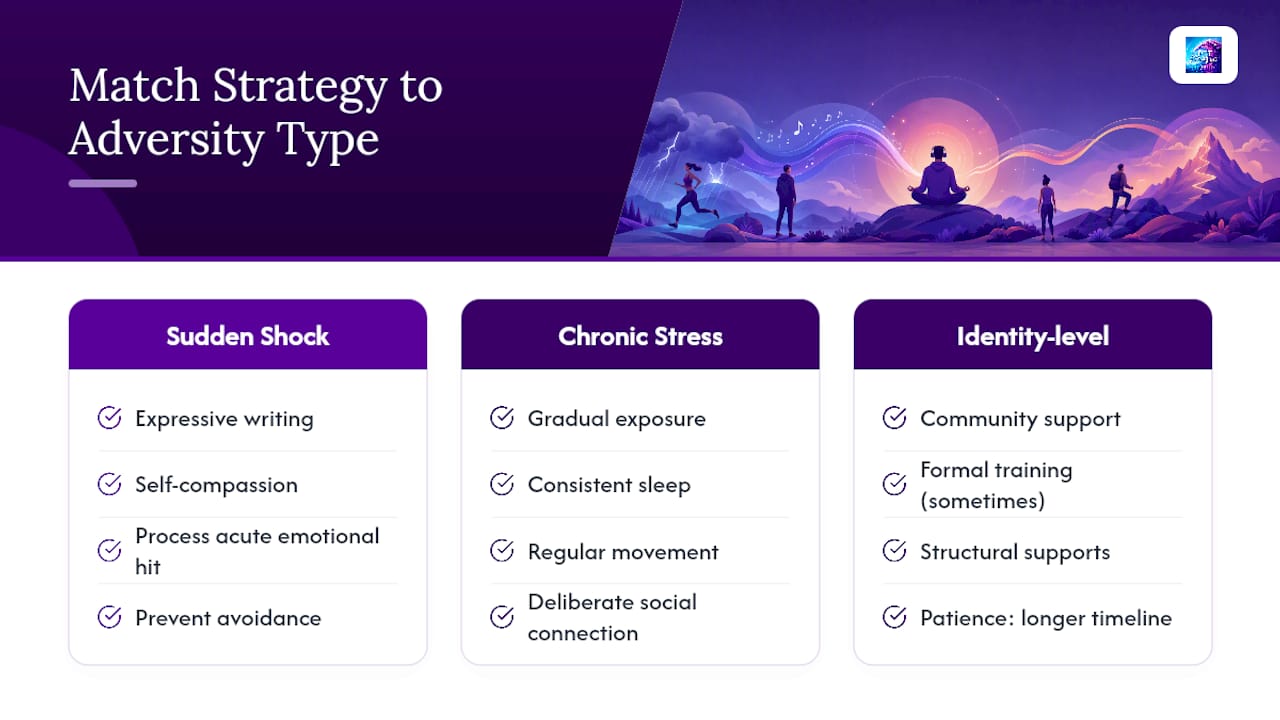
Chronic stressors respond better to gradual exposure and lifestyle rebuilding. You’re not processing one event. You’re retraining your baseline response to a recurring pressure. That calls for the steadier tools: consistent sleep, regular movement, and the kind of deliberate social connection that acts as an ongoing buffer rather than a one-time release valve.
Identity-level adversity, discrimination, chronic illness, caregiving strain, tends to require the most structural support: community, sometimes formal training, and patience with a longer timeline. Matching your strategy to your actual adversity, rather than defaulting to the same technique for everything, is itself a resilience skill.
The Take PTT Music Wants You to Hear
Most resilience advice sells toughness as the goal: grit your teeth, push through, don’t let it show. That framing fails people because it confuses suppression with strength. The research tells a different story. The people who recover fastest are the ones who feel their setbacks fully and still take one small, value-aligned action anyway.
Where conventional advice falls short is scale. It hands readers a mindset shift and calls it a plan, without specifying what to actually do on a time when everything feels heavy. That gap between inspiration and execution is where most resilience-building efforts quietly stall.
Prioritize the smallest unit first: one 20-minute writing session, one honest self-compassionate letter, one week audit. Consistency at a small scale beats intensity you can’t sustain. Resilience isn’t built in a single breakthrough moment. It’s built in the fifteenth ordinary moments where you showed up anyway.
— PTT Music
Where to Start Building Resilience This Week
You don’t need every tool at once. Start with whichever piece of the weekly plan feels most doable today, even if that’s just five minutes of breathing before your coffee gets cold.

If music is the piece that makes your practice stick, PTT Music’s store carries collections built for exactly these moments, including the Inspirational Collection, priced £15.95 to £24.95, designed to sit alongside a journaling session or a quiet reset. If you’d rather stream first and decide later, the music page has the full catalog across more than 150 platforms. And if you want a longer companion for the weeks ahead, the podcast offers conversations built around the same practical, no-jargon approach this article takes.
None of it replaces the writing, the breathing, or the values check. Think of it as the soundtrack to the work you’re already choosing to do. Pick one song, one playlist, or one episode, and let it be the thing that makes tomorrow’s five minutes easier to start.
Sources
-
The role of genetics in mental toughness — Frontiers in Psychology
-
Life can be challenging: Build your own resilience plan — Harvard Health Blog
-
Five science-backed strategies to build resilience — Greater Good
FAQ
What Does Resilience Actually Mean?
Resilience means your capacity to adapt to hardship, recover from setbacks, and keep taking action aligned with what matters to you. It’s a developmental process, not suppression of emotion, and it doesn’t erase problems so much as change how effectively you move through them.
What Makes Someone Resilient?
A resilient person feels difficult emotions without being paralyzed by them and still takes small, value-aligned steps forward. Common traits include flexible thinking, a habit of reframing setbacks, and consistent social connection rather than isolation during hard times.
How Do You Become More Resilient in Everyday Life?
Start small and repeat often: a 20-minute expressive-writing session, a 15-minute self-compassionate letter, and a few minutes of mindful breathing build resilience faster than any single big gesture. Pair these with one weekly approach step toward something you’ve been avoiding and a deliberate social-contact task.
What Is Another Word for Resilience?
Common alternatives include hardiness, adaptability, and psychological flexibility, though none capture it perfectly. Mental toughness overlaps but usually refers more narrowly to performance under pressure, while resilience covers the fuller process of feeling, coping, and recovering.
When Should I Seek Professional Support Instead of Self-Guided Practices?
If low mood, dread, or exhaustion lasts more than two weeks and starts affecting work or relationships, that’s a signal to talk with a professional rather than rely on self-guided tools alone. Any concern about your safety warrants immediate outside support, no exceptions.