
The most effective resilience strategies you can use today come down to four things: strengthen your connections, protect your body and routines, practice flexible thinking, and build meaning through your values. That’s the whole framework. Everything else is application.
Here’s a one-minute primer you can do right now:
-
Take three slow breaths (4 counts in, 4 counts out).
-
Name five things you can see around you to ground yourself in the present.
-
Play one song that genuinely lifts your energy, even for 60 seconds.
Done. You’ve just activated three of the most evidence-supported resilience techniques available: controlled breathing, grounding, and mood anchoring through music.
And if you have a few more minutes, try these micro-actions:
-
Write down one thing that went well today (takes 60 seconds).
-
Text or call one person you trust, even just to say hello.
-
Step outside for a 5-minute walk.
-
Recall one past challenge you got through and name what helped.
-
Identify one small, concrete step toward a problem you’re currently avoiding.
Pro Tip: You don’t need a perfect plan to start. Pick one micro-action from the list above and do it before you finish reading this article. Momentum is built by starting, not by planning.
Key Takeaways
Building resilience is a daily practice grounded in connection, physical self-care, flexible thinking, purposeful action, and meaning — and small consistent habits are what make it real over time.
| Point | Details |
|---|---|
| Resilience is a learnable skill | The APA and Mayo Clinic confirm it’s built through practice, not inherited as a fixed trait. |
| Five strategy areas cover the full picture | Connection, physical self-care, cognitive skills, problem-solving, and meaning each play a distinct role. |
| Time-boxed routines make it practical | 2-, 5-, 10-, and 30-minute options let you build the habit regardless of your schedule. |
| Approaching discomfort builds strength | Harvard Health research shows that small, graded steps toward avoided situations are what actually increase resilience. |
| PTT Music audio supports the practice | Short tracks and podcast episodes from PTT Music can be paired with breathing, journaling, and pre-task rituals to reinforce daily resilience habits. |
Your one-week experiment: Each day this week, do the 5-minute routine (breathing, three good things, one avoided task). Track your answers to “What went well? What did I learn? What’s one next step?” Pair it with one song that anchors your mood before the hardest part of your day. By day seven, you’ll have seven data points on what actually works for you.
Table of Contents
-
How music and storytelling can strengthen your resilience practice
-
Common barriers to building resilience — and how to move past them
-
Short music tracks and podcasts that support your resilience practice
What resilience really is — and what it isn’t
Resilience is not the absence of stress, pain, or failure. The American Psychological Association defines it as the process of adapting well in the face of adversity, and that word “process” matters enormously. It’s not a destination you reach. It’s something you practice, build, and strengthen over time through specific habits and skills.
Mayo Clinic and the APA both emphasize the same point: resilience is a learnable skill set, not a fixed personality trait. That distinction changes everything about how you approach it.
Three misconceptions tend to hold people back:
-
“Some people are just born resilient.” Research consistently shows resilience is built through practice, not inherited. Anyone can develop it.
-
“You have to handle hard things alone.” Seeking connection and support is one of the most powerful resilience moves available to you. Isolation works against it.
-
“Being resilient means suppressing your emotions.” Genuine resilience involves processing emotions, not burying them. Acknowledging how you feel is part of adapting, not a sign of weakness.
Harvard Health adds a useful frame: resilience can include not just bouncing back but growing through difficulty. The goal isn’t to return to exactly where you were. Sometimes you come back stronger, with new perspective and deeper self-knowledge.
Core resilience strategies, organized by skill area
The most effective approach groups resilience skills into five areas. Each one has its own logic, its own practices, and its own research base. Together, they create a layered system that holds up under real pressure.
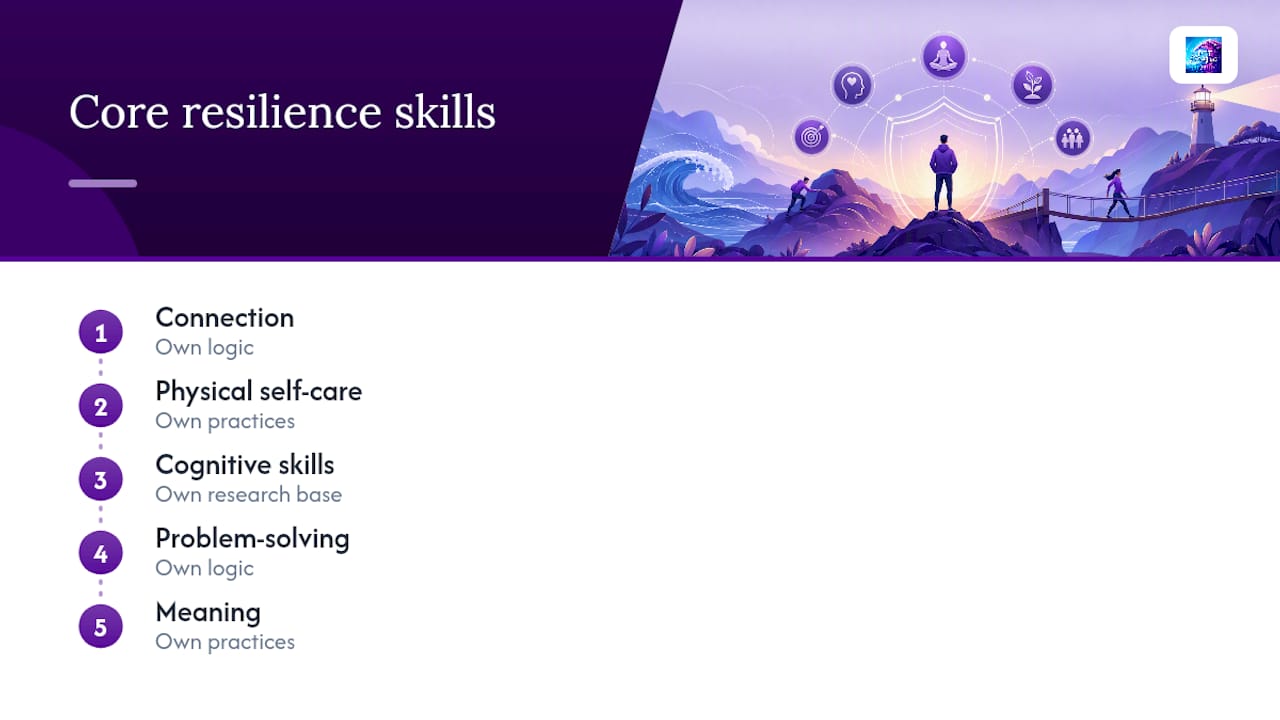
Connection and social support
Humans are wired for connection. Strong relationships don’t just feel good — they directly support your ability to cope with stress. Cornell Health identifies social connection as one of the core pillars of personal resilience, alongside self-awareness and self-care.
Concrete practices:
-
Schedule one meaningful conversation per week, not a quick check-in but a real talk.
-
Join a group organized around something you care about (a class, a community, a creative project).
-
When you’re struggling, name it to one trusted person rather than carrying it silently.
Physical self-care and routines
Your body is the foundation of your mental strength. Sleep, movement, and nutrition aren’t separate from resilience — they are resilience. PositivePsychology.com notes that short daily habits like movement, sleep protection, and social connection are practical routes to increase resilience over time.
Concrete practices:
-
Protect 7–8 hours of sleep as a non-negotiable priority.
-
Move your body for at least 20 minutes daily, even a walk counts.
-
Eat regular meals and limit the habit of skipping food when stressed.
Cognitive-behavioral skills
How you think about a situation shapes how you respond to it. Cognitive-behavioral skills help you catch unhelpful thought patterns and replace them with more accurate, useful ones. This is one of the most well-researched areas in resilience training. The Penn Positive Psychology Center has built entire training programs around teaching these skills in experiential formats, with results that scale through train-the-trainer models.
Concrete practices:
-
When a negative thought loops, ask: “Is this thought a fact, or an interpretation?”
-
Practice reframing: “This is hard” becomes “This is hard, and I’ve handled hard things before.”
-
Identify three things that went well each day, no matter how small.
Problem-solving and purposeful action
Avoidance feels like relief in the short term and costs you in the long term. Taking even one small step toward a problem you’ve been avoiding builds confidence and reduces the mental weight of the issue. Mayo Clinic recommends taking action as a core resilience skill — not waiting until you feel ready, but moving while the discomfort is still present.
Concrete practices:
-
Break a daunting problem into three smaller steps and commit to just the first one.
-
Set a 10-minute timer and work on something you’ve been putting off.
-
After a setback, ask: “What’s one thing within my control right now?”
Meaning, values, and growth mindset
People who connect their daily actions to something they genuinely care about tend to recover faster from adversity. Meaning acts as a psychological anchor. When you know why something matters, the how becomes more manageable.
Concrete practices:
-
Write down your top three personal values and check your weekly schedule against them.
-
Reflect on a past difficulty and identify one thing you learned or gained from it.
-
Pursue at least one activity each week that feels genuinely meaningful to you.
| Strategy Area | Typical Time Investment | One Quick Practice |
|---|---|---|
| Social connection | 10–20 min/day | Text one person you trust |
| Physical self-care | 20–30 min/day | 20-minute walk, consistent sleep |
| Cognitive-behavioral skills | 5–10 min/day | Write three things that went well |
| Problem-solving and action | 10 min/day | One small step on an avoided task |
| Meaning and values | 5–15 min/week | Weekly values-calendar check |
The 2026 National Resilience Strategy frames resilience as operating across personal, community, and systemic levels simultaneously. Your individual practices sit within that larger ecosystem — which is a reminder that building your own strength also contributes to the strength of the people around you.
Daily exercises you can start today
Time is the most common reason people skip resilience practices. These routines are designed to fit real schedules.
2-minute routine
-
Sit quietly and take five slow breaths (4 counts in, 6 counts out).
-
Write one sentence: “One thing I’m grateful for right now is ___.”
5-minute routine
-
Breathe slowly for 60 seconds.
-
Write three things that went well today and why each happened.
-
Identify one small action you can take tomorrow on something you’ve been avoiding.
10-minute routine
-
Start with the 5-minute routine above.
-
Add a short journaling prompt: “What’s one thought I keep having that isn’t helping me? What’s a more accurate way to see this situation?”
-
Read or listen to something that genuinely inspires you for 2–3 minutes.
30-minute routine
-
Move your body for 15 minutes (walk, stretch, or any movement you enjoy).
-
Journal for 10 minutes using these prompts: “What went well this week? What did I learn? What’s one next step?”
-
Spend 5 minutes reviewing your upcoming week and shifting anything that conflicts with your core values.
On frequency: Aim for the 2-minute or 5-minute routine daily. The 10-minute version works well three to four times per week. The 30-minute version once or twice a week creates a meaningful weekly rhythm.
For graded exposure (building tolerance to discomfort), the principle is simple: start smaller than you think you need to. If a difficult conversation feels overwhelming, start by writing what you’d want to say. If a social situation feels hard, start with a 5-minute commitment. Each small step builds the tolerance and confidence to take the next one. The NHS Every Mind Matters resource offers stepwise prompts for exactly this kind of gradual approach, including recalling past coping and identifying personal strengths.

How music and storytelling can strengthen your resilience practice
Music does more than fill the background. It actively shapes your emotional state, your arousal level, and your ability to shift out of a difficult mood. Understanding how music affects mood at a physiological level helps you use it deliberately rather than passively.
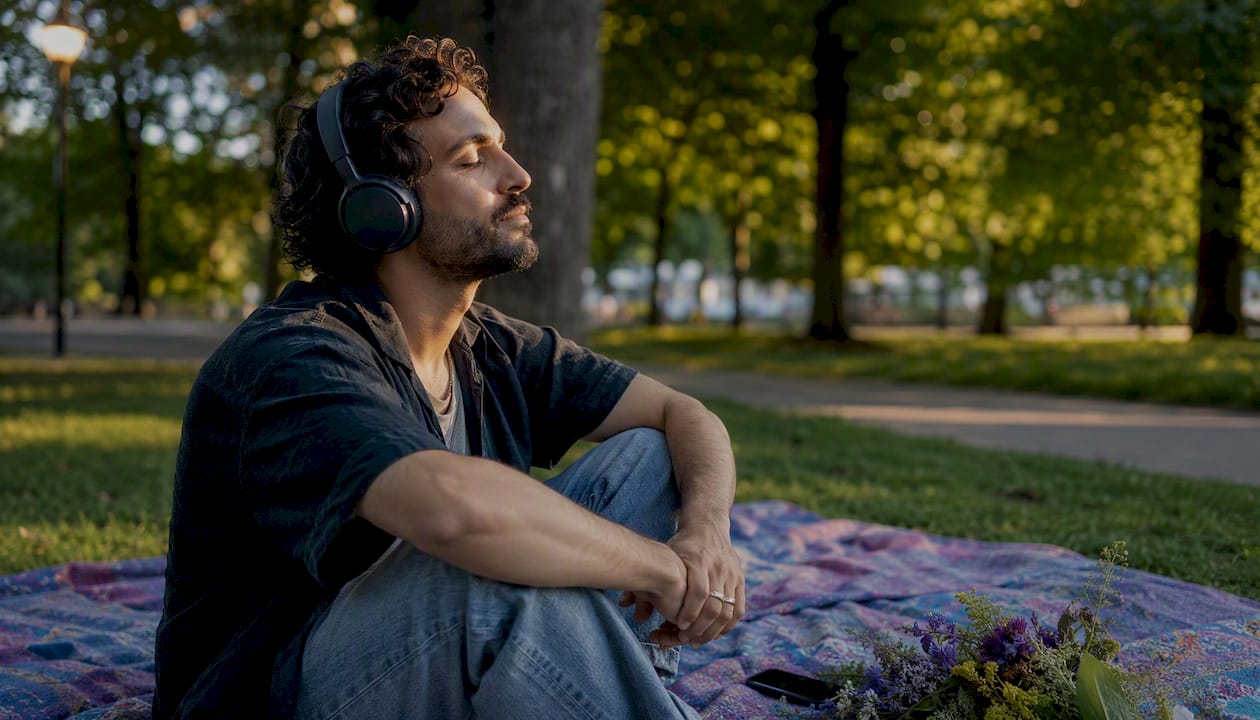
The connection to resilience is practical. When you consistently pair a specific song or sound with a calm, focused, or hopeful state, that association strengthens. Music becomes a cue, not just a soundtrack.
Three ways to integrate audio into your resilience practice:
-
Pre-task mood anchoring. Before a stressful meeting, a hard conversation, or a challenging task, play one song that reliably puts you in a confident, grounded state. Two to three minutes is enough to shift your emotional baseline.
-
Recovery playlist. After a stressful event, use music intentionally to help your nervous system settle. Slower tempos and familiar melodies tend to work well here. Music and mindfulness practices can make this even more effective by adding a brief listening focus.
-
Podcast reflection. After listening to a motivational podcastepisode (10–15 minutes), pause and write two sentences: “What idea from this episode connects to something I’m going through?” and “What’s one thing I can try this week based on what I heard?”
A short combined routine that works well:
-
Breathe slowly for 60 seconds.
-
Play one 2–3 minute track that carries genuine energy and meaning for you.
-
Write one sentence: “How do I want to show up today?”
Pro Tip: Build a short playlist of 3–5 songs that consistently make you feel capable and grounded. Use it as a pre-task ritual before anything that requires focus or courage. Consistency is what makes it a real tool rather than a nice idea.
Common barriers to building resilience — and how to move past them
Knowing what to do and actually doing it are two different things. These are the six most common obstacles, and a practical way through each one.
-
Avoidance. The discomfort of facing a problem feels worse than the problem itself. Counter it with a 5-minute exposure: commit to engaging with the avoided thing for just five minutes, then stop if you need to. Most of the time, starting is the hardest part.
-
Isolation. Stress pulls people inward, but withdrawal makes recovery harder. Set a low-bar social commitment: one text, one short call, one shared meal. Connection doesn’t have to be deep to be helpful.
-
Fatigue. When you’re exhausted, even small habits feel impossible. Protect sleep first. A rested nervous system is more resilient than any technique applied to an exhausted one.
-
Stigma around asking for help. Many people equate needing support with weakness. Reframe it: seeking help is a problem-solving behavior, not a character flaw. The strongest people you know have asked for help.
-
Misaligned values. Chronic stress often signals a mismatch between how you’re spending your time and what actually matters to you. A weekly values-alignment check — reviewing your calendar and shifting what conflicts with your priorities — reduces this friction consistently over time.
-
All-or-nothing thinking. “If I can’t do the full routine, I won’t do anything.” This is one of the most common resilience killers. Two minutes of breathing is better than zero minutes of a perfect plan.
Harvard Health’s work on approaching discomfort makes a compelling case: the act of moving toward something uncomfortable, even in tiny increments, is itself what builds resilience. Avoidance preserves the fear. Approach reduces it.
Pro Tip: Each Sunday, spend five minutes reviewing your upcoming week. Identify one item that conflicts with a core value and either reschedule it, delegate it, or drop it. This single habit reduces the low-grade chronic stress that quietly erodes resilience over time.
A simple 30-day resilience plan you can copy
This four-week template gives you a clear structure. Each week has a theme, a core daily task, and a tracking prompt. Adapt the tasks to your specific stressor — work pressure, relationship difficulty, or health-related challenge — by keeping the theme but swapping the specific practice for one that fits your situation.
| Week | Focus | Core Daily Task | Time/Day |
|---|---|---|---|
| Week 1 | Foundations | 5-minute breathing + write three things that went well | 5–7 min |
| Week 2 | Skills practice | Cognitive reframe journal + one avoided task (10 min) | 10–15 min |
| Week 3 | Exposure and action | One graded exposure step + values-calendar check | 10–15 min |
| Week 4 | Reflection and meaning | 30-minute weekly review + meaning journaling | 20–30 min |
Daily tracking prompt (use every day):
-
What went well today?
-
What did I learn?
-
What’s one next step?
Week-by-week breakdown:
-
Week 1 — Foundations. Start with sleep, movement, and the 5-minute daily routine. Don’t add anything else. Let the habit form before you layer on more.
-
Week 2 — Skills practice. Add the cognitive reframe journal prompt each day. Pick one task you’ve been avoiding and spend 10 minutes on it, three times this week.
-
Week 3 — Exposure and action. Identify one situation you’ve been avoiding and create three graded steps toward it. Take the first step this week. Also run the Sunday values-calendar check.
-
Week 4 — Reflection and meaning. Write about one past challenge and what it taught you. Identify one activity each day that connects to a value you care about. Do the full 30-minute weekly review at the end of the week.
For work stress, focus Week 2’s avoided task on one professional challenge (a difficult email, a conversation you’ve been putting off). For relationship difficulties, use Week 3’s exposure steps to practice one small act of connection or honesty. For health-related stress, pair Week 1’s foundations with a specific sleep or movement commitment tied to your situation.
For creative professionals navigating career setbacks, a 30-day music marketing plan offers a parallel structure that pairs resilience habits with concrete career activity — a useful companion if your stressor is professional and creative.
Making resilience a daily practice, not a one-time fix
Here’s what we’ve come to believe at PTT Music, after years of creating content designed to move people forward: resilience isn’t something you achieve. It’s something you practice, the same way you practice a musical instrument or a physical skill. Some days the practice feels natural. Other days it feels like you’re starting from scratch. Both are part of it.
The research backs this up, and so does lived experience. A person who spends 10 minutes every Sunday reviewing their values and adjusting their week accordingly doesn’t just feel less stressed — they gradually build a life that’s more aligned with what actually matters to them. That alignment is its own form of resilience. It means fewer decisions made from exhaustion or fear, and more made from clarity.
Small habits compound. That’s not a motivational slogan; it’s how psychological change actually works. The breathing practice you do today doesn’t feel like much. But the version of you who has done it 90 times has a genuinely different relationship with stress than the version who hasn’t. The gap between those two people is built one small, consistent choice at a time.
We’ve seen this in the stories people share with us — listeners who put on one song before a hard day and found it shifted something. Readers who tried the three-good-things practice for a week and noticed they were sleeping better. None of it is dramatic. All of it is real.
Short music tracks and podcasts that support your resilience practice

The resilience routines in this article work on their own. They work even better when you pair them with audio that carries real energy and purpose.
PTT Music’s catalog includes original tracks built for exactly the moments described here: the pre-task mood anchor before something hard, the recovery listen after a draining day, and the reflective background for journaling or a slow morning. The tracks are short enough to slot into a 2–5 minute routine without disrupting your schedule. The podcast episodes run 6–10 minutes and are designed for the kind of reflective listening that supports meaning-making and perspective.
Three ways to use PTT Music audio inside the routines from this article:
-
Mood anchoring: Before a stressful task, play one track from the PTT Music catalog that reliably puts you in a confident, grounded state.
-
Recovery listening: After a hard stretch, use a slower, familiar track to help your nervous system settle before you journal or rest.
-
Podcast reflection: Listen to a PTT Music podcast episode and write two sentences afterward: what connected to your life, and one thing you’ll try this week.
All of these are optional support tools, not requirements. The strategies in this article stand on their own. But if you want audio that does more than fill the silence, the PTT Music catalog and podcast are worth exploring.
Sources
These are the sources behind this article, each worth bookmarking for deeper study:
-
Life can be challenging: Build your own resilience plan — Harvard Health
-
Resilience skill set — Positive Psychology Center, University of Pennsylvania
This article is general information, not a substitute for advice from a qualified doctor. Consult a qualified healthcare professional about your own circumstances before acting on anything here.