
Being your own worst critic doesn’t make you stronger—it often makes it harder to recover, adapt, and move forward. Research continues to show that people who respond to setbacks with balance, patience, and healthy self-compassion are more likely to build resilience, maintain emotional well-being, and stay focused on long-term growth.
The good news is that developing this mindset doesn’t require hours of meditation or complicated routines. Simple, intentional practices can help quiet negative self-talk, improve emotional regulation, and strengthen your ability to respond thoughtfully when life becomes challenging.
In this guide, you’ll discover practical self-compassion exercises that take only a few minutes to complete, are supported by psychological research, and can be incorporated into your daily routine. Whether you’re overcoming disappointment, learning from mistakes, or simply looking to build greater confidence and inner strength, these techniques can help you develop a healthier relationship with yourself—one thoughtful moment at a time.
The three fastest, research-backed exercises you can try right now are the Pause and Reset, the Trusted Friend Perspective, and a simple Grounding Touch. Each takes less than three minutes and is supported by psychological research on emotional regulation, self-compassion, and resilience. Rather than simply trying to “think positive,” these practices help calm your mind, reduce self-criticism, and refocus your attention so you can respond with greater clarity and confidence.
Here’s how to start immediately:
-
Pause and Reset (60–90 seconds): Place one hand over your heart or rest both hands comfortably in your lap. Take three slow, steady breaths. Silently remind yourself:
“This is a challenging moment. I don’t have to react impulsively. I can respond with wisdom, patience, and compassion.”
Allow your breathing to settle before moving forward.
-
Trusted Friend Perspective (2 minutes): Think about something you’ve been criticizing yourself for. Then ask yourself:
“If someone I deeply cared about came to me with this same situation, what would I tell them?”
Write down your answer, then read it back to yourself. Often, we’re far more compassionate and balanced with others than we are with ourselves.
-
Grounding Touch (30 seconds): Cross your arms gently over your chest or rest one hand over your heart. Take a few slow breaths and notice the warmth and pressure. This simple physical cue can help interrupt stress and bring your attention back to the present moment.
These aren’t empty affirmations or wishful thinking. They’re practical techniques supported by research in emotional resilience and healthy self-regulation. PTT Music is sharing them because developing confidence, resilience, and inner strength begins with how you respond to yourself during life’s challenges.
The Pause and Reset Exercise — A 60–90 Second Practice for Challenging Moments
When emotions begin to rise, it’s easy to react before you’ve had a chance to think clearly. The Pause and Reset exercise is a simple technique designed to help interrupt that cycle. By slowing your breathing, acknowledging what’s happening, and responding with intention instead of impulse, you create space for better decisions and greater emotional resilience.
Research in psychology consistently shows that brief moments of mindful awareness, controlled breathing, and self-directed compassion can reduce stress, improve emotional regulation, and help people recover more quickly from setbacks.
The Exercise
Place one hand gently over your heart, rest both hands comfortably in your lap, or simply relax your shoulders. Take three slow, steady breaths.
Silently remind yourself:
-
“This is a challenging moment.”
-
“I don’t have to react impulsively.”
-
“I can respond with wisdom, patience, and compassion.”
Allow yourself a few moments to breathe before taking your next step.
The physical act of slowing your breathing and grounding yourself with a simple touch can help calm your nervous system, making it easier to think clearly and respond intentionally rather than emotionally.
Three Ways to Use It
Before an Important Meeting
Take thirty seconds before walking into the room. Breathe deeply and remind yourself:
“I can stay calm, focused, and confident.”
During a Difficult Conversation
If emotions begin to rise, pause before responding. Take a slow breath and silently repeat:
“I can choose my response instead of reacting.”
That brief pause often leads to better communication and fewer regrets.
At the End of the Day
Before going to bed, take one minute to reflect on the day. Rather than dwelling on mistakes, ask yourself:
-
What went well today?
-
What did I learn?
-
How can I move forward tomorrow?
Ending the day with reflection instead of self-criticism helps build resilience over time.
Pro Tip
Connect this exercise to something you already do every day, such as taking your first sip of morning coffee, waiting at a stoplight, or sitting down at your desk. Pairing a new habit with an existing routine makes it far more likely that you’ll remember to practice it consistently.

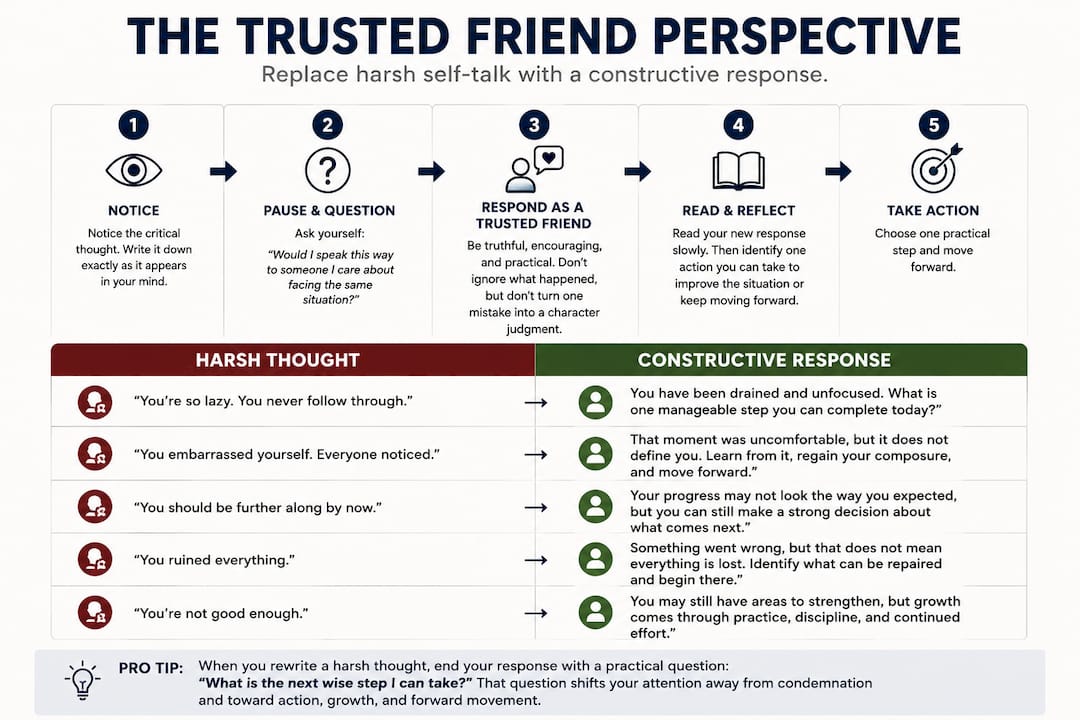
The Trusted Friend Perspective — Replacing Harsh Self-Talk With a Constructive Response
 Many people speak to themselves far more harshly than they would ever speak to someone they care about. That kind of inner criticism may feel like accountability, but it often drains confidence, magnifies mistakes, and makes it harder to move forward.
The Trusted Friend Perspective helps interrupt that pattern. It does not excuse poor choices or avoid responsibility. Instead, it replaces destructive self-talk with a response that is honest, balanced, and focused on the next constructive step.
Step by Step
-
Notice the critical thought.
Write it down exactly as it appears in your mind.“I failed again. I never get anything right.”
-
Pause and question it.
Ask yourself:“Would I speak this way to someone I care about who was facing the same situation?”
-
Respond as a trusted friend would.
Be truthful, encouraging, and practical. Do not ignore what happened, but do not turn one mistake into a judgment about your entire character. -
Read the new response slowly.
Then identify one action you can take to improve the situation or keep moving forward.
Harsh Thought vs. Constructive Response
| Harsh thought | Constructive response |
|---|---|
| “You’re so lazy. You never follow through.” | “You have been drained and unfocused. What is one manageable step you can complete today?” |
| “You embarrassed yourself. Everyone noticed.” | “That moment was uncomfortable, but it does not define you. Learn from it, regain your composure, and move forward.” |
| “You should be further along by now.” | “Your progress may not look the way you expected, but you can still make a strong decision about what comes next.” |
| “You ruined everything.” | “Something went wrong, but that does not mean everything is lost. Identify what can be repaired and begin there.” |
| “You’re not good enough.” | “You may still have areas to strengthen, but growth comes through practice, discipline, and continued effort.” |
The goal is not to flatter yourself or pretend that every decision was correct. The goal is to speak to yourself in a way that supports responsibility, clear thinking, and improvement.
Pro Tip
When you rewrite a harsh thought, end your response with a practical question:
“What is the next wise step I can take?”
That question shifts your attention away from condemnation and toward action, growth, and forward movement.
Make It a Habit
To make this exercise easy to use, create a note on your phone called “Trusted Friend Perspective.” Whenever a harsh thought appears, write it down exactly as it comes to mind. Then rewrite it as a trusted friend would—honest, balanced, encouraging, and focused on the next constructive step.
The more consistently you practice this, the more naturally you’ll begin replacing destructive self-talk with clear, constructive thinking.
This exercise is especially valuable immediately after making a mistake, following a difficult conversation, facing disappointment, or anytime you’re tempted to define yourself by a single moment instead of choosing your next wise step.
Write Yourself a Trusted Friend Letter
Sometimes our thoughts become so repetitive that simply replacing one sentence isn’t enough. Writing a short letter to yourself from the perspective of a trusted friend can help you step back, see the situation more clearly, and focus on what comes next.
The purpose is not to make yourself feel better through compliments. It is to replace distorted thinking with honesty, perspective, and practical direction.
Step by Step
1. Describe the situation.
In one or two sentences, write what happened as objectively as possible.
“I made a mistake during today’s presentation.”
Avoid exaggerations like always, never, or everyone.
2. Change perspectives.
Imagine someone you deeply respect—someone who is truthful, encouraging, and wants you to succeed.
Write:
Dear [Your Name],
Then explain how they would honestly view the situation.
3. Separate the event from your identity.
A mistake is an event.
It is not your identity.
Instead of writing:
“I failed.”
Write:
“I made a mistake that I can learn from.”
4. Identify what can be learned.
Ask yourself:
-
What actually happened?
-
What would I do differently next time?
-
What did this experience teach me?
5. Choose one next step.
End your letter with one practical action.
Examples:
-
Make the phone call.
-
Finish the project.
-
Apologize if necessary.
-
Practice the skill again.
-
Move on.
Use This Exercise When…
-
You’ve made a mistake.
-
You’re replaying a difficult conversation.
-
You’re disappointed in yourself.
-
You’re questioning your progress.
-
You feel stuck in negative self-talk.
Pro Tip
Keep your letter grounded in facts rather than praise.
Instead of writing:
“You’re amazing.”
Write:
“You handled part of this well, you learned something valuable, and you know what to do next.”
Specific observations build confidence far more effectively than empty compliments.
Supportive touch and soothing gestures that calm your nervous system
Physical gestures of self-care do something words alone can’t: they engage your body’s caregiving system directly. Cleveland Clinic clinical guidance notes that supportive touch, including a hand over the heart or a gentle self-hug, can activate oxytocin release and promote physiological calm.
Three gestures and when to use them:
-
Hand over heart: Sit or stand quietly. Place one or both hands flat over your chest. Feel the warmth and the gentle pressure. Breathe slowly for 30–60 seconds. Best for moments of anxiety or emotional overwhelm.
-
Self-hug: Cross your arms over your chest and hold your own shoulders or upper arms. Apply gentle pressure. This is particularly grounding after a difficult conversation or when you feel isolated.
-
Cradling your face: Cup your hands gently around your cheeks or jaw. Close your eyes. This gesture tends to feel more intimate, so it works best in private settings when you need a deeper sense of comfort.
A note on personal differences: Touch feels safe and meaningful for many people, but not for everyone. If any gesture feels uncomfortable, simply resting your hands in your lap with palms facing up can carry a similar quality of openness and receptivity. Mobility limitations? Placing one hand on your forearm or thigh works just as well.
For public settings, the hand-over-heart gesture is the most discreet. You can do it with your hand inside a jacket or while seated at a desk without drawing attention.
From Self-Criticism to Clear Thinking
Negative self-talk often feels factual, even when it is exaggerated or incomplete. The goal isn’t to replace it with unrealistic optimism. The goal is to replace distorted thinking with a response that is honest, balanced, and useful.
When your thinking becomes clearer, your decisions usually improve as well.
The Three-Step Method
1. Recognize the Thought
Pause and identify exactly what you’re telling yourself.
Examples:
-
“I always mess things up.”
-
“I’m not good enough.”
-
“I’ll never figure this out.”
Simply noticing the thought prevents it from automatically shaping your emotions and decisions.
2. Test It Honestly
Ask yourself:
-
Is this completely true?
-
Am I exaggerating one event into a conclusion about my entire life?
-
What facts support this?
-
What facts don’t?
The goal isn’t to defend yourself.
The goal is simply to see the situation as accurately as possible.
3. Replace It With a Constructive Response
Rewrite the thought as a trusted friend would.
Not softer.
Not harsher.
Simply more truthful and more useful.
Instead of:
“I’m terrible at this.”
Write:
“I’m still developing this skill. What’s one thing I can improve today?”
Everyday Examples
At Work
Harsh Thought
“I’m not good enough for this job.”
Constructive Response
“I’m still growing in this role. This week I’ll focus on improving one specific skill.”
Relationships
Harsh Thought
“I always say the wrong thing.”
Constructive Response
“That conversation didn’t go the way I hoped. Next time I’ll slow down, listen more carefully, and communicate more clearly.”
Personal Goals
Harsh Thought
“I have no discipline.”
Constructive Response
“I’ve been inconsistent recently, but consistency is built one decision at a time. What’s one commitment I can keep today?”
Build the Habit
Spend two minutes at the end of each day writing down:
-
One harsh thought you noticed.
-
One balanced response.
-
One practical action for tomorrow.
Over time you’ll begin recognizing recurring patterns, replacing automatic self-criticism with clearer thinking, wiser decisions, and consistent forward progress.
The Clear Thinking Journal — A Simple Daily Practice
One of the fastest ways to change your thinking is to write it down.
Thoughts that stay in your head often become exaggerated or distorted. Putting them on paper forces you to slow down, examine them honestly, and choose a better response.
You don’t need to write pages. Just a few focused questions each day can help you recognize patterns, make wiser decisions, and continue moving forward.
Daily Journal Prompts (5 Minutes)
Choose one prompt each day.
-
One challenge I faced today was:
What actually happened, without exaggeration? -
One harsh thought I noticed was:
How would a trusted friend honestly respond? -
One thing I handled better than I first realized was:
Give yourself credit where it is deserved. -
One lesson I learned today was:
What can I apply tomorrow? -
One wise step I will take next is:
End every journal entry with one practical action.
Weekly Reflection (15–20 Minutes)
Once each week, look back over your journal and ask yourself:
-
What challenged me the most this week?
-
Where did I grow?
-
Which harsh thoughts kept repeating?
-
Which responses helped me move forward?
-
What is one area I want to improve next week?
-
What is one specific action I will commit to?
A Simple Weekly Routine
| Day | Focus | Time |
|---|---|---|
| Mon | Describe one challenge objectively. | 5 min |
| Tues | Rewrite one harsh thought. | 5 min |
| Wed | Record one lesson learned. | 5 min |
| Thur | Identify one strength you demonstrated. | 5 min |
| Fri | Write one improvement for next week. | 5 min |
| Sun | Complete your weekly reflection and choose one goal for the week ahead. | 15–20 min |
Pro Tip
Don’t judge your journal by how much you write.
Judge it by whether it helps you think more clearly, make wiser decisions, and take meaningful action.
A few honest sentences written consistently will do more for your growth than pages of vague reflection.
Why These Exercises Work — The Science Behind the Practice
These exercises are effective because they interrupt automatic patterns of negative thinking and replace them with more balanced, constructive responses. Rather than encouraging unrealistic optimism or ignoring problems, they help you slow down, think more clearly, regulate your emotions, and focus on practical next steps.
Psychological research has consistently shown that people who develop healthier patterns of self-talk and emotional regulation tend to recover from setbacks more quickly, make better decisions under pressure, and demonstrate greater resilience over time.
Several factors contribute to their effectiveness:
They Create Space Between Thoughts and Reactions
When you pause to identify a harsh thought instead of immediately believing it, you create an opportunity to evaluate the situation more objectively. This simple pause helps reduce impulsive reactions and encourages more thoughtful decision-making.
They Support Emotional Regulation
Slow, controlled breathing and calming physical cues—such as placing a hand over your heart or taking a moment to pause—can help reduce the body’s stress response. As your breathing slows, it becomes easier to think clearly rather than react emotionally.
They Build Healthier Mental Habits
The brain strengthens the thought patterns it repeats most often. By consistently replacing exaggerated self-criticism with balanced, constructive thinking, you gradually develop healthier habits that become more automatic over time.
They Encourage Action Instead of Rumination
Constructive thinking doesn’t stop with changing your perspective. Each exercise ends by identifying one practical step you can take next. This shifts your attention away from replaying the problem and toward making meaningful progress.
What Research Has Found
Studies examining emotional regulation, resilience, and constructive self-talk have consistently associated these practices with improvements such as:
| Research Finding | Practical Benefit |
|---|---|
| Improved emotional regulation | Greater ability to stay calm under pressure |
| Reduced destructive self-criticism | Clearer, more balanced thinking |
| Increased resilience | Faster recovery from setbacks |
| Better decision-making | More thoughtful responses instead of impulsive reactions |
| Greater confidence over time | Consistent practice strengthens healthier thinking patterns |
These benefits are not the result of pretending problems don’t exist. They come from learning to respond to challenges with greater clarity, honesty, and purpose.
The Key Principle
None of these exercises are about avoiding responsibility or convincing yourself that everything is fine.
They’re about learning to replace distorted thinking with accurate thinking, emotional reactions with thoughtful responses, and self-condemnation with practical action.
The goal is simple:
Think clearly. Learn honestly. Act wisely.
Key Takeaways
Building healthier thinking patterns doesn’t happen overnight, but it does happen through consistent practice. Small, intentional habits can help you reduce destructive self-talk, improve emotional regulation, and respond to challenges with greater clarity and confidence.
| Key Point | What It Means |
|---|---|
| Start with one exercise | Choose one technique from this article and practice it consistently before adding another. |
| Pause before reacting | Even one minute of slowing down can help you think more clearly and make better decisions. |
| Replace harsh thoughts with balanced ones | Don’t ignore mistakes, but don’t let one setback become a judgment about your entire character. |
| Focus on your next wise step | Every exercise should end by identifying one practical action you can take next. |
| Consistency matters most | A few minutes each day will usually produce better long-term results than occasional, lengthy sessions. |
Your 7-Day Practice Plan
Day 1
Practice the Pause and Reset exercise during one challenging moment.
Day 2
Complete the Trusted Friend Perspective exercise for one harsh thought you notice.
Day 3
Use the Three-Step Clear Thinking Method to replace one negative thought with a balanced response.
Day 4
Write a short Trusted Friend Letter about a recent challenge and identify one lesson you learned.
Day 5
Complete one entry in your Clear Thinking Journal, ending with one practical action for tomorrow.
Day 6
Review the week and notice any recurring patterns in your thinking. Which responses helped you move forward?
Day 7
Choose the one exercise that helped you the most and commit to practicing it consistently during the coming week.
Final Thought
Changing the way you think about yourself isn’t about lowering your standards or avoiding responsibility. It’s about responding to life’s challenges with greater honesty, clearer thinking, and purposeful action.
Every setback presents a choice. You can repeat the same harsh story you’ve always told yourself, or you can pause, evaluate the situation honestly, and choose the next wise step.
Over time, those small choices become stronger habits—and stronger habits help build a stronger, more resilient life.
A word from PTT Music
Real growth rarely comes from being your own harshest critic. It comes from learning to think clearly, respond wisely, and keep moving forward—especially when life doesn’t go as planned.
The exercises in this article aren’t about lowering your standards or pretending mistakes don’t matter. They’re about replacing destructive self-talk with honest reflection, practical action, and a commitment to continual growth.
Don’t feel like you have to master every technique at once. Choose one exercise that resonates with you, practice it consistently, and let it become part of your daily routine. Over time, those small moments of intentional thinking can strengthen your confidence, improve your decision-making, and help you navigate life’s challenges with greater resilience.
We believe every day presents a new opportunity to learn, grow, and become a little stronger than the day before. It doesn’t begin with being perfect—it begins by choosing your next wise step.
At PTT Music, we create original music and motivational content designed to move alongside you during exactly these kinds of practices. Put something meaningful on in the background while you journal. Let a song carry the emotional weight while you breathe. Our podcast is built for the moments between moments, the commute, the quiet evening, the morning before the day gets loud. We’re here for all of it.
You don’t have to be perfect at this. You just have to keep showing up for yourself.

Useful sources and where to learn more
If you’d like to explore the science behind emotional resilience, healthy thinking patterns, and stress management, these organizations provide reliable, evidence-based information and practical resources.
-
Harvard Health Publishing– Articles covering stress management, emotional well-being, resilience, healthy habits, and the science behind behavior change.
-
American Psychological Association (APA)– Research summaries and practical guidance on resilience, emotional regulation, coping with stress, and building healthier thinking patterns.
-
Cleveland Clinic– Easy-to-understand articles on stress management, emotional health, mindfulness, healthy habits, and overall well-being.
-
National Institute of Mental Health (NIMH)– Information on emotional health, stress, coping strategies, and evidence-based approaches to improving mental well-being.
-
Greater Good Science Center (University of California, Berkeley)– Research and practical articles exploring gratitude, resilience, empathy, relationships, and emotional well-being from a scientific perspective.
Remember that no single exercise works for everyone. The most effective approach is to find practical techniques that help you think more clearly, respond more wisely, and consistently move forward.
This article is general educational information, not professional mental health advice. If you are experiencing significant depression, anxiety, or trauma, please consult a licensed mental health professional.