
Storytelling songs are tracks that use setting, characters, and a plot arc to deliver a narrative, and they’ve shaped music for centuries. This guide gives you a ready-to-use starter playlist spanning folk, country, rock, pop, and rap, plus a simple five-question listening method for hearing the craft behind any story song.
TL;DR:
Many storytelling songs feature detailed settings and characters, often following an arc where tension peaks around the middle before reaching resolution or unresolved conclusions.
Country and folk songs tend to emphasize specific, concrete details and chronology, while pop and rock songs prioritize quick emotional engagement and symbolic storytelling.
Rap songs frequently use verse-as-scene structures, multiple narrators, and specific references to places and dates to craft complex, layered narratives within a short timeframe.
When building a playlist, sequence songs to move from accessible and light-hearted stories into darker or more complex narratives, then finish with resolutions or hopeful endings to avoid emotional fatigue.
Actively listening with questions about who, where, when, what changes, and tension can deepen understanding of any story song’s narrative craft.
Table of Contents
-
Genre Spotlights: How Storytelling Changes Across Musical Styles
-
A Five-Question Method for Hearing the Story Inside Any Song
What Makes a Song a Storytelling Song
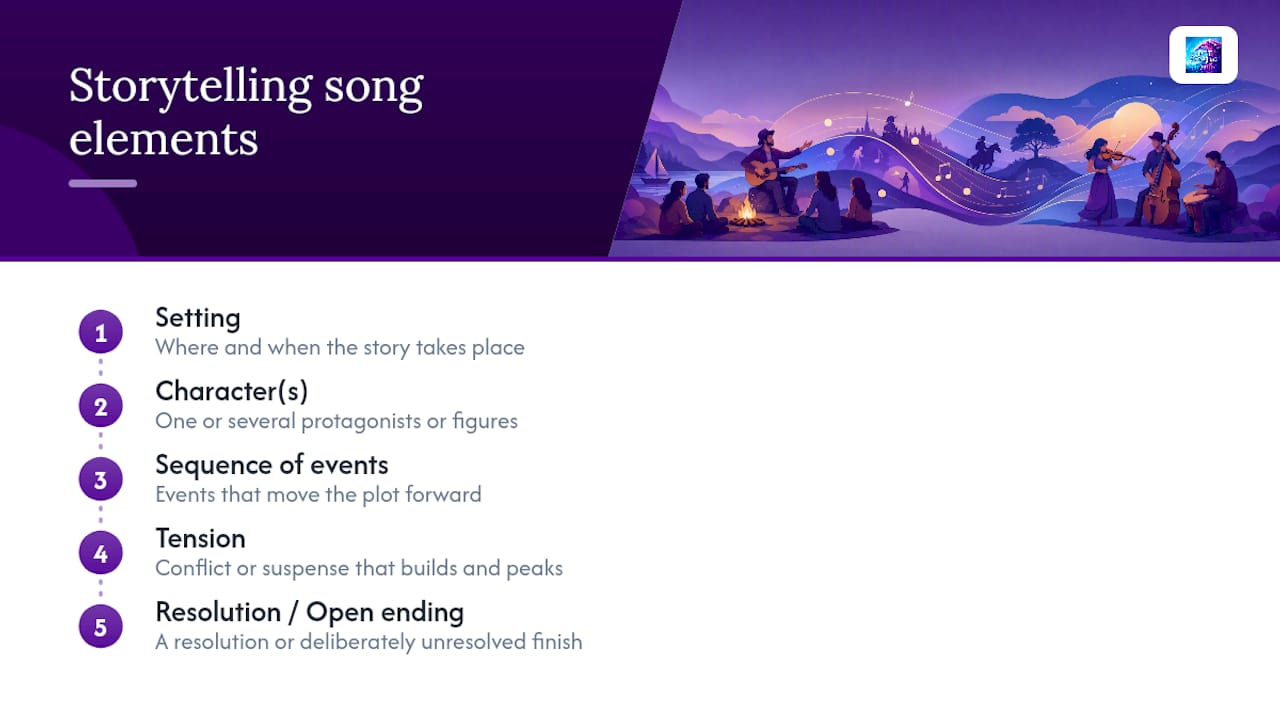
A storytelling song is built like a short story set to melody. It needs a setting, a character (or several), a sequence of events that moves forward, some tension, and either a resolution or a deliberately open ending. The Library of Congress notes that traditional ballads were narrative folksongs used to pass down histories, legends, fairy tales, and outlaw stories long before recorded music existed. Modern story songs across genres run on that same skeleton.
This is the more precise term worth knowing: narrative songwriting. “Storytelling songs” is the phrase most listeners search for, but songwriters, musicologists, and lyric researchers often talk about narrative structure, story-based lyrics, or lyrical storytelling when describing the same craft. You’ll see all these terms used interchangeably here, because they describe one thing: a song that tells you a story instead of just expressing a mood.
Not every story song needs a tidy plot. A 2024 peer-reviewed lyric study analyzing thousands of song lyrics found a recurring pattern researchers call the Arc of Narrative: staging happens early, tension builds and peaks around the midpoint, and some form of resolution arrives by the end. But that arc doesn’t require a three-act structure. A character portrait, a single decisive scene, a compressed life story, or a narrative that stays deliberately unresolved all count. Some of the most memorable story songs never tell you how things turned out. They just show you the moment that mattered.
 Genre Spotlights: How Storytelling Changes Across Musical Styles
Storytelling doesn’t sound the same in every genre, and knowing the conventions helps you appreciate what a song is actually doing rather than judging it against the wrong yardstick. The 2024 lyric study found real structural differences: country and rap songs tend to spend more time on staging (setting the scene, naming the place, establishing who’s who), while pop songs compress the plot and race toward emotional payoff.
Statistic Callout: The 2024 lyric analysis, drawing on a dataset of over 12,000 songs, identified a consistent Arc of Narrative across genres. Staging clusters near the start, tension climbs and peaks near the midpoint, and resolution (or its deliberate absence) lands in the final third. Genre shifts where the weight falls, but the arc itself shows up again and again.
Folk and country carry the clearest link to the ballad tradition. The Library of Congress traces this straight back to oral history, where songs functioned as a community’s record of events before written accounts existed. Songs that name concrete places, occupations, and consequences tend to stick in memory longer than vaguer ones, which is likely why country storytelling leans so heavily on specific detail.
Rock and pop tend to compress. Where country might spend two verses setting a scene, pop often gets you into conflict within the first line, because pop’s structure rewards a fast emotional hook over a slow build.
Rap and R&B often use verse-as-scene structure, where each verse functions like a chapter or a camera cut to a new moment. R&B narratives frequently center on a single relationship’s arc, while rap narratives more often juggle multiple voices or timeframes within one song.
Storytelling in Rap: Narrative Rhymes Worth Studying
Rap handles storytelling differently from other genres because the form itself rewards density. A single sixteen-bar verse can hold as much plot as an entire folk song, and rappers often use multiple narrators or nonlinear chronology to pack in more perspective than a standard verse-chorus structure allows.
Rap conventions worth listening for: verse-as-scene (each verse functions like a new setting or time jump), multiple narrators speaking in the same song without warning, and documentary-level specificity about brands, streets, and dates that grounds the fiction in something real. When you’re building a mixed-genre playlist, drop a rap narrative right after a slower folk or country track. The contrast in pacing and voice keeps a longer playlist from going flat.
How to Build Your Own Storytelling Playlist
A great narrative playlist isn’t just a pile of good songs. It’s sequenced with intention, the way a short story collection is ordered. Here’s a simple process.
-
Choose your story scope first. Decide whether this playlist is about single decisive scenes or historical ballads. Mixing scopes works, but knowing your dominant scope keeps the playlist from feeling scattered.
-
Mix genres and narrators deliberately. Alternate a first-person confession with a third-person observation. Follow a dense rap narrative with a slower country ballad. Aim for 25 to 40 songs; shorter playlists feel like a snack, longer ones start to lose narrative momentum and become background noise.
-
Sequence in three movements. Open with a warm-up (accessible, well-known story songs), move into tension (darker or more complex narratives), and close on resolution (songs with clear, even hopeful, endings like ). This mirrors the same warm-up to tension to resolution arc the 2024 lyric study found inside individual songs, just scaled up across a whole playlist.
-
Tag and name it for future discovery. Use playlist names like “Story Songs: Warm Up to Resolution” or “Narrative Mix: Crime and Consequence.” Streaming platforms surface playlists better when the title matches how people actually search, so skip the cryptic in-joke names for this one.
Pro Tip: Watch your emotional balance across the whole playlist, not just song to song. A playlist stacked entirely with tragic endings creates listening fatigue fast. Close on at least one or two songs with genuine resolution, even if the middle stretch runs heavy and dark.
If you want a template for thematic organization, PTT Music’s songs for reflection collection shows how a single emotional through-line can hold a whole playlist together without feeling repetitive.
A Five-Question Method for Hearing the Story Inside Any Song
Most listeners hear a story song once and move on. This five-question method, built around the Arc of Narrative that the 2024 lyric study identified, turns a passive listen into an active one.
-
Who speaks? Is the narrator inside the story or reporting on someone else?
-
Where and when? What details anchor the scene: a place name, a season, an era?
-
What changes? Track the shift between the first verse and the last.
-
Where does tension peak? Most story songs concentrate their emotional weight around the midpoint, not the end.
-
What remains unresolved? Not every song answers its own question, and that’s often intentional.
The Library of Congress observes that ballads often leave moral or psychological questions open rather than closed. That ambiguity isn’t a flaw. It invites the listener to keep inferring long after the song ends, which is a big part of why certain ballads outlive their era.
Why Storytelling Songs Matter Beyond Entertainment
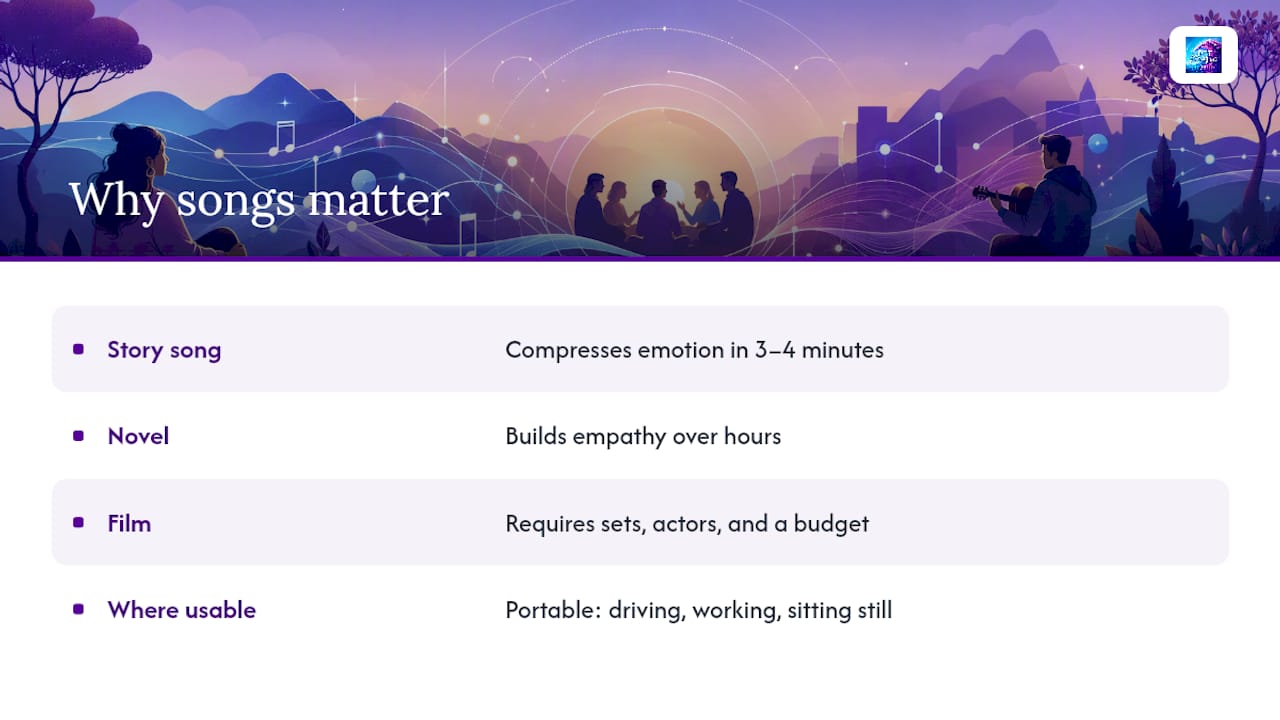
Storytelling songs do something a lot of other narrative art forms can’t: they compress an entire emotional experience into three or four minutes and let you carry it with you. A novel takes hours to build empathy for a character. A film needs sets, actors, and a budget. A story song does it with a voice, a melody, and a handful of well-chosen details, and it can do that while you’re driving, working, or just sitting still.
That compression is exactly why narrative songs work so well for reflection and personal growth. Hearing someone else’s hard decision, their loss, or their turning point put into words can loosen something in your own thinking that a straightforward pep talk never quite reaches. It’s empathy training disguised as a good song.
We build a lot of what we do around that same belief: music should carry more than a beat, it should carry meaning you can actually use. PTT Music is available across many platforms, including Spotify, Apple Music, and Amazon Music, and it’s beneficial to spend time with playlists that lean into narrative and reflection rather than just mood. If storytelling songs have ever helped you process something difficult, you already understand why we put so much care into ours.
— PTT Music
Keep the Story Going With PTT Music
Storytelling songs work because they hand you someone else’s experience, and some artists build original music around that same idea, pairing narrative lyrics with themes of resilience, confidence, and everyday growth. If the playlist above left you wanting more songs built around meaning instead of just melody, exploring related catalogs and merchandise collections can be a natural next step.

You can stream PTT Music across more than 150 platforms, or browse the PTT Music store for original collections like the Inspirational Collection and the Pop/Rock/EDM Collection, along with merchandise that carries the same message. Explore the full catalog on the PTT Music page, or start with something small: pick one collection, listen through it once, and notice which track tells the story you needed to hear today.
Sources
-
PTT Music - Your Premier Source for High-Quality Music Production, Licensing, and Audio Services
-
Spotify — Storytelling: short stories in indie, folk & pop songs
FAQ
What song has the best storytelling?
There’s no single answer, The “best” one usually depends on whether you value emotional intimacy, historical detail, or narrative complexity most.
What are storytelling songs called?
They’re most commonly called story songs or narrative songs, and the songwriting tradition behind them is often referred to as ballad tradition, especially in folk and country music. The Library of Congress uses “traditional ballads” specifically for the oldest form of this narrative folksong tradition.
What are some good song story ideas?
Strong story song ideas usually come from a specific, concrete moment rather than a general feeling: a decision made at a particular age, a place tied to a memory, or a single conversation that changed something. If you want structured prompts to get started, PTT Music’s lyric writing prompts collection offers many ideas built around exactly this kind of specificity.